dailynewsnblog
Washington — The start of the Supreme Court’s new term is quickly approaching, with cases involving climate change, President Trump’s immigration policies and the Second Amendment among the most high-profile disputes the justices will hear in the coming months.
But waiting in the wings at the Supreme Court are several legal battles involving Mr. Trump’s second-term agenda, which will be discussed by the justices in forthcoming closed-door conferences and, if taken up by the court, decided by the summer of 2027.
The Supreme Court kicks off its term Monday with arguments involving a lawsuit filed in state court by the city and county of Boulder, Colorado, that seeks to hold energy companies accountable for the effects of global climate change.
Here are the big cases that the Supreme Court is poised to decide so far in its upcoming term, which begins Oct. 5:
Climate change: Suncor Energy v. County Commissioners of Boulder County
On the first day of the new term, the Supreme Court will hear arguments in a dispute between Boulder and two energy companies, Suncor Energy and Exxon Mobil.
The question before the Supreme Court is a technical one: Whether federal law prevents Boulder County from suing energy companies in state court and claiming that the sale and allegedly deceptive marketing of fossil fuels violates state law.
AP Photo/J. Scott Applewhite 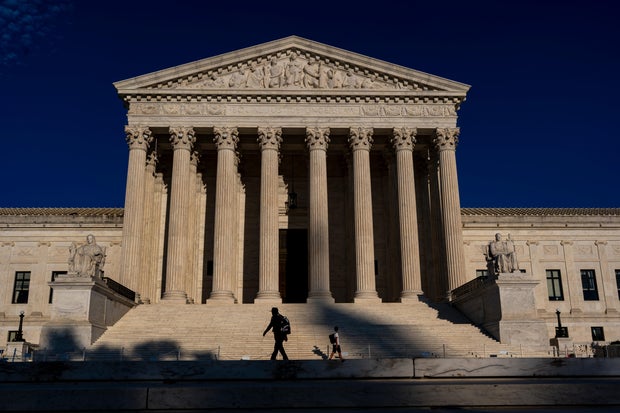
The outcome of the case could have significant ramifications for dozens of similar lawsuits brought by states and localities that seek to hold fossil-fuel producers accountable for the effects of climate change. A decision in favor of the energy companies would block Boulder’s lawsuit, which is still in its early stages and seeks money damages.
Lawyers for Exxon and Suncor warn that if the Supreme Court allows these suits to move forward and they are ultimately successful, they would effectively impose a carbon tax on fossil-fuel producers and “bankrupt” the industry.
In filings with the Supreme Court, they called climate change “one of the most complex public-policy challenges of our time,” resulting from the buildup of greenhouse gases that are emitted by every state and every country. Those emissions, Suncor and Exxon lawyers said, “cannot be unmixed and traced to their individual sources.”
The case landed at the Supreme Court on appeal from the Colorado Supreme Court, which allowed Boulder’s lawsuit to proceed. The high court will also consider whether it has jurisdiction to review that decision.
The energy companies warned that if that ruling is upheld and adopted on a nationwide scale, it would give the green light to all 50 states and their municipalities “to ask local courts to establish countless, conflicting climate policies for the Nation.”
Lawyers for Boulder County argued that the Constitution allows states to address the harms that arise within their own borders. Whether those harms should be better addressed at the federal level is a decision that rests with Congress, they said.
The county officials said the energy companies rushed to the Supreme Court and instead should wait until the state court has issued its final decision in the case before seeking review.
“That climate change is a global problem does not disempower states from redressing its local harms either,” they wrote. “This litigation is not an attempt to solve climate change; it merely asks that petitioners bear their fair share of local costs incurred in part because of their tortious conduct.”
Justice Samuel Alito will not participate in the case, according to a letter sent to lawyers for the parties Monday. The letter did not include a reason for his recusal. In his financial disclosure for 2025, Alito reported owning stocks in two energy companies, ConocoPhillips and Phillips 66, but did not list individual holdings in Exxon or Suncor.
Religious liberty: St. Mary Catholic Parish v. Roy
On Nov. 3, the justices will convene for arguments in a case involving a Catholic preschool in Colorado that argues it is unlawfully excluded from the state’s universal preschool program. The dispute is the latest in which the Supreme Court will consider participation by religious entities in state-funded programs.
Colorado’s program provides state funding for families to send their 4-year-olds to the preschool of their choosing. The program allows all children in the state to receive up to 15 hours of free preschool each week before they enter kindergarten. Families can send their children to public or private preschools, or to faith-based or in-home providers.
The law creating the program includes a nondiscrimination provision, which requires all schools to ensure children have the equal opportunity to attend regardless of their or their parents’ religious affiliation, race, ethnicity, sexual orientation, gender identity, lack of housing or income level.
In 2023, the Archdiocese of Denver, which oversees more than 30 Catholic preschools, requested an exemption from the universal preschool program’s nondiscrimination rule so it could admit only participating families who adhere to the Catholic Church’s teachings, including on gender identity and sexual orientation.
But the Colorado Department of Early Childhood declined to provide the accommodation. In response, the Archdiocese, two parishes and a family with children who attend parish schools sued and argued they were entitled to an exemption under the First Amendment’s Free Exercise Clause.
The plaintiffs said because the universal preschool program created exemptions to the nondiscrimination requirement, it was not neutral and generally applicable. The Supreme Court said in a 1990 decision called Employment Division v. Smith that laws burdening the free exercise of religion generally do not violate the First Amendment as long as they’re neutral and generally applicable.
A federal district court sided with the state in June 2024, and the U.S. Court of Appeals for the 10th Circuit upheld that decision, finding that the program’s nondiscrimination rule “exists in harmony with the First Amendment” and doesn’t violate the plaintiffs’ free exercise rights.
Gun rights: Viramontes v. Cook County and Grant v. Higgins
This latest Second Amendment dispute to arise following the Supreme Court’s landmark 2022 decision expanding gun rights involves state laws banning AR-15s and similar semiautomatic weapons.
The two cases, which will be argued Dec. 2, involve a Connecticut law and an ordinance in Cook County, Illinois. Cook County’s prohibition was put in place nearly 20 years ago, while Connecticut tightened its rules for semiautomatic firearms after the 2012 mass shooting at Sandy Hook Elementary School.
More than 10 states and the District of Columbia prohibit AR-15-style semiautomatic weapons.
In both of the cases from Illinois and Connecticut, lower courts upheld the bans. The appeals courts each applied the new standard for determining the constitutionality of gun restrictions that the Supreme Court laid out in 2022, which requires the government to show that a law is consistent with the nation’s historical tradition of firearms regulation.
In its ruling then, the Supreme Court recognized for the first time that the Second Amendment protects the right to carry a firearm outside the home. The justices have been asked to take up a number of challenges to longstanding federal and state gun laws in the years since.
In 2024, the Supreme Court upheld a federal law that bars people subject to domestic violence restraining orders from having guns. Then, last year, it said that under the Second Amendment, the government cannot prosecute a habitual marijuana user for having a firearm. The high court also struck down a Hawaii law that required concealed-carry permit holders to receive permission before bringing their firearms onto private property that is open to the public.
The Supreme Court had turned away challenges to laws from Maryland and Illinois banning AR-15s and other semiautomatic weapons, leaving those restrictions in place.
Parental rights: International Partners for Ethical Care v. Ferguson
On Dec. 7, the Supreme Court will consider a case that involves laws from Washington state that expanded exceptions for when a youth shelter has to notify parents of a runaway teenager.
Under one of the new exceptions, if a child seeking or receiving medical treatments for gender dysphoria, including mental and physical health services, arrives at a shelter, it does not have to inform the parents that their child is there and instead must notify the Department of Children, Youth and Families.
The new measure also says the department must offer runaway teenagers those medical interventions at shelters if they seek that care without their parents’ consent.
The question before the Supreme Court is whether parents have standing to file lawsuits challenging Washington’s laws. The five sets of parents involved in the case all have children who they said have experienced gender dysphoria, and they allege the laws violate their constitutional right to direct the care and upbringing of their children.
A federal district court dismissed their case in 2024, finding that the parents lacked legal standing. The U.S. Court of Appeals for the 9th Circuit upheld that decision.
Arizona’s voting rules: Republican National Committee v. Mi Familia Vota
Amid President Trump’s push for a federal proof-of-citizenship requirement to register to vote, the Supreme Court will weigh an Arizona rule that requires would-be voters to provide proof of citizenship when registering to vote using a state form. The case also involves the state’s procedures for cleaning up its voter rolls. Federal law says any state program to systematically remove people from their voter registration lists must be completed 90 days before an election.
Arguments are set for Dec. 8.
Arizona’s legislature approved the new voting policies in 2022. But soon after, Democratic groups including the Democratic National Committee filed lawsuits seeking to block their enforcement. The challengers argued that the requirements violated or were preempted by the National Voting Registration Act and a 2018 consent decree between Arizona’s secretary of state and the Maricopa County recorder.
A federal district court said that under the consent decree, local election officials could not reject state voter registration forms that lacked proof of citizenship. The court also said that under the NVRA, Arizona couldn’t systematically cancel voter registrations within 90 days of an election.
The U.S. Court of Appeals for the 9th Circuit upheld that decision last year.
Arizona’s voting rules have been before the Supreme Court before, though at an earlier stage in the case. In August 2024, the Supreme Court allowed the state to enforce the proof-of-citizenship requirement for the general election. But the high court did not let the state enforce rules requiring proof-of-citizenship to vote for president or by mail.
Third-country deportations: Department of Homeland Security v. D.V.D.
The Trump administration implemented a policy in March 2025 that allowed for the swift removal of migrants to countries that they do not come from — so-called third countries — if those nations have provided credible assurances that deportees will not be persecuted or tortured.
The administration has argued that the third-country removals are an “essential tool” to remove certain migrants, including those who have criminal records. But last year, a group of four migrants subject to final orders of removal filed a class-action lawsuit arguing that their due-process rights would be violated if they were denied sufficient notice and an opportunity to challenge their removals before they were deported to a third country.
A federal district judge in Boston ruled that the Department of Homeland Security’s guidance likely violated their due process rights, and he ordered immigration officials to provide migrants with written notice of the third country of removal, as well as a “meaningful opportunity” — at least 10 days — to assert a fear of removal.
The case ended up at the Supreme Court during an earlier stage, and the high court allowed the Trump administration to resume the deportations to third countries while litigation continued.
Then, in February, the judge in Boston ruled that the Trump administration’s policy of deporting migrants to third countries without giving them notice is unlawful and said it must be set aside. A federal appeals court largely upheld that decision last month and said immigration authorities must offer detainees “a meaningful opportunity to contest” their deportations to countries that are not their own.
The Justice Department filed an emergency appeal with the Supreme Court and asked it to block the district court’s decision.
The high court granted that request, allowing DHS to resume third-country removals for now, but also said it would decide the legal merits of the case. Arguments will take place Dec. 9.
Among the questions that the Supreme Court has asked the Justice Department and lawyers for the migrants to answer is whether the administration’s guidance on third-country removals is unlawful under federal immigration law, the Constitution’s Due Process Clause and protections against torture.
Immigration detentions: Rhoney v. Barbosa da Cunha
At issue in this case is the Trump administration’s policy of detaining immigrants in the country illegally during their removal proceedings without access to bond hearings.
Immigration and Customs Enforcement rolled out the policy last year when it reinterpreted an immigration law from the 1990s and determined detainees facing removal are no longer eligible to be released on bond if they entered the country unlawfully, even if they have been in the U.S. for years.
Since then, as part of the president’s crackdown on immigration, tens of thousands of immigrants have been detained by immigration authorities and held indefinitely. Many have filed petitions in federal court challenging their detentions and seeking release or a hearing. Hundreds of federal judges across the country have granted those requests and rejected the Trump administration’s policy.
Two federal appeals courts have allowed noncitizens to be subject to mandatory detention without bond, but nine others have ruled against the Trump administration.
The case before the Supreme Court involves a Brazilian man, Ricardo Aparecido Barbosa da Cunha, who came to the U.S. illegally more than 20 years ago. Barbosa da Cunha has never been convicted of a crime, according to court papers. He applied for asylum in 2016 and was granted a valid work permit.
But last year, during a traffic stop in Massachusetts, Barbosa da Cunha was taken into custody by ICE officers, and the Department of Homeland Security initiated removal proceedings against him.
Barbosa da Cunha requested a bond hearing, but an immigration judge denied the request on the grounds that he was subject to mandatory detention without the possibility of bond under a provision of federal immigration law.
He then filed a petition in federal court alleging that his detention without access to a bond hearing was illegal and a violation of the Constitution’s Due Process Clause. A federal judge sided with Barbosa da Cunha, and the U.S. Court of Appeals for the 2nd Circuit upheld that decision, rejecting the Trump administration’s mandatory detention policy.
In its decision, the 2nd Circuit panel of judges said accepting the administration’s interpretation of immigration law would “send a seismic shock through our immigration detention system and society, straining our already overcrowded detention infrastructure, incarcerating millions, separating families, and disrupting communities.”
Arguments in the case will likely be held early next year.
More big cases looming
The Supreme Court could also decide to take up several new cases that involve Mr. Trump’s policies and actions taken during his second term.
Solicitor General D. John Sauer has asked the justices to decide the constitutionality of the Department of Defense’s policy prohibiting transgender people from the military. An appeals court ruled that the ban discriminates against transgender individuals. But the Trump administration argues that the military has the power to decide who can serve in the armed forces and cannot be prohibited from exercising that authority.
The solicitor general, who argues on behalf of the U.S. government before the Supreme Court, has also appealed lower court decisions that have blocked Mr. Trump’s appointments of acting U.S. attorneys in New York and Nevada.
The Trump administration has sought to install his allies as second-in-command, a position called first assistant U.S. attorney, of those offices and then elevate them to serve as the acting U.S. attorneys. But lower courts have said that those prosecutors, John Sarcone in Albany and Sigal Chattah in Nevada, were unlawfully appointed since they were not serving as the first assistant when the U.S. attorney position became vacant.
Mr. Trump has used the same mechanism to put his preferred picks atop U.S. attorney offices in New Jersey and Los Angeles, circumventing the Senate confirmation process required for those prosecutor positions. But lower courts have all said the appointments were unlawful.
Sauer has also asked the Supreme Court to decide whether Mr. Trump’s efforts to effectively suspend asylum at the U.S.-Mexico border is lawful.
Mr. Trump, in his personal capacity, has asked the Supreme Court to review an $83.3 million defamation judgment stemming from statements he made about E. Jean Carroll and whether presidential immunity applies to those remarks.
Separate from the cases involving the president, the Supreme Court could also take up challenges to laws from Texas and Louisiana that require the Ten Commandments to be displayed in public school classrooms. The U.S. Court of Appeals for the 5th Circuit has upheld the Texas law.
The high court has also been asked to take up a legal fight over a plea agreement reached by military prosecutors and two of the men allegedly behind the Sept. 11, 2001, terror attacks, including accused architect Khalid Sheikh Mohammed.