dailynewsnblog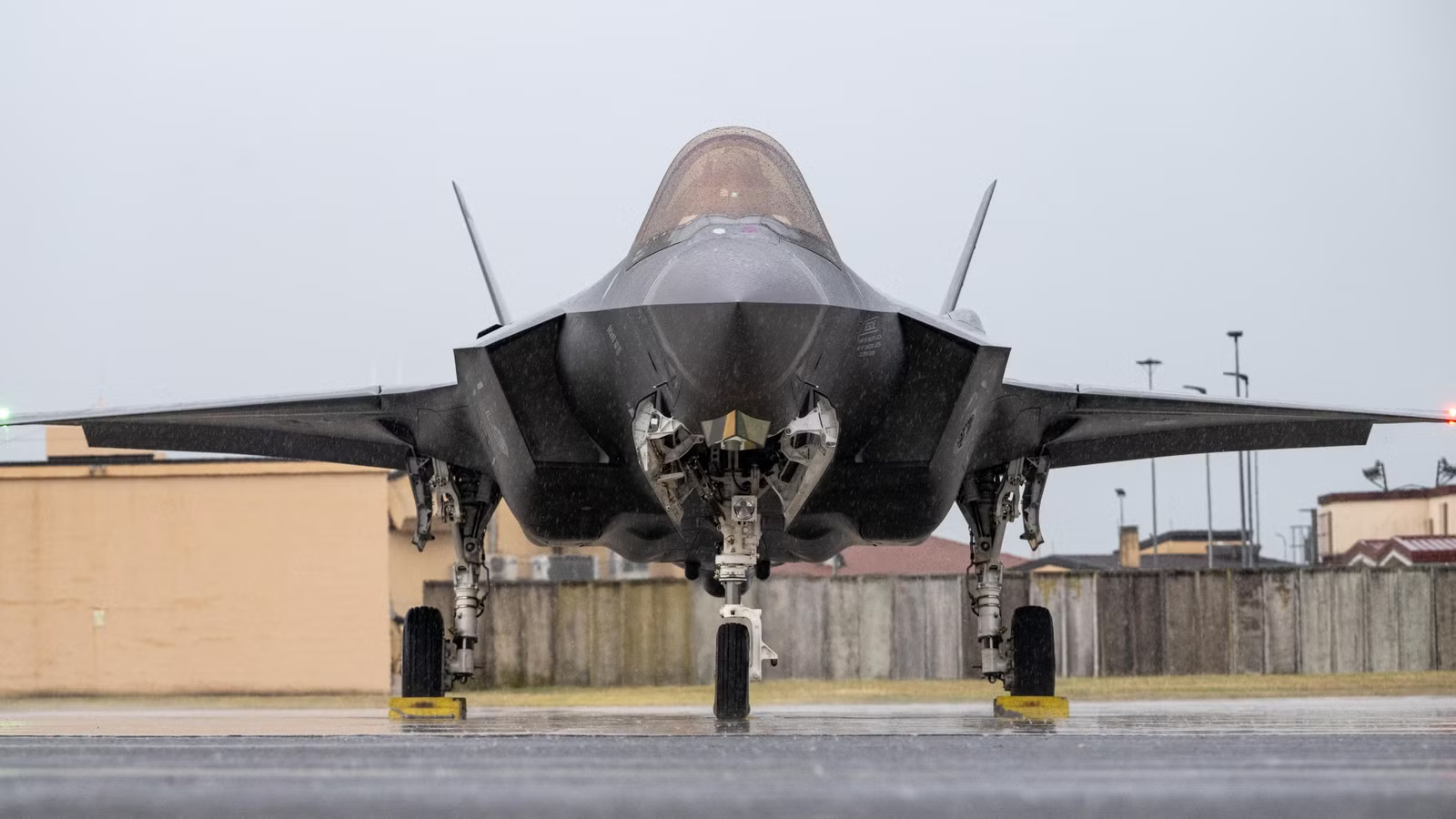
The United States Air Force (USAF) has the largest and most powerful fleet of modern fighter jets in the world. At the same time, the fleet is gradually shrinking and aging. The fleet is expected to grow in the 2030s as older aircraft are retired, and more F-35As and F-15EXs arrive. Around that time, Collaborative Combat Aircraft (CCAs) are expected to enter service, and they could permanently change the structure of the Air Force’s fighter jet fleet.
The USAF’s fleet of fighter jets includes F-15C/Ds, F-15Es, F-15EXs, F-16s, F-35As, F-22s, and (for the purposes of this article) A-10 Warthogs. The F-35A may be the final mass-produced crewed fighter jet the Air Force acquires. For now, it says it plans to purchase at least 185 sixth-generation F-47s, but this is very low by historical standards. The F-47 is likely always to be outnumbered by the CCAs it operates with.
The A-10 Warthog Will Soon Be Gone

The Fairchild Republic A-10 Thunderbolt II ‘Warthog’ saw action in the Middle East in 2024, 2025, and 2026, including strafing runs with its gun. Even so, the type is on its way out and is now mostly retired. In Fiscal 2026, Congress allowed the Air Force to retire up to 59 more aircraft and keep at least 103 examples remaining in inventory.
After Operation Epic Fury, the Air Force said it would keep the A-10 in service until 2030, with enthusiasts hailing it as validation for the beloved ground-attack aircraft. However, on closer inspection, this was little more than retirement by another name. The Air Force is still requesting to retire half (49) of its remaining fleet and keep three squadrons of 18 (54) aircraft in service for a couple more years.
One squadron would retire in 2029, leaving 36 in service, and the other two would divest their aircraft in 2030, bringing an end to the aircraft. However, this still requires approval from Congress, and it is unclear if it will go through, although it is largely in keeping with Congress’ de facto phase-out plan over the last few years.
A draft House NDAA (which passed the House in July) includes Section 144, which calls for an evaluation of the potential transfer of some A-10 aircraft among military departments. Demonstrating how the process continues to evolve, a bill called the BRRRRT Act was introduced in July by Republican Abe Hamadeh from Arizona and would keep at least 126 A-10s in service until 2033. While it is unlikely to pass, it highlights how sensitive Warthog retirements are.
Retirement & Acquisition Of The Eagles

Retirement of the US Air Force’s aging F-15C/D legacy Eagles has slowed, with no divestment requested for Fiscal 2027, 2028, or 2029. 21 of the legacy Eagles are slated for retirement in 2030 and another 21 in 2031. Congress has previously moved to limit the Air Force from retiring its Strike Eagles, and in its 2027 proposal, it would retire 20 F-35Es in 2027 and another 31 in 2028 (older F100-PW-220 engine variants), with no retirements in 2029, 2030, or 2031.
The Air Force wants to retire the F-15Es with older engines and upgrade the 99 with modern F100-PW-229 engines. It could seek to divest more and have a fleet of 99–150 by 2030. As has previously been reported, the US Air Force is increasing its F-15EX acquisition target to 267 aircraft and is investing heavily in ramping Boeing’s production capacity from around 12 a year to up to 36.
Air Force fighter jets | Inventory (per budget documents) | By end of 2030 (estimated) |
|---|---|---|
A-10 Warthogs | 103 (authorized) | |
F-15C/Ds | 42 | 21 |
F-15Es | 217 (approx.) | 166 (maybe fewer) |
F-15EXs | 25 (approx. | 110-125 |
F-16s | 826 | 820 (550-600 combat-coded) |
F-35As | 540+ | 750 (approx.) |
F-22 Raptors | 185 | 185 |
F-47s | Low numbers |
It has a budget request for 24 new F-15EXs in 2027, 24 in 2028, 28 in 2029, 36 in 2030, and 36 in 2031. The starting inventories of these aircraft (mid-2026) are around 42 combat-coded F-15C/Ds, 217 F-15Es, and around 25 delivered F-15EX fighter jets. By the end of 2030, these documents suggest it would reasonably have 21 F-15C/Ds, 166 (or fewer) F-15Es, and 110-125 F-15EXs. Meanwhile, for the F-16 Fighting Falcon, the Air Force is requesting to divest six in 2027 and then no more through 2031.
F-35As & F-22s

The Air Force now has around 540 F-35As in service, and they are on track to become the force’s most common fighter jet. The Air Force has a program of record to eventually purchase 1,763 F-35As, meaning it is now close to being a third of the way through the program. No F-35s are expected to be retired for many years, although low numbers may be lost to mishaps and combat.
The 2027 budget request has a provision for 38 (up from 24 in an earlier proposal) new Air Force F-35A fighter jets. This is a low point, as the Air Force funded around 48 each year between 2022 and 2025 (fewer in 2025). Future procurement estimates include 18 for Fiscal 2028, 32 for 2029, and 2030 for 39. These numbers could change. By 2030, the fleet size could grow to around 700-780 F-35A fighters.
For the F-22, it seems unlikely Congress will approve any divestment until the F-47 enters service. Even then, it will take time for the F-47 to mature and be available in numbers. The Air Force has previously and repeatedly asked to retire the 32 non-combat-coded F-22 Block 20 Raptors used for training. Requests to retire those jets have not appeared in Fiscal 2027 proposals. It is highly unlikely any of the 145 combat-coded F-22s will retire unless through mishaps.
US Fighter Jet Outlook

One bill would require the Air Force to keep a total aircraft inventory of “fighter aircraft of not less than 1,800” between 2026 and 2035 and for it to “maintain a total aircraft inventory of combat-coded fighter aircraft of not less than 1,369 aircraft by December 31, 2030.” It is unclear whether that mandate will pass. There are similar provisions requiring the Air Force to operate a minimum number of tanker aircraft.
According to the Congressional Budget Office, the US military’s total fighter fleet is to shrink to around 3,000 aircraft by 2029. This includes the fighters operated by the US Navy and the US Marine Corps. After 2029, it is expected to grow steadily from 2031 to 2040 and reach around 3,600 aircraft. It says that “that shrinking and subsequent growth will occur largely in the Air Force’s fighter fleets.”
Notably, by 2030, the United States Air Force’s F-35A fleet is expected to overtake the F-16 Fighting Falcons to become the largest fighter fleet in the Air Force. Even so, the Air Force doesn’t plan to retire its F-16s for many years and expects to operate over 600 F-16s in 2040. In 2025, 27% of the US DoD’s fighter fleet was fifth-generation stealthy aircraft, and this ratio is to grow to over 50% by 2033.
The Average Air Force Fighter Jet Age Will Fall

The Air Force also has a much older fleet of fighter jets than the Department of the Navy (Navy and Marines) on average. The average age of Air Force fighters is 27.7 years, while it’s only 14.7 years for the Navy and Marines. The Marines have retired the last of their old AV-8B Harrier IIs and are phasing out their legacy Hornets, while the Navy has phased out its legacy Hornets.
Both the Navy and Marines are purchasing new F-35s, although production of the Navy’s Super Hornets is to end in 2027. After that, the Department of the Navy’s average age is expected to slowly rise to 15 years in 2030 and 16 years in 2038. Meanwhile, the peak age for the Navy’s fighter was 17 years in 2018.
The average age of the Air Force’s fighters peaked at 28.2 in 2024 and is now projected to decline through 2037, narrowing the age gap with the Navy. After 2037, the average fighter age in the Air Force is projected to start increasing again. By 2030, the average Air Force fighter age is to be around 23 years, and 21 years by 2037.
Worryingly, the report says that “the average amount of time the military’s fighter aircraft are available for use and are flown in a given year will decline between 2026 and 2040, even though the overall fleet will be younger, on average, than it was in 2025.” This is due to modern fighter jets being stealthy, more complex, and more difficult to maintain.
2030 Is Set To Be A Transition Point

The F-47 may enter service in 2029. Although this is ambitious, it is unlikely to be available in significant numbers or mature well into the 2030s. At the same time, the Air Force wants its Increment 1 CCAs to enter service by around 2026, starting with the F-22 Raptor and then expanding to other aircraft like the F-35.
While these jets need modifications to operate CCAs, the F-47 is being designed from the ground up to operate them. By the end of 2030, the Air Force may have a few hundred uncrewed CCAs in service. It will also be working to bring its much more advanced Increment 2 CCAs into service. These are expected to be much more capable than the initial Increment 1 aircraft being hurriedly developed.
This means that 2030 will be something of a milestone and transition point. Until around 2030, the Air Force’s fighters will operate traditionally (though networked). After 2030, the fleet will increasingly become a hybrid force with a mixture of crewed and uncrewed fighters and loyal wingman drones/CCAs. Time will tell to what degree these new autonomous and semi-autonomous aircraft will be able to supplant or complement traditional crewed fighter jets.