dailynewsnblog
In a statement, members of the International Longshore and Warehouse Union (ILWU) Local 500 called Bill C-39 the “most aggressive federal assault on collective bargaining and the right to strike we’ve witnessed in decades.”
The union representing West Coast longshore workers has come out against the Liberals’ omnibus economic legislation.
In a statement, members of the International Longshore and Warehouse Union (ILWU) Local 500 called Bill C-39 the “most aggressive federal assault on collective bargaining and the right to strike we’ve witnessed in decades.”
Members took issue with Ottawa’s proposed national interest test for determining when to use s. 107 of the Canada Labour Code to order an end to a strike or lockout. The union said that it essentially means the labour minister can invoke s. 107 if they feel there’s an economic impact to a strike, which is a given when longshore workers walk off the job.
“The membership of ILWU Local 500 moves billions of dollars in goods every year,” read the statement, noting that everything from grain to oil to potash moves through the West Coast ports.
“We keep this country moving, but we will not do so at the expense of our constitutional liberties.”
As it stands, s. 107 gives the government broad powers to make orders impacting federally regulated sectors. It has been around for decades, but it’s only been recently that the government used that power to squash strikes and lockouts, including at the West Coast ports in 2024.
READ MORE: ‘Good for all parties’: Feds’ labour changes create more processes, delays intervention, says union head
Bill C-39 overhauls s. 107 by setting conditions for when the minister can disrupt strikes or lockouts, and order binding arbitration. Those conditions include appointing a special mediator to observe the labour dispute.
Under the revised s. 107, the minister can only act if the special mediator files a public report supporting intervention and declaring the matter to be in the national interest.
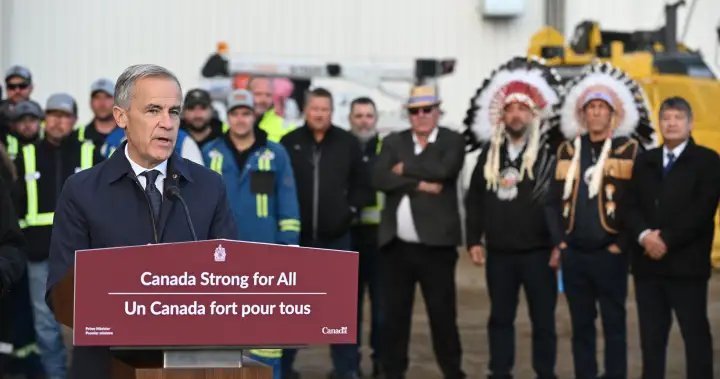
Jobs and Families Minister Patty Hajdu said the section created “guardrails” and promised the government would consider the impact on the economy and the “constitutional right to strike” when weighing whether to intervene.
Unions countered that the national interest test comes with no judicial oversight and remains at the discretion of the government.
The Canadian Labour Congress, a coalition of unions, said that means Canada has the broadest power to curtail strikes out of any G7 countries and vowed to take Canada to the International Labour Organization if the bill passes in its current form.
“Canada cannot claim to champion workers’ rights around the world while weakening them at home,” Lily Chang, secretary-treasurer of the Canadian Labour Congress, said in a statement.
While the revised s. 107 has no judicial oversight component, Canada’s Building Trades Union president Sean Strickland said it would at least delay how quickly a minister could issue an order to halt a job action because of requirements for the appointment of a special mediator.
There are no disclosure requirements in the current iteration of s. 107 and the minister can invoke it simply by making the order to the Canada Industrial Relations Board.
“If you just look at the the process now, they’re building in way more process before it gets to a decision point around Section 107, which I think is good for all parties in determining a fair collective agreement,” Strickland said, noting the mediator would have 21 days to complete a report.
“At the end of the day, a strike or lockout still may occur, but you’ve gone through some really substantive steps here to try to get parties to make a deal.”
Local 500 also took aim at language in the bill limiting their right to determine preferred bargaining units.
Currently, longshore workers can choose to negotiate as a single bloc or decide to negotiate by employer type or geographic region.
The ILWU is structured as a council of individual locals that have their own leadership. The ILWU has chosen voluntarily to bargain on a B.C.-wide basis in the past, but wanted to retain the option to choose in the future.
Under C-39, the labour board could consider an application from the employer for geographic certification, potentially restricting the union’s ability to choose their preferred bargaining arrangement.
The BC Maritime Employers Association, which represents port businesses, said this change and the new special mediator role will “protect industry bargaining and help stabilize the bargaining framework at Canada’s largest maritime gateway.”
Industry has long argued for the need for structural labour reforms, saying the frequent, disruptive disputes are jeopardizing Canada’s reputation and the $1.1 billion in cargo crossing West Coast docks every day.
Local 500 said this could pave the way for the ports employers to turn to the labour board to redraw the union’s bargaining units.
That idea was a direct recommendation made in the spring 2025 industrial inquiry commission, which the government ordered to explore what was driving labour disputes at the West Coast ports. The commission was ordered after a nearly two-week long strike at the West Coast ports in 2023 paralyzed shipments and led to layoffs.
The BCMEA locked out longshore foremen in 2024 after their union authorized but didn’t initiate a strike. Talks stalled, and the Liberal government invoked s. 107 to restart operations.
Bill C-39 is currently at second reading in the House. The unions are objecting to the government’s proposal to refer the bill to a special legislative committee, a process which hasn’t been used since 2012.
A legislative committee can only examine the bill that triggered its creation — no tangents, fact-finding missions or opposition-initiated investigations, although members can put forward amendments.
Because of this, it’s much more difficult for opposition members to delay the proceedings by putting forward a steady stream of motions proposing that the committee hit pause on the bill to focus on other business, either by circling back to a study already in progress or launching an entirely new investigation.