dailynewsnblog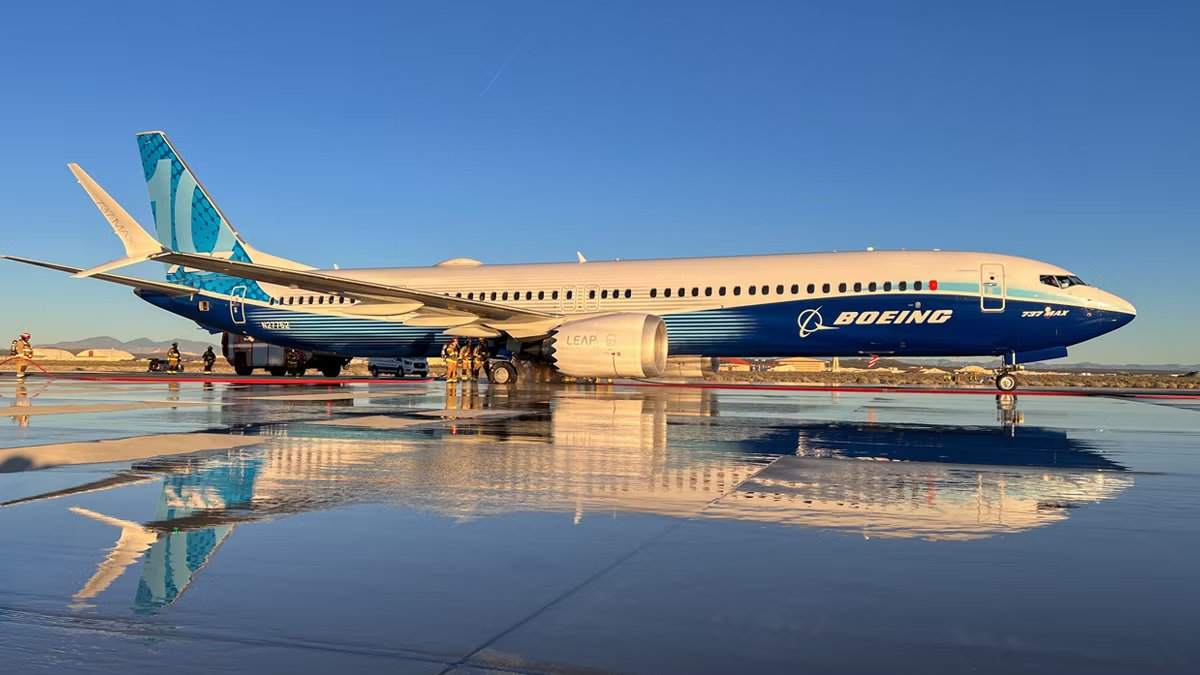
The Boeing 737 MAX 10 will soon be certified, and it might just be the most important aircraft of the decade. In the commercial aircraft industry, the large narrowbody market has seen the highest growth in demand, yet Airbus has been essentially uncontested in this space. It’s been grabbing market share for years with its A321neo, which is by far the best-selling commercial aircraft variant of all time, and only now, with the 737 MAX 10, does Boeing have a true competitor.
The 737 MAX 10 slots in well for carriers that already operate the 737 family, and it should have enough range to operate essentially any route desired. But what will really determine whether the MAX 10 will be a success or not is how economical it is. The less fuel an aircraft burns, the less money an airline spends to fly it, so it’s crucial to know the MAX 10’s fuel-related figures. This information can then inform the MAX 10’s market appeal against the competition.
Overview Of The 737 MAX 10

The 737 MAX 10 is the latest derivative of the 737 MAX family. Unlike the other variants of the MAX family, which directly succeeded variants of the 737NG and are quite similar to their predecessors, the MAX 10 is a new size category for the 737 family with no direct 737NG equivalent, as it’s a further stretch of the 737 airframe. At 143 feet, 8 inches (43.8 meters), it’s nearly as long as the original Boeing 707, while it’s designed to carry between 180 and 230 passengers, nearly as many as the Airbus A321neo.
The MAX 10 is rated for a Maximum Takeoff Weight (MTOW) of 89.8 tons, or about 1.5 tons more than the 737 MAX 9. The plane’s empty weight will depend heavily on airline configurations, but should range between 48.5 tons and 50 tons. It’s advertised as having 3,100 NM (5,700 km) of range, which is actually more than the Airbus A321neo without auxiliary fuel tanks, but it also has the least range of any 737 MAX variant. Meanwhile, takeoff and landing performance should be comparable to the MAX 9.
Catch what other flight trackers miss
Emergency squawks, holds, NOTAMs — live signals, no signup.
Open tracker
Catch what other flight trackers miss
Emergency squawks, holds, NOTAMs — live signals, no signup.
Open tracker
Like all members of the MAX family, the MAX 10 features new split-tip Advanced Technology (AT) winglets, while being equipped with the CFM LEAP-1B. The aircraft features an updated flight deck compared to the 737NG, and it also features a new tail cone. The MAX 10 specifically includes telescoping main landing gear to preserve runway performance. Naturally, the MAX 10 includes the Boeing Sky Interior as standard and should be very similar to the rest of the family on the inside, apart from the added length.
The 737 MAX 10’s Range And Fuel Burn

As per Boeing’s ACAPS, the 737 MAX 10 has the same fuel capacity as the rest of the 737 MAX family, at 6,820 gallons (25,816 liters) or 20.73 tons. When empty and fully loaded with fuel, the aircraft will go about 4,100 NM (7,600 km), but of course, planes don’t fly empty, and their actual range also differs based on winds. Boeing’s brochure range of 3,100 NM (5,700 km) for the MAX 10 is calculated with zero winds using maximum fuel and a payload of roughly 19 tons, which is roughly equal to between 165 and 170 passengers in a typical two-class layout and no cargo.
With this payload and fully loaded, the MAX 10 gets about 0.52 miles per gallon (roughly 0.22 kilometers per liter). However, most airlines will configure their MAX 10s with at least 180 seats, meaning that the quoted range figure may only be accomplished with blocked seats. For simplicity, we’ll calculate a payload of 21 tons, equivalent to about 185 to 190 passengers depending on passenger weight calculations (which vary by regulator and airline). This leaves space for roughly 18 to 20 tons of fuel, depending on empty weight.
Being conservative and assuming a relatively heavy configuration with heavy passenger weights, the MAX 10 will have a still-air range of about 2,750 NM (5,090 km), giving it an MPG of roughly 0.51 miles per gallon (0.22 kilometers per liter). However, if you take into account how many passengers the aircraft carries, you’ll find a per-passenger MPG ranging between 95 and 98 passenger MPGs (40.5 to 41.6 kilometers per liter per passenger). This statistic is much more relevant when discussing aircraft economics.
Doing The Same Calculation For The 737 MAX 8 And A321neo

The 737 MAX 10 has to answer two questions: is it more economical to operate than the Boeing 737 MAX 8(currently the best-selling member of the 737 MAX family), and how does it compare to the A321neo (its main rival). With the MAX 8, Boeing publishes a brochure range of 3,500 NM (6,480 km), but this is with a reduced payload. With 165 passengers plus their bags, we’re looking at 3,150 NM (5,830 km), which gives us around 0.58 MPG (0.25 KPL) and about 96 mpg per passenger (40.9 KPL per passenger).
The A321neo, however, is more interesting because Airbus offers up to three Auxiliary Centre Tanks (ACTs) and multiple airlines operate the A321neo with one, two, three, or no ACTs, while also regularly selecting different MTOW options (usually either 93.5 or 97 tons). Airbus refers to an A321neo with three ACTs and the top 97-ton MTOW as the A321LR, so we’ll exclude this configuration.
With a 93.5-ton MTOW and loaded with 195 passengers (an average two-class layout), the A321neo will only fly around 2,650 NM (4,900 km), while it has a fuel capacity of 6,230 gallons (23,577 liters). It also usually weighs close to 50.5 tons empty. Each ACT adds around 824 gallons (3,121 liters), which brings fuel capacity up to 8,700 gallons (32,940 liters). With one ACT, it’ll go about 3,050 NM (5,650 km), whereas with the 97-ton MTOW option and two ACTs, it’ll do around 3,400 NM (6,300 km).
In all three cases, the A321neo will do about 50 to 51 MPG (0.21 to 0.22 KPL), while achieving between 97.5 and 99 MPG per passenger (or about 41.5 to 42 KPL per passenger). Notably, the A321neo is actually fuel-volume limited in these instances, and the plane’s MTOW leaves enough room that you could potentially take a few more passengers in certain circumstances. With the 737 MAX 10, it’s the other way around: the aircraft’s range is limited by its MTOW rather than fuel-tank volume.
Why The 737 MAX 10 Will Be A Success

First, a few asterisks are needed regarding the above calculations. These calculations use publicly available data, don’t account for winds, and assume heavy passenger loads with relatively heavy empty-weight figures. Airlines have their own unique fuel policies, which can change real-world ranges dramatically. In addition, the average configuration used is based on how US full-service carriers configure these planes.
With that in mind, the 737 MAX 8 is only economically competitive with the MAX 10 once it’s flying beyond the MAX 10’s range. Within the MAX 10’s range, it’s much more economical than the MAX 8, burning only slightly more fuel while carrying 20 to 25 additional passengers in most cases. Meanwhile, the MAX 10’s range with a sizable payload is still sufficient for routes like Phoenix to Hawaii, Scandinavia to the Canaries, and Singapore to India.
Aircraft | Typical Two-Class Capacity | Range With Passengers+Bags |
|---|---|---|
Boeing 737 MAX 8 | 165 | 3,150 NM (5,830 km) |
Boeing 737 MAX 10 | 185-190 | 2,750 NM (5,090 km) |
Airbus A321neo | 195 | 2,650 NM-3,400 NM (4,900 km-6,300 km) |
The 737 MAX 10 burns about the same fuel as the A321neo, and the per-passenger fuel burn is also nearly identical. Considering that the 737 MAX 10 can integrate seamlessly within existing 737 fleets and is generally cheaper, it’s an excellent buy, especially for existing Boeing customers. It does basically the same job as the A321neo, but it’s a 737, which matters for a large portion of the world’s airlines.
The Advantage Of The A321neo

For the vast majority of the world’s narrowbody routes, the 737 MAX 10’s range is good enough, and it delivers competitive fuel burn to the A321neo. On the flip side, the A321neo is competitive with the 737 MAX 10, yet it can be specced to fly significantly farther than its rival. The ACTs cut into cargo space, cost money, and add weight, but they don’t significantly change the aircraft’s economics.
The 737 MAX 10 is just as economical as the A321neo, but the Airbus is more flexible, which is a valuable strength. What’s more, Airbus also sells the A321neo and A321XLR, which are true long-haul airliners, and Boeing has no answer to those variants. It doesn’t necessarily need to, since long-range narrowbody flying is a niche market, but this is an advantage of the A321neo.
The 737 MAX 10 has all of the qualities to potentially become the best-selling 737 MAX variant annually, and its sales figures should be competitive with the A321neo as well. However, the type won’t suddenly steal huge orders from Airbus because there remain legitimate reasons to buy the A321neo.