dailynewsnblog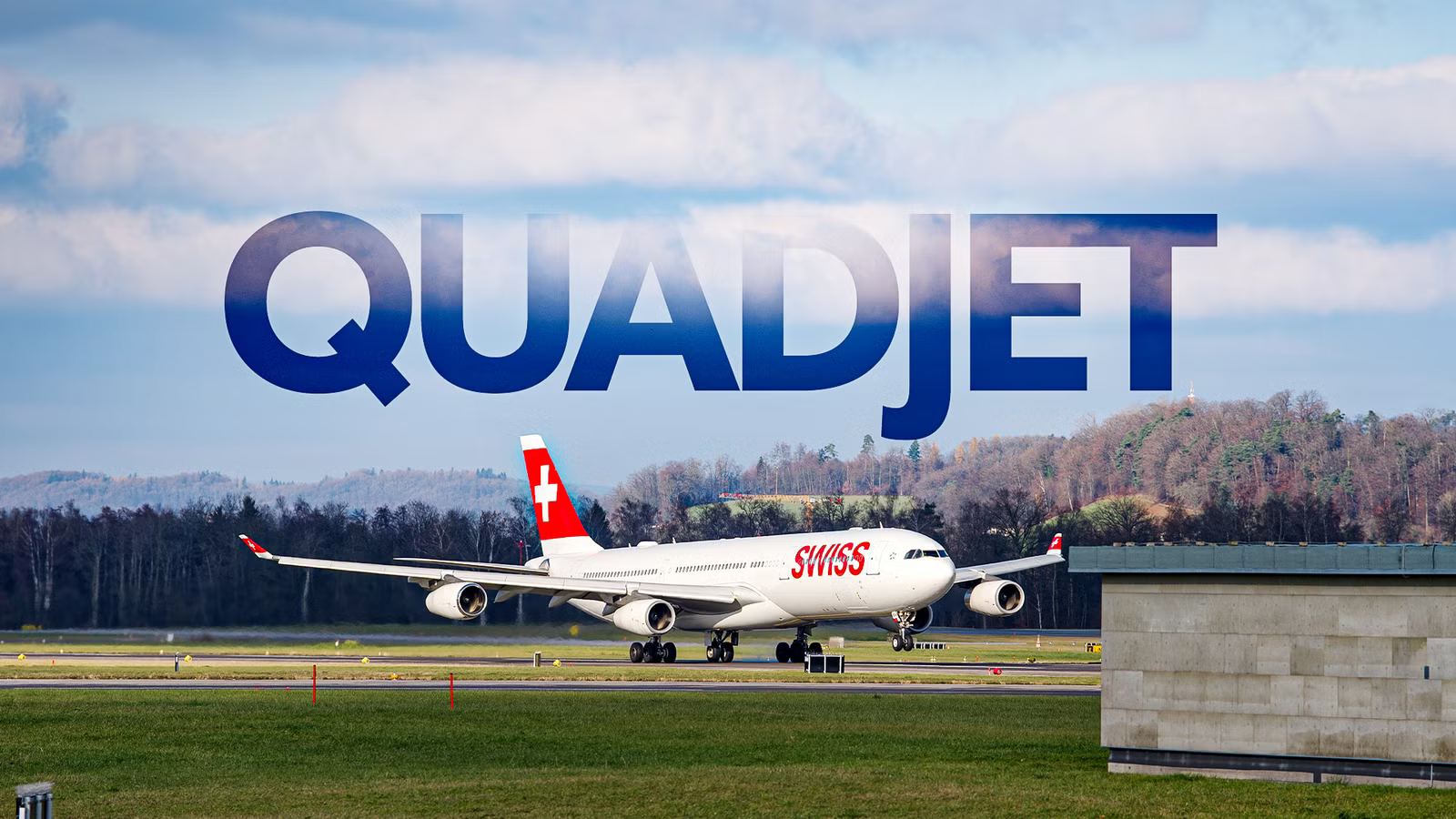
SWISS International Air Lines will retire its last four Airbus A340-300s by the end of 2027, ending more than two decades of quadjet long-haul flying at Switzerland’s flag carrier. SWISS took delivery of the A340 in 2004, and it rebuilt the intercontinental network after Swissair’s collapse in 2001. Nine were delivered. Four remain. The final airframe, HB-JMH, will be donated to the Swiss Museum of Transport in Lucerne, where it will sit alongside a Swissair Convair 990 Coronado as a physical timeline of Swiss long-haul aviation from the 1960s to the 2020s.
The retirement was supposed to happen in 2024-2025, but delivery delays on the A350-900s and 787-9s that were meant to replace the A340 kept the quadjets flying two years longer than planned. Across the broader Lufthansa Group, which owns SWISS, the same pattern is playing out on a larger scale. Lufthansa mainline is retiring its A340-600s in October 2026, its 747-400s in 2027, and its A340-300s by 2028. Edelweiss Air, the group’s Swiss leisure carrier, is replacing its five A340-300s with A350-900s at the same time. Approximately 25 A340s across three Lufthansa Group carriers will exit service within a two-year window.
SWISS Is Retiring Its Last Four A340-300s By The End Of 2027

SWISS operates four A340-300s from its hub at Zurich Airport (ZRH) as of late 2026, the last quadjets in the Swiss flag carrier’s fleet. The aircraft serve a shrinking number of long-haul routes including Shanghai Pudong International Airport (PVG) and Johannesburg O.R. Tambo International Airport (JNB), destinations where SWISS has not yet transitioned to twin-engine replacements. Routes to Calgary International Airport (YYC), Halifax Stanfield International Airport (YHZ), and Vancouver International Airport (YVR), previously operated by the A340, have already been transferred to the A350-900. The remaining A340 routes will follow as additional A350 deliveries arrive through 2027.
SWISS plans to retire all four A340-300s by the end of 2027, ending more than two decades of quadjet long-haul flying at Switzerland’s national carrier. The aircraft entered service with SWISS shortly after the airline was founded in 2002 and has operated continuously since, connecting Zurich to destinations across North America, South America, Africa, and Asia. At their peak, the A340s formed the backbone of SWISS’ intercontinental network, serving routes that required the range and capacity of a large widebody before the A350 and 777-300ER arrived to take over.
The retirement has been expected for years but has been repeatedly delayed by supply chain constraints. SWISS CEO Dieter Vranckx indicated as early as 2021 that the airline planned to retire all A340s by 2024-2025. Delivery delays on replacement aircraft pushed the timeline to 2027. Aerospace Global News reported that the A340 continued operating through spring and summer 2026 on routes including Tampa and Colombo before those services transitioned to other equipment. For aviation enthusiasts, 2026 is likely the final full year of regular SWISS A340 operations. Airport Spotting advised spotters to target Zurich departures to Shanghai and Johannesburg as priority opportunities before the type disappears from the schedule.
From Swissair To SWISS: How The A340 Became The Backbone Of Swiss Long-Haul Flying

Swissair, the original Swiss flag carrier, was known as “the Flying Bank” for its perceived financial invincibility. The airline operated McDonnell Douglas MD-11 trijets on its long-haul network from Zurich before failed investments and a liquidity crisis brought the carrier down in one of the most dramatic collapses in aviation history. On October 2, 2001, Swissair grounded its entire fleet after running out of cash to buy fuel. The event, known in Switzerland as “the Grounding,” stranded thousands of passengers and ended the operations of an airline that had been flying since 1931.
SWISS was founded in 2002 as the successor carrier, inheriting Swissair’s route network, its Zurich hub, and its remaining MD-11 fleet. The carrier needed a new long-haul aircraft quickly. As such, it ordered nine A340-300s, with the first, registered HB-JMH, arriving in early 2004, according to Airport Spotting. The A340 offered lower fuel costs per seat than the three-engine MD-11 it replaced and provided a modern, reliable platform for rebuilding the intercontinental network that Swissair’s collapse had disrupted. Key. Aero’s operational history of the type described the A340-313X as representing “stability and continuity following the collapse of Swissair, forming the backbone of long-haul operations while the airline rebuilt its network, brand, and financial footing.”
SWISS became part of the Lufthansa Group in 2005, securing the financial backing that the independent carrier needed to survive long-term. The A340 fleet connected Zurich to destinations across North America, South America, Africa, and Asia for more than two decades under the SWISS brand. For passengers transiting Zurich on intercontinental flights throughout the 2000s and 2010s, the A340’s four-engine silhouette on the tarmac was as much a part of the airport’s identity as the Alps, visible through the terminal windows.
Why The A340 Lasted This Long At SWISS

The A340 was supposed to be gone from SWISS’ fleet years ago. CEO Dieter Vranckx indicated as early as 2021 that the airline planned to retire all A340s by 2024-2025, replacing them with more fuel-efficient twin-engine widebodies ordered through the Lufthansa Group. The timeline assumed that replacement aircraft would arrive on schedule. They did not. Boeing 787-9 Dreamliner deliveries to the Lufthansa Group slipped repeatedly through production quality issues and supply chain disruptions. Airbus A350-900 deliveries, while more reliable than Boeing’s timeline, did not arrive in sufficient numbers to allow SWISS to retire the A340 fleet on the original schedule.
The A340-300 burns approximately 25-30% more fuel per seat than the A350-900 on equivalent routes. Four CFM56-5C engines consume more fuel than two Rolls-Royce Trent XWBs producing comparable combined thrust. The operating-cost penalty is substantial per departure and compounds across hundreds of long-haul flights each year. SWISS knew this when it set the 2024-2025 retirement target. The airline accepted the higher costs temporarily because the alternative, canceling routes or reducing frequencies due to insufficient widebody capacity, would have cost more in lost revenue and market share than continuing to fly the A340.
SWISS upgraded the A340’s first- and business-class cabins in the years before COVID, extending the passenger product’s competitiveness even as the aircraft’s economics deteriorated. By 2026, four A340s remained from the original nine, operating the last routes that had not yet transitioned to twin-engine equipment. The bridge is nearly crossed. The A350 deliveries that were supposed to arrive in 2024 are arriving now, and the A340’s final routes are being transferred one by one.
Lufthansa Group’s Broader Quadjet Exit Is Happening Simultaneously

SWISS is not retiring its A340s in isolation. Across the Lufthansa Group, every carrier operating quadjets is either winding them down or managing a finite fleet toward a defined exit date. Lufthansa mainline is the only airline in the world simultaneously operating all five quadjet types produced by  Boeing and Airbus: the 747-400, 747-8, A340-300, A340-600, and A380. The A340-600 will fly its last revenue service on October 18, operating from
  Frankfurt Airport (FRA) to
  John F. Kennedy International Airport (JFK) and Washington Dulles International Airport (IAD). Only four of Lufthansa’s original 24 A340-600s remain active. The 747-400 fleet, with eight aircraft averaging 26 years old, will retire in 2027 after two airframes are grounded for the winter 2026/2027 season. Lufthansa plans to retire its 16 A340-300s by 2028.
Edelweiss Air, Lufthansa Group’s Swiss leisure carrier, is executing its own parallel A340 exit. The airline ferried the first of its five A340-300s, registered HB-JMG, to a storage facility in Teruel, Spain, in October 2025. Six Airbus A350-900s are replacing the five A340s, with deliveries continuing through 2026. Between SWISS, Edelweiss, and Lufthansa mainline, the group will retire approximately 25 A340s across three carriers within a two-year window.
Two Lufthansa quadjet types are staying. The 747-8 is being retrofitted with the new Allegris intercontinental cabin product and will fly well into the 2030s, with the airline reportedly considering ultra-long-haul routes including Hawaii. The A380, configured with 509 seats, provides irreplaceable capacity at slot-constrained airports like  London Heathrow Airport(LHR) where moving the same passenger volume on smaller aircraft would require additional slots that are not available. The quadjet era at the Lufthansa Group is not ending all at once. It is contracting to the two types where four engines still make commercial sense, while everything else transitions to 787s, A350s, and eventually the 777X.
What Is Replacing The A340 At SWISS

The A350-900 is the primary replacement for the A340 at SWISS. The airline has been receiving A350s through the Lufthansa Group’s centralized widebody orders, and the type has already taken over routes to Calgary, Halifax, and Vancouver that the A340 previously served from Zurich. The A350 carries more passengers in a more efficient configuration, burning approximately 25-30% less fuel per seat than the A340-300 while offering passengers a newer cabin product with lower cabin altitude, higher humidity, and larger windows. Each A350 that arrives lets SWISS transfer another A340 route and move one step closer to its 2027 retirement target.
SWISS also operates 777-300ERs on its highest-demand long-haul routes, giving the airline two twin-engine widebody types for its intercontinental network once the A340 departs. The 777-300ER handles the densest routes where its approximately 340-seat capacity is needed per departure, while the A350-900, with approximately 240 seats, serves markets where demand does not justify the larger aircraft. The combination gives SWISS the flexibility to match capacity to demand across its Zurich hub network without the fuel penalty the A340 imposed on every route it served.
The fleet transition extends beyond the widebody types. SWISS announced its new “SWISS Senses” cabin product this year, with the first A330-300 sent to Hong Kong in July for a full interior retrofit. The refreshed A330s will complement the A350 and 777 on medium and long-haul routes, completing a long-haul fleet built entirely around twin-engine aircraft for the first time in the airline’s history. When the last A340 departs Zurich for the final time in late 2027, SWISS will operate a widebody fleet of A350-900s, 777-300ERs, and retrofitted A330-300s. Four engines will no longer be part of the equation.
Catch what other trackers miss
Emergency squawks, holds, NOTAMs — live signals, no signup.
Open tracker
Catch what other trackers miss
Emergency squawks, holds, NOTAMs — live signals, no signup.
Open tracker