dailynewsnblog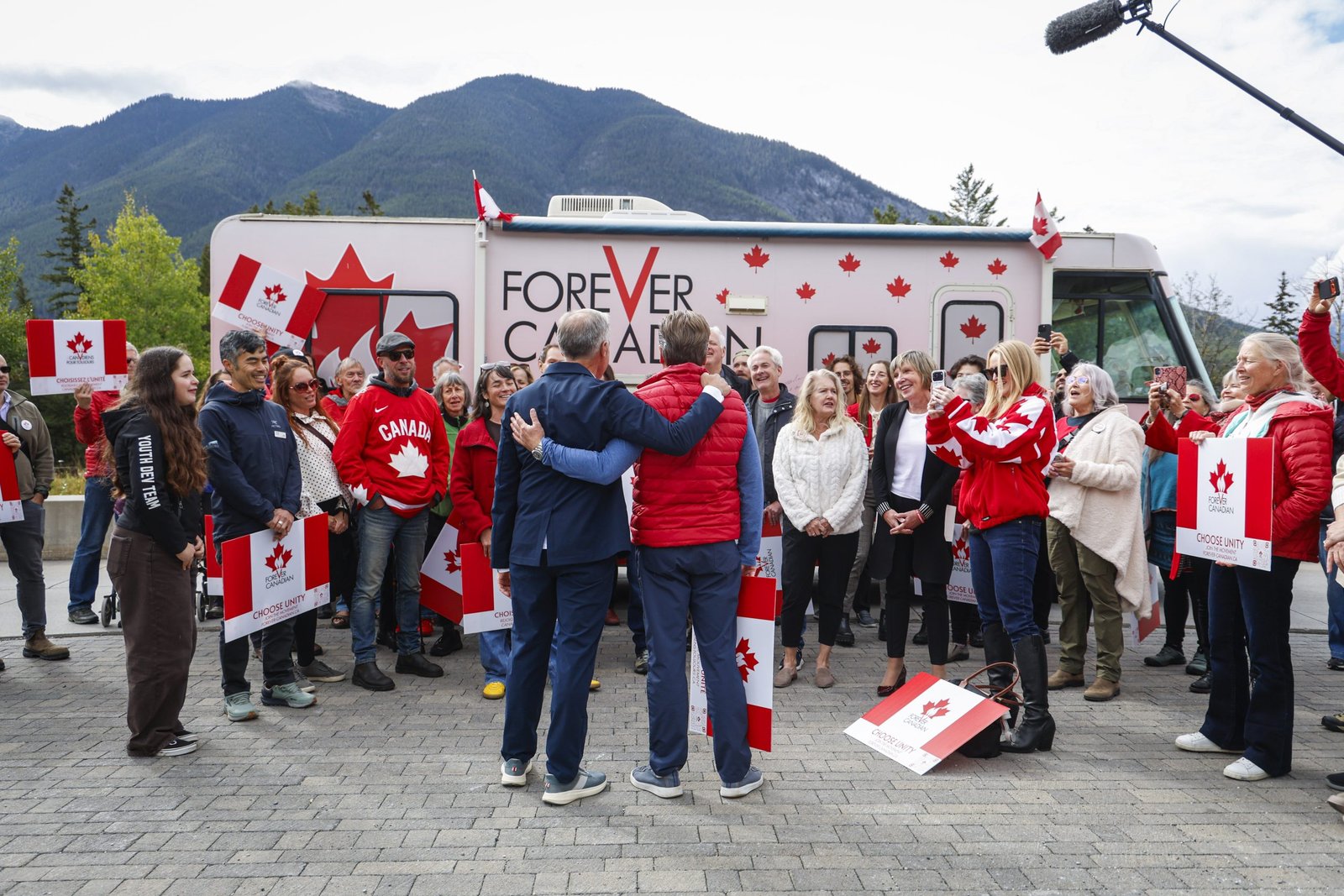
Here’s what the activist media is reporting on this week.
With just over a month to go until Alberta voters head to the polls to vote on a non-binding question that asks if the province “should remain a province of Canada” — or, alternately, should the Alberta government “commence the legal process required under the Canadian Constitution to hold a binding provincial referendum on whether or not Alberta should separate from Canada,” Rebel Media’s Alberta bureau chief Sheila Gunn Reid announced that the avowedly right-leaning network would be “taking Elections Alberta to court” after the agency seemingly ignored a request to investigate why one pro-Canada group has yet to report a single dollar in donations via the provincial registry.
“Thomas Lukaszuk’s group, Forever Canadian ….registered with Elections Alberta on June 8 as a referendum third-party advertiser,” notes Gunn Reid — who, as the site acknowledges, is also the primary contact for another third-party advertiser, Alberta’s Choice, which urges voters to support a binding referendum on the question.
“The rules that follow registration are straightforward: file a contribution report every single week. Every donation, every donor. If someone gives you goods or services instead of money — a bus, an office, a stage, a truckload of lawn signs — you report that too, at fair market value.”
And yet, despite having a ‘Unity Bus’ that “has toured the province,” as well as “campaign offices” in both Calgary and Edmonton, has “handed out thousands of (lawn) signs” and is set to hold a free concert later this month, Elections Alberta’s public registry shows that Forever Canadian “has raised $0.00” since the campaign began, she notes.
“Zero dollars, zero cents, every week since June,” while every other group — including at least one that supports remaining in Canada — has reported donations ranging from $35,937.95 for Alberta’s Choice to the $484,988 racked up by Let Alberta Decide.
“Every independence group reports,” Gunn Reid contends.
“The other federalist groups report. But one group, running the biggest campaign in the province, has reported nothing,” and “it gets stranger,” she explains.
“On July 10, the Globe and Mail reported that Lukaszuk says Elections Alberta sent him a letter telling him Forever Canadian doesn’t have to report contributions — because, he says, it ‘isn’t promoting a position in the referendum.’ He wouldn’t share the letter and Elections Alberta offered no comment, claiming they don’t discuss private correspondence.”
For her part, Gunn Reid stresses that she’s “not going to tell you that’s illegal — I don’t know that, maybe there’s an explanation,” and this is “exactly what we asked Elections Alberta to find out,” she notes.
“But if a public regulator sent a private letter exempting one side of a referendum from the rules everyone else follows, Albertans have a right to see it. So our court application asks the judge to order Elections Alberta to produce it — or to confirm in writing that it doesn’t exist.”
A few days later, she alerted her audience to a “BIG WIN,” courtesy of a Calgary judge who “has given a direct signal that the court will not allow Elections Alberta and Thomas Lukaszuk’s Forever Canadian group to drag the proceedings past the referendum vote” by directing lawyers for both sides to file arguments for and against holding an expedited hearing no later than this week, which could lead to the question being heard in court before the referendum takes place.
“There was one notable sidebar,” Gunn Reid reports.
“The lawyer representing Forever Canadian in these proceedings is Brent Rathgeber — a former Conservative MP from St. Albert who resigned from Stephen Harper’s caucus in 2013, citing concerns that the party wasn’t transparent enough. He is now in court arguing to keep Forever Canadian’s finances opaque from Albertans ahead of a province-wide vote.”
Gunn’s as yet unanswered questions about Forever Canadian’s lack of reported donations also inspired a fresh ‘Alberta Fact Check’ that explores whether a registered advertiser can, for instance, hold a free concert headlined by high-profile artists without reporting the associated costs as in-kind donations.
The answer: No, it can’t. “Alberta’s rules do not allow referendum advertisers to make donated goods or services disappear from their books simply because no cash changed hands,” Gunn Reid points out.
“That could include a donated musical performance, venue, sound equipment, promotional work or other professionally supplied services if they are provided for the referendum campaign without payment.”
She also debunks the claim made by “opponents of Alberta independence” that leaving Canada “would force you to change your phone number” when there’s actually “no technical reason that would have to happen,” she explains.
“(An) independent Alberta could negotiate its continued participation while keeping the +1 country code and its existing area codes. Phone numbers would not suddenly become unusable because Alberta’s constitutional status changed.”
Her fellow Alberta Fact Check-er Cory Morgan, who also writes for the Western Standard, takes a closer look at the theory that the now imminent referendum was responsible for Alberta Premier Danielle Smith’s United Conservatives losing the “relatively safe seat” of Calgary — Shaw to the New Democrats in a recent byelection.
Although the by-election “was heavily impacted by the upcoming referendum vote … it can’t be considered a bellwether for the referendum on independence itself,” he argues.
“The referendum has created a volatile and divided electoral environment, and Premier Smith’s attempted balancing act has managed to alienate both independence supporters and non-independence supporters among her traditional base of support. Both sides expressed their discontent in Calgary-Shaw either by staying home or choosing an alternative candidate, which created the environment for an NDP win.”
It’s worth noting that both Morgan and Gunn Reid are on the marquee for an upcoming Rebel News LIVE! event in Calgary, which is set to take place a little less than two weeks after the vote on Oct. 31, and promises a “one-of-a-kind, full-day gathering will bring together leading voices, activists, political figures, and concerned citizens to discuss the future of the West and where we go from here,” according to the programme.
The keynote speaker? Smith herself, who will also take part in what will undoubtedly be a lively “fireside chat.”
Elsewhere on the site, after going through the latest round of increasingly dire warnings about the potentially catastrophic consequences of unregulated Artificial Intelligence, Rebel News commander Ezra Levant says that, while he “doesn’t dismiss the risk,” and “if the guy who builds the thing says it scares him, (he’ll) listen to him,” he’s “been around long enough to notice something: When the biggest players in an industry agree that the industry needs more rules, it’s a good time to ask, well, who would benefit from those rules?”
As he sees it, it’s “a little bit like Pfizer saying this is the worst pandemic ever, and boy, we have to bring in tough regulations — and one of the regulations is that everybody has to buy a Pfizer vaccine. Doesn’t that ring a bell?”
Meanwhile, Toronto-based mission specialist David Menzies sounds the alarm over a report that the Royal Canadian Mounted Police “has quietly changed its uniform policy, (and) no longer requires its officers to wear name tags while on duty,” he explains.
“Apparently, the move toward secrecy is all about the threat of doxxing and internet harassment against officers. Really? In any event, I know from bitter experience that the Mounties were already hiding their identities – both names and badge numbers – before the official policy change.”
He points to his own failed attempt to scrum then-Foreign Affairs Minister Chrystia Freeland about why her government hadn’t formally recognized the Islamic Revolutionary Guard Corps as a terrorist organization during a 2024 event in Richmond Hill, which led to an on-camera clash with an unnamed Mountie and, eventually, Menzies’ arrest.
“This crackpot idea of hiding the identities of police officers is an insidious trend that completely goes against transparency – especially given the fact that police officers are armed with lethal force,” he concludes.
“It’s shameful. But then again, these days, does the RCMP even give a rodent’s rectum about public trust? I really don’t think they do. And that’s scary.”
Over at Juno News, Clayton DeMaine reveals that, “at around 8:55 pm MST on (Sept. 14), Calgarians were blasted with a commercial not in French or English, but in Punjabi” via a “specific advertisement that aired on CBC Calgary,” which “featured English subtitles and followed an Indian woman living abroad who arranged medical care for her mother back in India.”
The ad “is part of a campaign run by Axis Bank, whose main corporate headquarters is in Mumbai, Maharashtra, India, called ‘Far Away But Never Apart, (and) besides those living in Canada, the campaign also targets ‘Non-Resident Indians’ in the U.S., Saudi Arabia, Qatar and Singapore through various platforms,” he reports.
“In May, another institution that receives taxpayer funding, the Calgary Police Service, defended its use of Punjabi signs to warn the city’s South Asian diaspora about potential extortion, signalling significant cultural changes. When asked how long the state broadcaster has been playing commercials in languages other than Canada’s two official languages and where else in Canada it has aired the advertisements, a spokesperson for the CBC said it had ‘limited control’ over the advertisements.”
Rounding out the right-of-centre lineup this week, Juno contributor Alex Dhaliwal highlights how China “is deepening its ties with Canadian First Nations as Indigenous control over land and resources becomes increasingly consequential, despite longstanding warnings about Beijing’s efforts to influence Indigenous communities,” he warns.
“Chinese Ambassador Wang Di hosted an economic roundtable in Vancouver on September 3 with nearly 60 representatives from Chinese and Canadian companies and institutions, as first reported by Business in Vancouver. The meeting focused on China-Canada trade, the green transition, Indigenous finance and community development, according to the Chinese embassy,” and Wang “specifically called for Chinese and Canadian businesses, financial institutions and First Nations communities to strengthen their ties,” he reports.
“The outreach comes as Indigenous land rights and control over resources have become increasingly consequential in British Columbia — and as Ottawa looks to advance major projects requiring Indigenous consultation, participation or partnerships.”
Trending on the progressive-left side of the Canadian activist mediaverse:
- U.S. Ambassador Pete Hoekstra may not have faced protests during his recent visit to Gander, Nlfd., to mark the 25th anniversary of the Sept. 11 terror attacks, but “the wildly unpopular diplomat left the province with a powerful message from residents and political leaders, who shared their displeasure with him in other ways,” Ricochet contributor Justin Brake writes.
- The Breach writers Saima Desai and Anthony Fenton team up for a feature report on the “Gulf billionaire dictators” who “are looking to cash in on Mark Carney’s investment bonanza.”
- Also keeping a close eye on the now-wrapped Canada Investment Summit: Rabble reporter Evan Wexler, who reports that, “as the megaphone was passed around” during an evening rally, “protesters chanted for everything from worker’s rights, environmental preservation, indigenous solidarity, Palestinian liberation, fair housing advocacy, and a generally anti-capitalist and anti-corporate agenda.”
- Canadian Dimension writer Owen Schalk makes the case for why “Canada’s role in the disastrous ‘War on Terror’ should not be celebrated.”