dailynewsnblog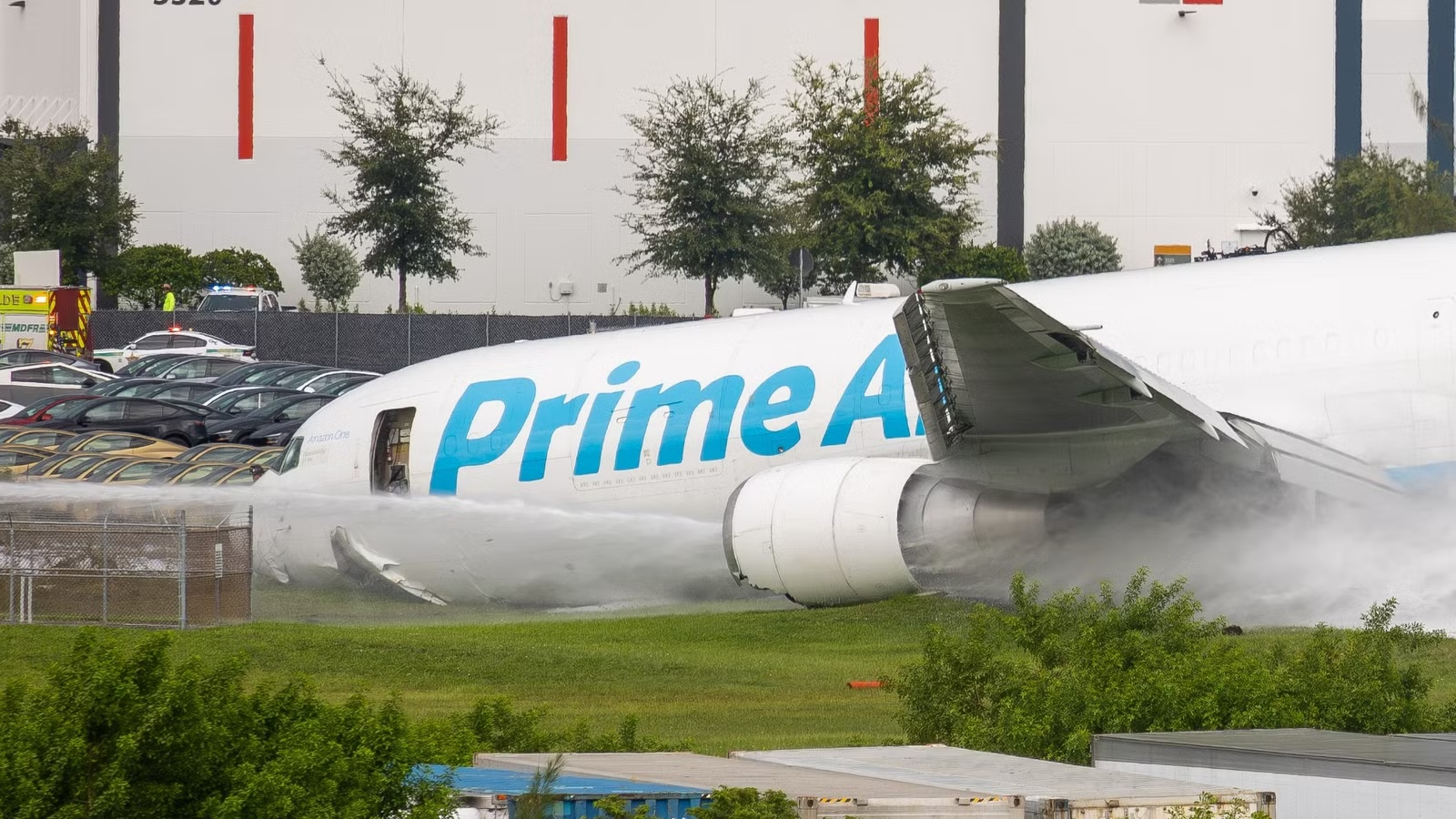
Following the fatal mishap at  Miami International Airport (MIA), after 21 Air Flight 7598 overran the runway, two of the four runways were closed at the busy hub. According to the Miami Herald, runway 8R/26L commenced eastbound departures only on the evening of September 8 but fully reopened Wednesday morning after the crashed plane’s hull was moved by salvage crews.
Despite the fact that the third runway was not used by the accident aircraft, the site of the crashed plane, lying directly on the strip’s westbound path, forced its closure. Runway 12/30, the fourth strip at MIA, remains completely closed for ongoing inspections by local authorities, the Federal Aviation Administration and the National Transportation Safety Board and repairs following the crash that claimed the lives of five bystanders and injured seven more.
Flight 7598’s Trail Of Damage And Destruction

While the hull of the destroyed Boeing 767 was 1,300 feet past the pavement, its tall tail section and wreckage rose up high into the air right close to the edge of the third runway’s path until it was moved. Eastbound departures were allowed because planes taking off were climbing away from the wreckage. However, planes could not arrive from the west or take off westbound because they would fly dangerously close to the crash site and interfere with NTSB investigators working on the ground.
Late on Tuesday, September 15, heavy crews finally moved the charred hull of the Amazon plane out of that critical safety zone and towed it to a remote open lot. Because the plane never actually touched the pavement of the third runway, there were no deep gouges, fuel spills, or broken lights to repair on that strip specifically. The same cannot be said for the fourth runway on which tail number N1997A attempted to stop before careening into the public road.
After Flight 7598 landed at the highly excessive speed of 158 knots (293 km/h), it left severe, deep tire skid gouges on the tarmac. Then, when it departed the runway, the widebody freighter tore up the ground-level approach lights, runway centerline lights, and electrical wiring conduit buried at the end of the strip. It also demolished the perimeter fence and spilled jet fuel all along its path.
Miami’s Low-Tech Overrun Area At Runway 12/30

Notably, Miami does not have EMAS at the end of the runways, or Engineered Material Arresting Systems. Because MIA has a grass and soil Runway Safety Area (RSA) instead of an engineered runoff bed, it will be less expensive and faster to reopen the runway. The material is crushable under the weight of a heavy plane like a 767, which rapidly slows down planes in the overrun area.
The FAA promotes the installation of EMAS as it has contributed to safely stopping planes in previous overrun mishaps. EMAS beds are made of thousands of highly specialized, pre-cast cellular cement blocks. By draining the jet’s forward energy, EMAS may have stopped the plane within the airport’s grass buffer zone. It’s possible that the slowing effect could have prevented N1997A from crossing Northwest 67th Avenue, which lies 1,000 to 1,200 feet (305 to 366 meters) from the end of Runway 30.
EMAS blocks act like artificial mud. These blocks are custom-engineered to match the specific weight mix of the aircraft using that exact airport, which makes them very expensive and time-consuming to build and maintain. There are 70 airports in the US that currently have EMAS, but MIA does not require it due to the 1,000-foot safety area it already has.
How EMAS Could Have Helped Save Lives

While the absence of an EMAS makes the physical cleanup and runway reopening much faster, it highlights the severe trade-off of the accident itself. If an EMAS bed had been present, it could have heavily decelerated the fast-moving 767 freighter. Even though the airport would have faced a months-long shutdown to rebuild a crushed EMAS block system, the plane may have been stopped or at least greatly slowed down.
Even though the plane wouldn’t have frozen in place, the energy required to crush thousands of concrete blocks would have acted like a massive brake. Although it may not have truly brought the jet to a halt at the end of the tarmac, forcing the plane to slog through the crumbled concrete would have diminished the momentum that allowed it to plow 1,300 feet (396 meters) beyond the runway.
The FAA does still promote the technology even though it is not legally required at many airfields as it claims EMAS has slowed and stopped flights carrying over 500 souls in total since it was introduced, according to NPR. While it is speculative to propose that EMAS could have averted the disaster of Flight 7598, replacing it would have almost certainly extended the impact on operations for weeks.