dailynewsnblog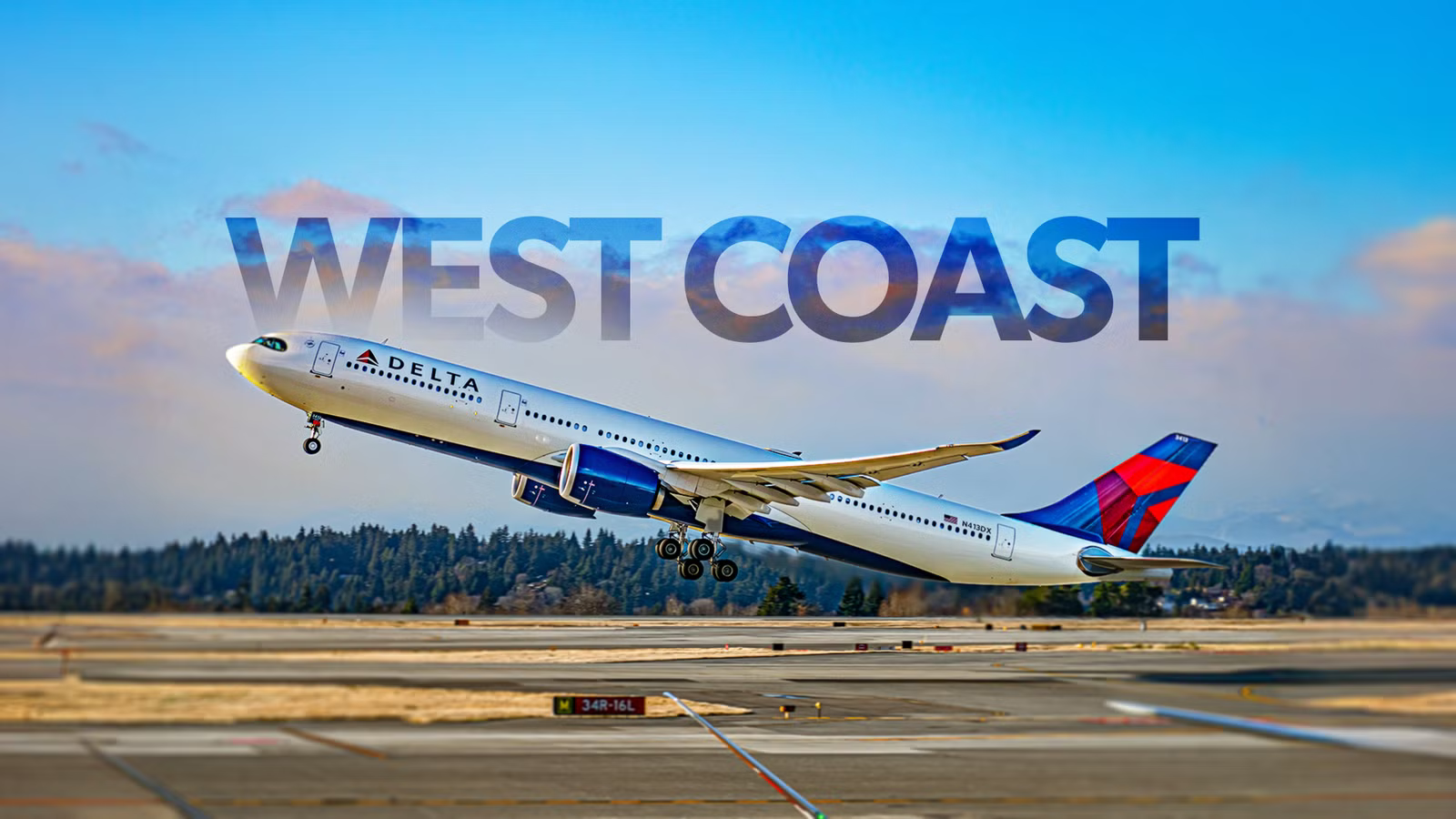
 Delta Air Lines, facing a $4 billion revenue deficit across the Pacific Ocean, is in the midst of a strategy that initially looks like commercial surrender, dismantling its multi-hub ambition and compressing its entire long-haul Asian growth into just two West Coast gateways.
Rather than fighting  United Airlines for hub-and-spoke dominance from
  Chicago(ORD) or
  Newark(EWR), Delta is making a stand on
  Los Angeles(LAX) and
  Seattle(SEA). Now tying 15-hour ultra-long-haul routes to the heavy belly-cargo capacity of the Airbus A350-900 and routing secondary Asian traffic through Korean Air’s Seoul mega-hub, Delta is testing whether radical gateway concentration can outperform brute network scale across the world’s most lucrative ocean corridors.
Well Behind The Competition

Delta’s strategic retreat to two West Coast gateways stems from the fact that United Airlines currently dominates the transpacific market. In 2025, United generated $6.88 billion in Pacific route revenue, whereas Delta recorded $2.79 billion over the same period. Rather than attempting to close this $4 billion shortfall by dispersing aircraft across traditional mainland hubs such as Chicago O’Hare or Newark, Delta management concluded that replicating United’s hub-for-hub geographic spread was economically unviable.
United uses its long-time hub position at  San Francisco International Airport(SFO) to funnel massive connecting traffic across Asia, backed by long-haul departures from four additional domestic hubs and Guam. To compete with that entrenched scale, Delta previously tried to build standalone Asian gateways, but suffered from fragmented passenger flows and high operating costs. The decision to abandon multi-hub dispersion allows Delta to channel its long-haul fleet, specifically its A350-900s and A330-900neos, into markets where local high-yield demand can sustain standalone premium cabins.
By surrendering secondary-market connectivity to a partner airline, Delta freed up capital to launch high-density routes from California and the Pacific Northwest. The retreat from secondary hubs leads to a far more aggressive posture in primary gateway markets, which challenges Delta to extract maximum revenue from two of the most competitive airports on the US West Coast.
The Return To Hong Kong

The launch of daily nonstop service between Los Angeles and Hong Kong on June 6, 2026, is Delta’s first step in testing the new model. Deploying its 275-seat A350-900 onto the 7,260-mile (11,684-kilometer) route marks the carrier’s return to Hong Kong after eight years without service. Instead of attempting to funnel low-yield connecting passengers through a secondary gateway, Delta is targeting established corporate travel and high-value cargo flows directly out of Southern California.
Catch what other flight trackers miss
Emergency squawks, holds, NOTAMs — live signals, no signup.
Open tracker
Catch what other flight trackers miss
Emergency squawks, holds, NOTAMs — live signals, no signup.
Open tracker
The economics of the flight rely heavily on the belly capacity of the A350-900, which can carry more than 20 tons (18.1 metric tonnes) of freight alongside a full passenger load. That freight capacity, handling electronics, e-commerce, and perishables, lowers the passenger yield needed to break even on the 15-hour sector. It separates the Los Angeles route from Delta’s failed Seattle to Hong Kong operation, which folded in 2018 due to weak local demand and inferior aircraft economics. The new daily departure adds 4,300 weekly seats to a market previously split between Cathay Pacific and United Airlines.
Challenging two highly established competitors on a high-density route is a tough hill to climb for Delta, as it now needs to capture share in a market where Cathay Pacific has structural corporate loyalty, and United controls broad domestic connectivity. However, competing head-to-head for shared corporate volume in Hong Kong is only one of the airline’s targets in its Southern California playbook. To establish true market dominance outside Los Angeles, Delta is also targeting high-volume Asian destinations where competitors offer no direct flights.
Taking Over At Manila

While the return to Hong Kong requires competing for shared corporate traffic, Delta’s entry into the Philippines relies on a different competitive dynamic, with market exclusivity among domestic operators. On March 28, 2027, Delta will launch service between Los Angeles and Manila, scaling from three times weekly to daily operations on June 7, 2027. Operating the 7,292-mile (11,735-kilometer) transpacific route on the A350-900 makes Delta the only US mainline carrier flying nonstop between the US mainland and the Philippines.
The move targets Southern California, home to the largest Filipino community outside the Philippines, according to Remitly, where travel demand is driven by plenty of visiting friends and relatives traffic alongside growing corporate trade. In the past, US carriers served Manila via multi-stop routing through Tokyo or Seoul, ceding direct passenger traffic to Philippine Airlines. Now deploying widebody aircraft with flat-bed premium suites and dedicated premium economy cabins directly into Ninoy Aquino International Airport(MNL), Delta has a product barrier that one-stop competitors operating through North Asian hubs struggle to match on total elapsed travel time.
Monopolizing nonstop US flag service to Manila allows Delta to capture premium demand while filling its economy cabins with high-yield point-to-point traffic originating in Greater Los Angeles. Furthermore, the route complements the Korean Air joint venture, which serves secondary Filipino destinations like Cebu through Seoul Incheon. Overall, Southern California has become critical to Delta’s future, but it is not the only focus area. Farther north, an escalating battle for regional dominance is unfolding.
Battling With Alaska Airlines In Seattle

Defending the northern hub of Delta’s West Coast network is becoming ever more difficult for Delta. Seattle-Tacoma International Airport has seen incredible growth from Delta’s hometown rival  Alaska Airlines, which has aggressively expanded its international ambitions following its acquisition of Hawaiian Airlines. As Alaska builds out long-haul routes from Seattle, including its daily service to
  Tokyo Narita, Delta cannot afford to surrender market share in its primary Pacific Northwest gateway. Delta’s response pairs seat capacity growth with a dual-airport Tokyo strategy designed to lock up corporate business travel while offering cargo options across the North Pacific.
On March 27, 2027, Delta will officially return to Tokyo Narita Airport for the first time since consolidating its operations at  Tokyo Haneda(HND) in March 2020. This time with the A330-900neo, the daily flight operates alongside Delta’s established daily service to Haneda. Splitting operations between close-in Haneda for downtown business travelers and Narita for freight infrastructure allows Delta to directly counter Alaska Airlines’ single-flight Narita operation while scaling total seat capacity out of Sea-Tac.
The parallel Tokyo services protect Delta’s local corporate base in Seattle, but double-daily flights into Japan are also highly expensive if sustained purely by point-to-point travel. Unlike United or American, which lean on Japanese joint venture partners All Nippon Airways and Japan Airlines to distribute passengers beyond Tokyo, Delta operates without a Japanese domestic partner. That gap shifts the burden of secondary Asian connectivity onto another key route, meaning Delta has to rely on a single, ultra-efficient megahub not too far away.
Highly Reliant On Seoul

Delta answers its lack of a Japanese domestic partner by routing secondary Asian traffic through  Seoul Incheon International Airport (ICN), using its transpacific joint venture with Korean Air as the connecting piece. Rather than committing multi-million-dollar widebody aircraft to thin point-to-point routes like Bangkok, Singapore, or Taipei, Delta outsources secondary market access entirely to Korean Air, set to expand further with the merger between Korean Air and Asiana Airlines, per Yahoo Finance. This joint venture model turns these two West Coast gateways into true high-density funnels, relying on a single mega-hub in Korea to distribute passengers across East and Southeast Asia.
Operating out of Incheon’s Terminal 2, where Delta and Korean Air are co-located, the partnership provides minimum connection times as short as 45 minutes across 80 destinations in Asia. The pending integration of Asiana Airlines into Korean Air further expands the hub advantage, creating a dominant market share at Incheon that rivals United’s hub position at San Francisco. The aim is to feed long-haul flights from Los Angeles and Seattle directly into Korean Air’s dense regional network, providing transpacific coverage without the financial burden of flying low-yield 6,000-mile (9,656-kilometer) secondary sectors on its own fleet.
Outsourcing secondary Asian connectivity keeps Delta’s fleet capital focused strictly on high-margin primary routes, but it exposes the airline to severe single-point vulnerability. If geopolitical friction disrupts East Asian airspace or operational problems choke Seoul Incheon, Delta lacks alternative hub infrastructure to reroute traffic. Having surrendered its historic intra-Asia hub at Tokyo Narita years ago, Delta has tied its long-term Pacific strategy to the performance and stability of a single foreign airline partner.
Key Developments Are Coming

The true test of Delta’s two-gateway model extends beyond whether Los Angeles and Seattle can produce sufficient local traffic to fill widebody cabins. The strategy is a very different approach to how a legacy US global carrier balances asset deployment against alliance reliance. If Delta succeeds in generating higher unit revenues through point-to-point density while ceding secondary Asia to Seoul, it will show to other airlines that multi-hub geographic reach is no longer a prerequisite for transpacific profitability.
The operational validity of this strategy will be tested over the next 12 months, particularly regarding two key fleet and alliance developments. First is the December 17, 2026, final merger completion between Korean Air and Asiana Airlines, which consolidates Delta’s joint venture partner as the single dominant mega-hub operator at Seoul Incheon. Second is the targeted June 2027 entry into service of Delta’s flagship Airbus A350-1000 fleet. Deploying these larger, high-capacity widebodies onto core West Coast routes will show whether Delta can generate the unit revenue needed to permanently narrow its $4 billion transpacific shortfall against United Airlines.
Delta has narrowed its focus, and the work has truly begun to reclaim lost ground from its competitors. Delta’s concentrated strategy may become the modern playbook for international network planning, but it could also become a case study in partner dependence. Whatever comes next will be decided across the runways of Los Angeles and the transfer corridors of Incheon.