dailynewsnblog
EV batteries usually fade gradually, so the real warning signs are often changes in behavior rather than age alone.

An electric vehicle battery doesn’t have a universal age or mileage at which it suddenly needs replacing. The high-voltage traction battery that powers the motors gradually loses some of its ability to store energy as it ages, which can reduce driving range without meaning the pack has failed.
Complete battery failure is also relatively uncommon in newer EVs. A Department of Energy analysis of about 15,000 plug-in vehicles found that 1.5 percent had batteries replaced because of failure, excluding recalls. Replacement rates were below 1 percent for every model year from 2016 through 2023.
The useful question, then, isn’t whether your EV has lost any range. It is whether the changes you’re seeing look like normal battery aging or a problem that needs professional diagnosis.
Gradual range loss doesn’t automatically mean the battery is failing

Some loss of usable battery capacity is expected over time. The Department of Energy estimates that today’s EV batteries may last 12 to 15 years in moderate climates and eight to 12 years in extreme climates. Actual lifespan varies with battery chemistry, temperature, charging habits and how the vehicle is used.
A 2026 Geotab analysis covering more than 22,700 EVs across 21 models found average battery degradation of 2.3 percent per year, although individual vehicles can age faster or slower.
Battery state of health, often shortened to SOH, describes how much usable energy the pack can hold compared with when it was new. A lower state of health generally means less available range, but the number of miles displayed on your dashboard isn’t a direct measurement of battery health.
Temperature, cabin heating and cooling, highway speeds, acceleration, hills and extra weight can all change how far an EV travels on a charge. Cold weather alone can produce a noticeable temporary drop. If your range suddenly looks worse, there are several ways to get more range out of your EV before assuming the battery itself is the problem.
What deserves more attention is a persistent decline under comparable conditions. If the same commute in similar weather repeatedly uses much more of the battery than it did before, degradation becomes a more plausible explanation. This recent look at EV battery lifespan goes deeper into how modern packs are aging.
Battery warnings and sudden changes are stronger signs of trouble
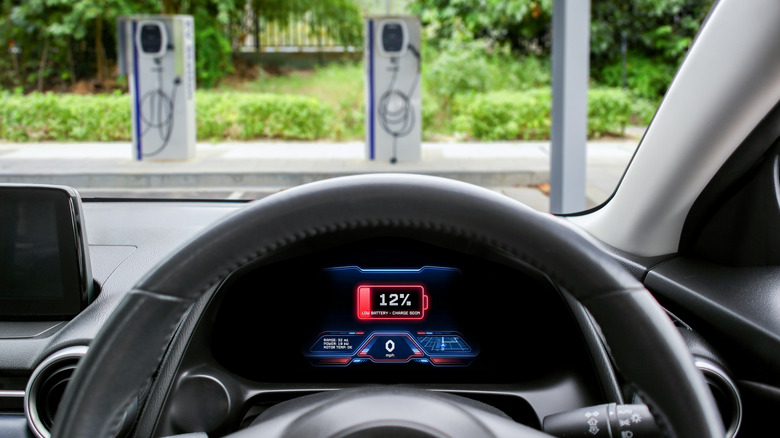
Gradual capacity loss is different from an abrupt change in how the car behaves. A sharp and unexplained drop in available range, a new limit on how much the battery will charge or reduced vehicle performance deserve more attention, particularly when it arrives alongside a battery or high-voltage-system warning.
The exact symptoms vary by vehicle. Tesla, for example, documents high-voltage battery alerts that can reduce maximum charge level and range when the car detects certain internal battery conditions. Its owner documentation tells drivers to schedule service if the relevant alert persists.
Other automakers use different warnings, so there’s no universal dashboard symbol that means the battery needs replacing. What matters is that the car can detect internal battery faults that a driver can’t diagnose from range alone.
Charging speed is similarly weak evidence on its own. Battery temperature, state of charge, charger power and the vehicle’s charging curve can all slow a session, so a persistent slowdown matters more when it appears alongside a warning or another unexplained change.
Get the battery diagnosed before replacing the whole pack

If an EV is reporting a battery fault or has lost enough usable capacity to interfere with normal driving, the next step is a battery-health check. An EV-qualified service center can read diagnostic codes and battery data to determine whether the car has ordinary degradation, a repairable fault or a problem that calls for complete pack replacement.
Check the battery warranty before assuming the repair will be an out-of-pocket expense. Some EV manufacturers provide separate long-term coverage for the traction battery, although the mileage limits, duration and capacity guarantees vary by model.
If the entire pack needs replacing outside warranty, the cost can be substantial. Recurrent’s survey puts many replacements at roughly $5,000 to $16,000, although pack size, vehicle design, labor and available replacement parts can push individual bills outside that range. A diagnosis may also uncover a smaller repair instead of a full-pack replacement.
Replacing an EV traction battery isn’t a normal DIY project. The high-voltage pack requires specialized procedures, tools and protective equipment, so opening or removing it belongs with trained technicians.
If your EV otherwise works normally, gradual range loss alone is not a reason to replace the battery. A persistent warning, sudden unexplained change or range that no longer meets your needs is a reason to get the pack tested before deciding what comes next.