dailynewsnblog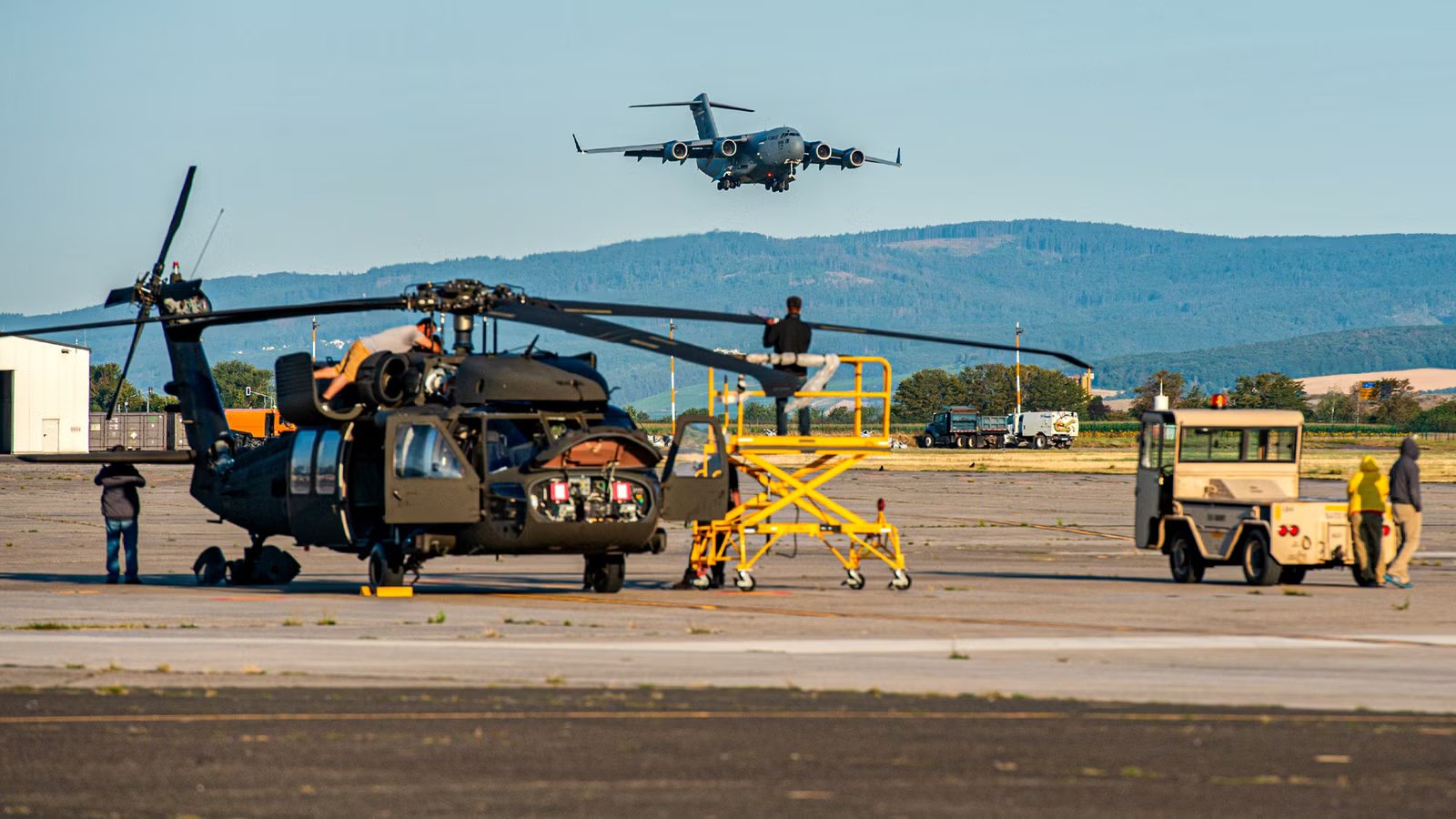
Ramstein Air Base’s title as the Global Gateway is not just branding. That moniker is a clear operational description that instantly encapsulates the mission of the largest United States Air Force hub outside the continental US. The 86th Airlift Wing is the host unit, primarily flying Lockheed Martin C-130 Hercules in support of US Air Forces in Europe—Air Forces Africa. Yet the traffic that gives Ramstein its reputation comes from every corner of the globe.
The massive number of aircraft movements is coordinated by its chief tenant organization, the 521st Air Mobility Operations Wing, headquartered at Ramstein under Air Mobility Command’s Expeditionary Center. The 521st traces its legacy to the 1950s when the Cold War was just ramping up. Since then, the demands of conflicts in Southeast Asia and the Middle East have turned Ramstein into what the wing calls ‘the natural central hub’ for a network spanning all across the eastern hemisphere.
Its subordinate, 721st Air Mobility Operations Group, is described as the largest en route aerial port in the Air Force. What that means is the 721 launches or recovers an average of more than 350 aircraft a month at a routine, peacetime baseline tempo. That figure predates the current build-up for Operation Epic Fury. Today, Ramstein is once again a vital link in the chain that connects the troops on the front line to the vast supporting military apparatus in the States.
From Peacekeeping Hub To Battle Zone Lifeline

Beginning in late January, the US undertook what has since been called its largest military buildup in the Middle East since the 2003 invasion of Iraq. OEF launched on February 28 after the collapse of nuclear talks with Iran and a violent crackdown on Iranian protesters that killed tens of thousands of people. Since then, a massive aerial campaign has devastated the Iranian military forces, but a resolution to hostilities has yet to be found.
In the months preceding the first opening salvos to the joint US-Israeli air campaign, continuous streams of  Boeing C-17 Globemaster III Jets shuttled into Ramstein. Those aircraft will make stops at Souda Bay, Sofia, and other bases throughout the Gulf. The surge in numbers was apparent from public air traffic trackers online.
Independent tallies put more than 300 US military aircraft in the CENTCOM area of responsibility by late February, including an estimated 270 C-17 sorties as well as many by the colossal Lockheed C-5 Super Galaxy in January alone. The comparison to the 1948-49 Berlin Airlift is not simply rhetorical color. The numbers make an instructive contrast when it becomes clear that the ramp-up to OEF required hauling almost the same amount of tonnage through the air, but in a fraction of the time.
The Cold War Comparison, And Where It Breaks Down

At the height of that operation, the Combined Airlift Task Force delivered roughly 8,000 tons of supplies to West Berlin daily using a fleet of Douglas C-54s each carrying about 10 tons. The 278,228 total flights delivered 2.3 million tons over fifteen months under the Berlin Airlift, according to MiGFlug. In comparison, one C-17 can move up to ‘170,900 pounds (77,519 kg) in one sortie, meaning one modern Globemaster can lift what took roughly eight C-54s to carry, which allows Ramstein to conduct massive airlifts far more efficiently in the 21st century.
The air bridge between the US and Ramstein is no longer measured in tonnage, but rather in the strategic parallel that has never changed since that famous humanitarian mission almost eight decades ago. Where the analogy breaks down is sustainability. The Berlin Airlift ran for 15 months with a fleet of hundreds of propeller aircraft that the US and Britain could replace relatively cheaply. Today, the US Air Force is facing an overstressed and aging Fleet with limited modernization prospects.
Although there are numerous airframes in the logistics fleet, AMC heavily relies on runs on a fixed fleet of 222 C-17s that Boeing stopped building in 2015. The Air Force’s own mobility leadership was already warning about accumulated flight hours before this crisis began. In the Truman era, a blockade-era airlift could be scaled up by building more C-54s. A 2026 air bridge can only scale up by pulling harder on a static fleet of active, Guard, and Reserve Squadrons. That strain is increasingly evident as the OEF wears on, yet Ramstein has been the constant anchor throughout it all.
Geography, Not Choice, Built The Bottleneck

The reason the base is so critical is that Ramstein sits at the intersection of three combatant commands’ areas of responsibility. Its strategic site is no geographic accident but rather the result of institutional design. Aircraft flying from across the Atlantic can stage through Ramstein after completing the journey ‘across the pond.’ The stopover allows planes to refuel, pick up and drop off, and either return to the US or continue on to more distant destinations.
Another critical node in the European network of air bases that helps Ramstein accomplish its mission is NSA Souda Bay in Crete. Just a short hop to the south, the naval base is host to the only deep-water Mediterranean pier capable of servicing a nuclear-powered carrier. It also functions as a refueling and logistics waypoint for aircraft transiting towards all three theaters. This complements the equivalent function performed by Ramstein on land.
Landlocked in southern Germany, Ramstein is the largest and most developed NATO air hub. It is even home to the Allied Air Command. Additionally, it serves as a critical deployment point for large equipment, such as main battle tanks, other armored vehicles, and even combat helicopters, to support ground forces in Europe. The strategic function was designed to support a conventional conflict against the Soviet Union, but it continues to be an indispensable rallying point for us and allied troops across the continent.
An Aging, Overcommitted Fleet Forces A Total-Force Answer

The C-17 fleet tasked with covering this tempo is smaller and older than it appears from the outside. The Air Force operates 222 C-17s in total. There are 157 flying with active-duty units. Meanwhile, 47 are assigned to the Air National Guard, and only 18 belong to the Air Force Reserve. The type entered service in 1995, and Boeing delivered the last new USAF C-17 in 2015, so every airframe now flying is at minimum a decade old.
Against that fixed and aging fleet, demand has spiked sharply. Retired AMC Commander, General Michael Minihan, told an interviewer in early 2026 that hours have been accumulating on C-17 airframes faster than planned as the jets support one crisis after another. He pointed to the current Middle East buildup as compounding, rather than replacing existing global commitments, according to The War Zone.
Analysts at the Center for a New American Security flagged airlift, alongside aerial refueling, as one of the two mobility functions most likely to be strained by a sustained campaign against Iran. According to Breaking Defense, the requirement to keep dispersed operating locations resupplied with munitions and spare parts on an ongoing basis pushes the fleet to its limits.
The C-17 is, in one sense, the fleet best positioned to absorb that strain. Its roughly 75% mission-capable rate as of 2024 data compares favorably to the tanker fleet’s 60–70% and the C-5’s under-50% rate. Yet, a reliable jet flown at an unsustainable tempo by too few active-duty crews still needs bodies in the cockpit. That is precisely the gap Total Force Integration is built to close.
What Total Force Integration Actually Buys The Air Force

Total Force Integration is a crew architecture that blends active-duty, Guard, and Reserve airmen into the same flying and maintenance units so that surge capacity exists without a permanent expansion of the active-duty Roster. The 911th Airlift Wing is a case study in how recently that architecture was built around the C-17 specifically. The wing flew C-130s until 2018, when the Air Force Reserve converted it to the C-17 mission.
The unit began its transition in 2017, with support from Reserve units at Wright-Patterson, and the changeover was formally declared in 2018. Wrapping up in 2019, the conversion was explicitly framed at the time as filling a strategic-lift gap the active-duty force could not fill alone. Wings like the 349th Air Mobility Wing at Travis AFB extend the same model further, flying C-5Ms, C-17s, and KC-46s as the largest associate wing in the Reserve, embedded directly alongside active-duty crews at the same base.
The result is that when a C-17 lands at Ramstein today, the tail number alone won’t tell an observer whether the crew that flew it in was on active orders or a traditional reservist balancing a civilian job back home, which is exactly the point. It means the Air Force can generate CENTCOM-demanded large-scale airlift sorties without permanently increasing the active-duty C-17 force.
It also means that sustaining a crisis this size now depends on how many hours part-time reservists like the 911th’s airmen can be mobilized to fly. That dependency is new enough, and specific enough to this crisis, that it invites comparison to the last time Germany hosted an airlift of comparable scale and stakes.
Catch what other flight trackers miss
Emergency squawks, holds, NOTAMs — live signals, no signup.
Open tracker
Catch what other flight trackers miss
Emergency squawks, holds, NOTAMs — live signals, no signup.
Open tracker