dailynewsnblog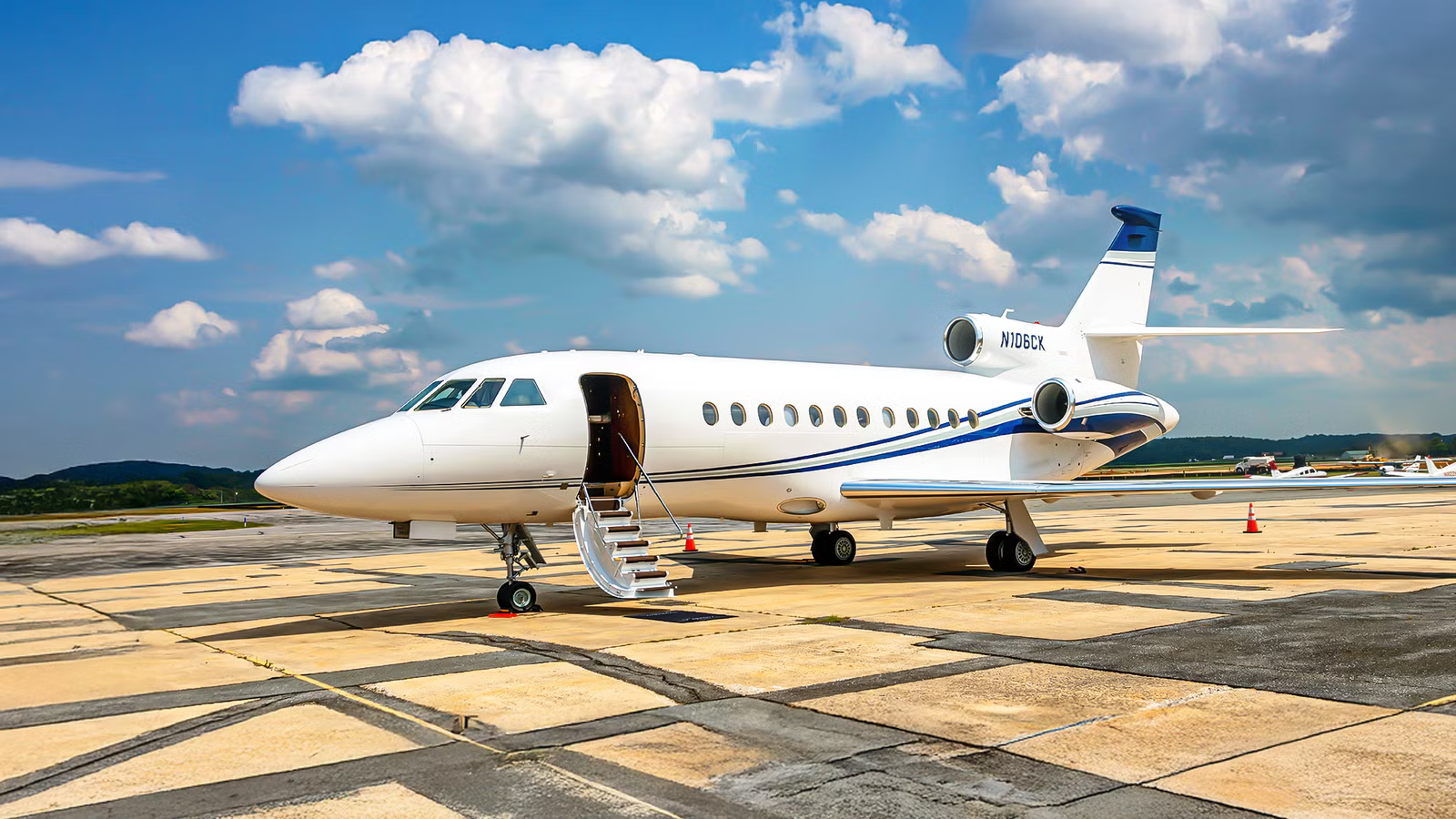
Dassault records show that three new-build Falcon 900LX airframes were delivered between January 2025 and July 2026, all of which were delivered (mostly) by July 2025. In the year since, it appears Dassault has not delivered another example. Meanwhile, its primary competitor, the Bombardier Challenger 650, has seen 25 aircraft delivered over that time period, with deliveries potentially accelerating in 2026. The other aircraft to occupy this market segment, the Gulfstream G400, has not yet entered service.
As discussed below, it also seems that the listing for the 900LX has disappeared from Dassault’s production page, strongly suggesting Dassault has ended active production. While it’s unclear if Dassault is still taking orders for it or if there are unfulfilled orders, it is becoming clear that Dassault needs a replacement for the aircraft. Here is what to know about why the iconic Falcon 900LX trijet is being superseded by twin-engined aircraft in its class.
2025: 900LX’s Final Delivery Year

Launched in 2010, the Dassault Falcon 900LX is the current production variant of the EX (the long-range version) and comes with blended winglets and a range of 4,750 nautical miles. Dassault advertises it as having a 7% longer range over the 900EX, with a climb performance increasing by 10%, allowing it to reach FL390 in just 20 minutes. Having first entered service in 1986, the basic 900 airframe has evolved through the Falcon 900, 900B, 900EX, 900EX EASy, and 900LX.
Dassault says, “In October 2016, at the NBAA convention, Dassault launched a modernized Falcon 900LX with a sleek, stylish cabin and features like FalconEye, Dassault’s unique Combined Vision System option, as well as onboard connectivity.” But now the larger 900 series is an aging design whose market niche is being squeezed by Dassault’s newer twin-engined Falcon business jets, particularly the 6X, and its Bombardier and Gulfstream competitors.
As of August 2026, Dassault continues to list the Falcon 900LX in its current product family. But it also seems like its end is coming. In August 2026, the Flight Plan wrote, “Dassault’s own marketing site no longer lists the F900LX on its primary aircraft lineup, leaving only a broken footer link; and industry brokers now describe 2026 as the model’s final delivery year.”
Erosion Of Trijet Engine Advantages

A major issue Dassault and Canadian rival Bombardier face is a similar challenge across parts of their large-business-jet portfolios, from the United States-based Gulfstream’s G500 to the upcoming G400. Both business jet makers are facing the issue of whether to upgrade their existing aircraft or develop a clean-sheet alternative. The twin-engined G400 offers broadly comparable mission capability in a newer, more efficient twin-engine design, while potentially undercutting the 900LX on acquisition cost.
The trijet design survived longer with business jets than it did with commercial airliners. All trijets are now retired from regular commercial passenger use, while legacy MD-11s converted to freighters are being rapidly phased out. Corporate trijets were long valued for their advantages, including strong short-field and high/hot performance, steep approach capability, ETOPS-era rules allowing flexibility over ocean routes, and so on.
But those advantages have eroded, and the corporate industry is now moving on from trijets. The Falcon 900 family has been the most successful and one of the longest-running business jet platforms, but now it is looking increasingly like a legacy aircraft outclassed by modern twin-engined designs. The 900LX’s traditional selling point was that its three-engine design could offer performance that twin-engine jets couldn’t; that is changing.
The Incoming Gulfstream G400

The Gulfstream G400 can be understood as a newer-generation twin-engine jet that overlaps with the Falcon 900LX’s mission. It is powered by a pair of Pratt & Whitney PW812GA engines, while the 900LX is fitted with three Honeywell TFE731 engines. The 900LX retains a longer range (4,750 nautical miles vs 4,200 nautical miles), but the G400 has a slightly higher long-range cruise speed (Mach 0.85 vs Mach 0.80). These figures are still preliminary and could be revised.
The G400 is designed with a capacity for up to 12 passengers, while the 900LX is a little larger at up to 14 passengers. What is notable is that the G400 provides roughly the same broad mission category with a modern clean-sheet design with two engines. While the G400 is a new aircraft, its price point is similar. Flight Plan writes, “the G400 ($44.95M) and F900LX ($45.5M) have converged to within $0.55M of one another higher up.”
Specifications (per Dassault, etc.) | Dassault Falcon 900LX | Gulfstream G400 | Bombardier Challenger 650 |
|---|---|---|---|
Engines | 3x Honeywell TFE731-60 | 2x Pratt & Whitney PW812GA | 2x GE CF34-3B |
Engine thrust (each) | 5,000 lbf | 13,500 lbf | 8,729 lbf |
Range | 4,750 nautical miles | 4,200 nautical miles | 4,000 nautical miles |
Maximum passengers | 14 | 12 | 12 |
First flight | 2009 (variant) | 2024 | 2008 |
Approx. new price | $45.5 million | $44.95 million | $32.4 million |
Gulfstream G400’s first flight took place in 2024 and had been expected to enter service in 2025, but this has been delayed with certification testing ongoing. Gulfstream claims, “Advanced Pratt & Whitney engines work with our aerodynamic fuselage, clean wing and swept winglets to deliver 29% more fuel-efficiency than previous-generation aircraft.” The super-midsize/large-cabin G400 is not a direct competitor to the Falcon 900LX, but it’s close enough to offer a strong alternative.
The Issue With The Dassault Falcon 6X

The closest Dassault replacement for the 900LX is the Falcon 6X, but this is complicated by the fact that the aircraft sits in a different market category. The Falcon 6X is a modern twin aircraft with an enormous cabin and a greater range (5,500 nautical miles). It is an extraordinarily capable aircraft powered by a pair of Pratt & Whitney TW812D engines. But that’s also the problem: it is an ultra-widebody business jet, with Dassault calling it the first purpose-built ultra-widebody business jet with the largest cabin in its class.
It is a great option for customers with a need for a big cabin, but not a great option for customers looking for a smaller cabin like the 900LX. As a bigger aircraft, it would generally require more fuel, be more expensive to purchase, have larger airport requirements, potentially have higher maintenance costs, and just be excessive for many customers’ needs. Many customers don’t need a jet with such an impressive range.
The distinction becomes clearer when viewed as two separate product families rather than one continuous series. The Falcon 8X remains Dassault’s only current-production trijet because it is an evolution of the Falcon 7X, retaining the proven three-engine architecture while extending the fuselage, increasing range, and refining the wing. By contrast, the Falcon 6X and forthcoming Falcon 10X are entirely clean-sheet aircraft designed from the outset around two high-thrust engines.
The Issue With The Dassault Falcon 2000LXS

Dassault’s other aircraft in this part of the market is the Falcon 2000LXS. Although it shares much of its cabin architecture with the Falcon 900, it was conceived as a twin-engine alternative offering lower operating costs and slightly shorter range. The current Falcon 2000LXS was developed as a replacement for the long-range 2000LX and entered service in 2014 (the original Falcon flew in 1993). The aircraft offers a greatly improved takeoff, better landing performance, superior cabin comfort, and reduced emissions, among other improvements.
Catch what other flight trackers miss
Emergency squawks, holds, NOTAMs — live signals, no signup.
Open tracker
Catch what other flight trackers miss
Emergency squawks, holds, NOTAMs — live signals, no signup.
Open tracker
The 2000LXS is still fundamentally derived from an aircraft whose first flight was in 1993. It runs into the same issues as the Falcon 900LX; it has been modernized repeatedly, but there is only so much that can realistically be achieved by upgrading an old architecture. Put another way, Dassault is in need of a clean-sheet twin-engine replacement to fill the voids left behind by the Falcon 2000LXS and Falcon 900LX.
Dassault markets the aircraft as “Most fuel-efficient aircraft in its category” and “Lowest operating costs in its category,” It claims, “Two PW 308C engines, each rated at 7,000 lb., power the Falcon 2000. Each engine is managed by a Full Authority Digital Engine Control (FADEC) system, offering the highest level of efficiency with the lowest fuel consumption during every segment of the mission.” However, this is a series of claims that are expected to become more and more difficult to defend as Gulfstream and Bombardier develop improved options in this segment.
Dassault’s Falcon 4X Concept

One concept Dassault is exploring is developing a smaller Dassault 4X variant of its clean-sheet 6X. The idea would be to fit the two Pratt & Whitney PW812D engines on a smaller, lighter aircraft. A hypothetical Falcon 4X could therefore combine modern aerodynamics, avionics and propulsion with a range in the region of 4,000–4,500 nautical miles, while offering substantially lower acquisition and operating costs than the larger Falcon 6X. It would also allow for a transition away from the trijet design.
Should Dassault pursue the Falcon 4X, it could replace both the 2000XLS and the 900LX aircraft. The Falcon 6X is arguably too good and too large for a part of the market that could be better served by a smaller variant. Should Dassault develop it, then the 4X would have a (roughly) 4,000-nautical-mile range; the 6X would offer a 5,500-nautical-mile range; the 8X would have a 6,450-nautical-mile range; and the 10X would offer an impressive 7,500-nautical-mile range.
Some industry experts see a clean-sheet Falcon 4X as needed for Dassault to remain competitive in this mid-sized corporate jet market segment, given that the 900LX and 2000XLS are aging. Without a new competitive aircraft, Dassault could risk losing the market segment to Gulfstream and Bombardier.