dailynewsnblog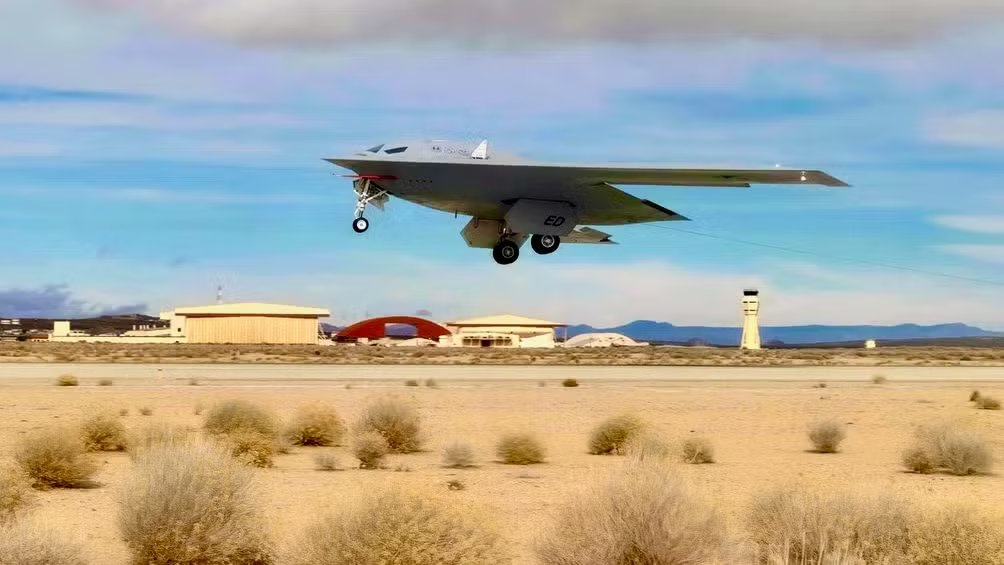
The US Air Force’s long-term bomber strategy rests on an as-of-yet-untested aircraft, the Northrop Grumman B-21 Raider. To secure the future of its strategic strike platform until the sixth-generation fleet is online, the service is pouring engineering resources into the opposite problem. Those bombers are the Rockwell B-1B Lancer supersonic, swing-wing jets that are both the fastest aircraft in the Air Force Global Strike Command and haul the heaviest payload.
In May 2026, a B-1B Lancer departed Wichita State University’s National Institute for Aviation Research three and a half months ahead of a scheduled 12-month structural overhaul, after engineers replaced a 33-foot section of its upper fuselage using a fully digitized replica of the airframe. The repair was not a one-off feat of scheduling; it was the first operational payoff of a six-year, now $200 million effort to scan, disassemble, and digitally rebuild the B-1 down to its nuts and bolts.
The Saga Of Wichita’s Digital Lancer

NIAR began scanning its very first retired B-1 hulls, also known as BONEs, in 2020 directly from the Davis-Monthan 309 Aerospace maintenance regeneration group. January 2024 marked the high-profile arrival of an additional retired B-1B Lancer to scale up the digital twin effort. Once an aircraft arrives at the NIAR facility, it undergoes a meticulous destruction-to-creation pipeline to be reborn in a virtual environment, as the National Interest wrote.
The Air Force chose specific retired airframes because they were manufactured in the mid-1980s and flew well past their original structural design lives. Lt. Col. Joseph Lay, B-1 program manager, described the aims of the program in 2024 when it inducted its first B-1 Lancer from the Boneyard.
“Through the scanning process, we will discover all the places that saw structural failure or damage. It will create a living health record for the B-1. Then we will be able to apply data from aircraft in the field to help us predict areas that are more likely to have structural issues.”
“We have never had the ability to prototype a repair part. With this, we will be able to design a part and fit and test it in the digital world before we manufacture the real thing. The ability to do a virtual fit check could be very beneficial.”
“You would even be able to put on some goggles and take a virtual walk along the airplane, see how parts fit together and interact with each other without ever having to leave the office or your teleworking environment. We expect to learn a lot about this platform.”
Teams consisting of hundreds of research engineers and WSU students systematically take the entire airframe apart, literally down to the individual nuts, bolts, and fasteners. Every single structural component is reverse-engineered using 3D laser scanners. This captures microscopic structural wear, manufacturing variations, and exact physical dimensions.
The scanned parts are digitally reconstructed and managed inside Dassault Systèmes’ 3DEXPERIENCE platform. Engineers apply virtual flight loads, finite element models, and fractography, or the study of fracturing in materials, to the digital twin. By tearing down an airframe that has already weathered decades of supersonic flight, the Air Force can safely discover hidden structural flaws, predict where operational B-1s will crack next, and virtual-fit test new prototype parts before manufacturing them.
A Fatigue Problem the Air Force Is Still Mapping

The effort began in early 2020, with the stated purpose of translating a Cold War-era design, built before computer-aided engineering was standard, into a modern digital format capable of predicting structural fatigue and validating repairs before technicians ever touched an operational jet. NIAR’s Digital Twin program started by disassembling the first airframe piece by piece, cleaning and scanning each component, and reassembling the aircraft as a virtual model, initially focused on a single wing.
The B-1B is a four-engine, variable-sweep-wing supersonic bomber powered by General Electric F101-GE-102 turbofans generating roughly 30,780 pounds (13,962 kg) of thrust each with afterburner, giving it a top speed of Mach 1.2 and a maximum takeoff weight near 477,000 pounds (216,364 kg). Its three internal weapons bays and six external hard points give it the largest conventional payload capacity in the Air Force inventory. But that payload advantage has come at a structural cost.
The airframe’s blended wing/body design and low-level penetration profile, originally developed for high-speed nuclear strike, subject the fuselage to fatigue loads that its 1980s-era engineering never fully modeled for a multi-decade conventional bombing career. The Air Force has run a physical structural fatigue test on a retired B-1 carcass since 2012 specifically to find life-limiting cracks before they appear in the operational fleet in the early 2020s. Yet the test halts every time it uncovers a new failure, allowing engineers to design, prototype, and install a fix before continuing.
Cracks on the fuselage’s dorsal and shoulder longerons were among the failures serious enough to stop the test outright, and the forward intermediate fuselage repair now being fielded operationally traces directly back to that prototyping process. If the physical fatigue test is still incomplete after more than a decade, that leaves open exactly how many more B-1s carry undiscovered structural problems. The digital twin is meant to help close that gap by predicting where cracks are likely before the physical test finds them.
The BackBONE Repair as Proof of Concept

That test came with the BackBONE Project. In September 2025, a B-1B Lancer landed at McConnell Air Force Base in Wichita to begin a preemptive replacement of its Forward Intermediate Fuselage that had emerged as a persistent fatigue point across the fleet. Engineers used the digital twin to design and sequence the repair, then validated the process on a prototype fuselage before ever cutting into the operational aircraft, transferring precise measurements from the digital model directly to the physical build fixture with a laser measurement tool.
The payoff was immediate. A repair the Air Force had budgeted a full year for was completed in roughly eight and a half months, returning the bomber to Dyess Air Force Base three and a half months early. That commitment has grown, not shrunk. Air Force budget documents released in spring 2026 revealed plans to spend nearly $1.7 billion over five years to modernize the B-1B and B-2 fleets and keep both flying past their previously planned retirements, with $342 million earmarked for B-1 modernization between 2027 and 2031.
From Boneyard Teardown to Digital Airframe

Congress authorized the Air Force to retire 17 of the 62 B-1Bs then in service under the 2021 National Defense Authorization Act, concentrating maintenance resources on the 45 most capable airframes rather than spreading thinning parts and manpower across a larger, less reliable fleet. The move followed a 2019 readiness crisis in which only six B-1Bs were available for operations fleet-wide at one point, and it was explicitly billed as a measure to protect mission-capable rates for the remaining aircraft.
By 2025, the operational fleet stood at 42 aircraft, down further after the total loss of a B-1B in a crash at Ellsworth Air Force Base. Yet the Air Force is simultaneously investing in new capability for that shrinking fleet. Fiscal year 2026 budget documents included $50.26 million for a Load Adaptable Modular external pylon program that would let the B-1 carry hypersonic weapons such as the air-launched rapid response weapon and the Hypersonic Attack Cruise Missile, potentially raising the aircraft’s total missile loadout to 36 weapons.
The BONE Gets A Last Lease On Life

LAM positioned the Lancer as the lead platform for hypersonic weapons testing that has, until now, been conducted almost entirely on the B-52. Investing in new weapons carriage for an airframe with an incomplete fatigue picture and a declining mission-capable rate is a bet that the digital twin’s structural insurance will hold.
Still, the Congressional Budget Office has previously flagged the B-1B as less reliable and costlier to operate than expected over its service life, warning that the trend was likely to worsen as the airframes aged past 30 years, and estimated that retiring the fleet outright rather than sustaining it could save on the order of $18 billion.
The Air Force’s counter-argument is that keeping the B-1 and B-2 flying longer reduces risk elsewhere. It buys time to build up B-21 production, depot capacity, spare parts, and maintenance expertise before the service is forced to retire older platforms on a fixed schedule, regardless of how the newer bomber’s fielding is actually going. Whether that trade-off pays off now depends on a program the Air Force says is running unusually far ahead of its own plan.
The B-21 Clock: The B-1 Is Actually Racing

Two B-21 Raiders are flying test missions out of Edwards Air Force Base, built on production tooling so they can be converted directly to combat configuration. In June 2026, the Raider Combined Test Force put an operational test pilot in the cockpit alongside a developmental test pilot. That marked an unusually early blending of developmental and operational testing intended to surface crew-interface and mission-planning problems before the aircraft reaches higher production rates.
The program has also compressed its own schedule. A planned 180-day flight-test campaign was completed in 73 days. Then a $4.5 billion February 2026 agreement between the Air Force and Northrop Grumman raised Palmdale production capacity by 25%, with first deliveries to Ellsworth Air Force Base still targeted for 2027 and a minimum planned inventory of 100 aircraft. There are already talks of raising that number to at least 145, maybe even as high as 185 or 200.
Catch what other trackers miss
Emergency squawks, holds, NOTAMs — live signals, no signup.
Open tracker
Catch what other trackers miss
Emergency squawks, holds, NOTAMs — live signals, no signup.
Open tracker