dailynewsnblog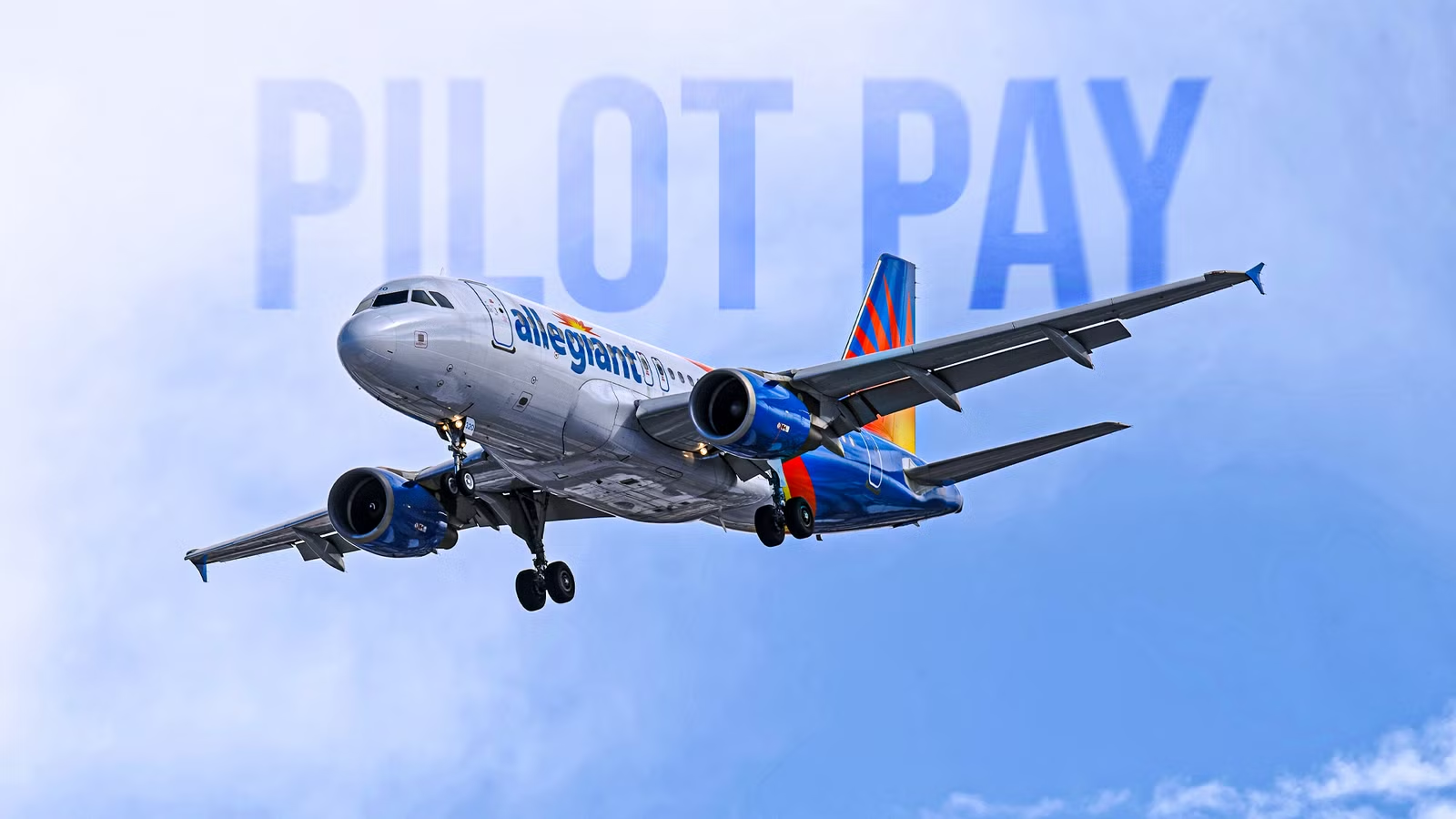
Allegiant Air’s new pilot contract is easy to describe as a big raise, but that undersells what happened on August 3rd. The pilots of Allegiant Air ratified TA26 with 79.51% of the vote, with 970 pilots voting yes and 250 voting no, and the agreement immediately lifted average hourly wages by roughly 40% while unlocking about $300 million in retention bonuses. The more important story is that a low-cost carrier has effectively acknowledged that pilot pay at the bottom of the seniority list is no longer simply another variable in the ultra-low-cost-carrier model.
For years, the airline industry could tolerate a meaningful compensation gap between low-cost carriers and the major airlines because pilots used those carriers as stepping stones, accepting lower pay in exchange for experience, seniority, and a path to a cockpit at a legacy airline. TA26 changes the economics of that bargain. Allegiant Air has dramatically narrowed the gap at the entry door, but the exit door remains wide open, because the likes of  Delta Air Lines,
  United Airlines, and
  American Airlines can still offer greater long-term earning potential, particularly for senior captains flying larger aircraft.
The Entry-Level Problem Became Too Big To Ignore

The most revealing number in the TA26 agreement is the first-year first officer rate. Before the agreement, an Allegiant Air first-year first officer earned $57.67 per hour. Under the new contract, that jumps immediately to $107.28, an extraordinary 86% increase, before rising again to $115.20 in January 2027 and $118.54 in January 2028. That is not the kind of adjustment normally associated with fine-tuning an established pay scale – it is a wholesale attempt to remove a recruiting disadvantage.
The significance becomes clearer when the new rate is compared with the major airlines. Allegiant Air’s $118.54 first-year first officer rate in 2028 is essentially level with the current $118.31 first-year rate cited for Delta Air Lines, meaning the carrier that once asked new pilots to accept a substantial financial discount is moving remarkably close to legacy-airline entry pay. For an applicant comparing offers, that changes the conversation because the traditional argument that starting at an ultra-low-cost carrier means sacrificing substantial income for a future opportunity becomes much harder to make.
That matters because pilot recruiting is no longer just about getting enough qualified applicants into a training class. The bigger challenge is keeping those pilots after they accumulate the experience required to become attractive to a major airline. Allegiant Air can raise starting pay and improve its recruiting numbers, but it cannot prevent ambitious pilots from looking at the next rung once they have the qualifications, which means TA26 is better understood as a retention strategy that begins on day one rather than a promise that pilots will stop leaving.
The Contract Rebuilds The Middle Of The Career

TA26 does not concentrate all of its money on new hires, and that is important because a contract that dramatically improved first officer pay without repairing captain compensation would simply create another retention problem later in the career. A fourth-year Allegiant Air captain moves from $185.36 to $255.67 per hour immediately, with the rate scheduled to reach $284.92 in 2027 and $293.17 in 2028. The increase therefore follows pilots as they progress rather than leaving the new first-year rate as an isolated recruiting headline.
At the senior end, a year-12 captain goes from $232 per hour to $320 immediately, followed by $345 in 2027 and $355 in 2028. Those figures represent a fundamental reset of Allegiant Air’s pilot compensation structure, especially because the old rates had remained tied to a contract that was ratified in 2016 and became amendable in 2021. The company is therefore not merely responding to one season of hiring pressure – it is catching up after years in which the labor market moved substantially beyond the previous agreement. Allegiant Air’s largest base is at Orlando Sanford International Airport (SFB), with data from the US Bureau of Transportation Statistics listing its busiest destinations from the airport as below:
Ranking | Destination | Passengers |
|---|---|---|
1 | Lehigh Valley International Airport (ABE) | 103,000 |
2 | McGhee Tyson Airport (TYS) | 96,000 |
3 | Asheville Regional Airport (AVL) | 73,000 |
4 | Grand Rapids Gerald R. Ford International Airport (GRR) | 66,000 |
5 | Bishop International Airport (FNT) | 53,000 |
Yet the numbers also show why the title of this story has two halves, as the new pay scale closes the entry-level gap much more effectively than it closes the seniority gap. A senior captain at a legacy carrier can earn roughly $388 to $402 per hour on a narrowbody, while a senior widebody captain can reach about $465 per hour, leaving Allegiant Air’s $355 ceiling meaningfully lower. The gap is smaller at the front door, but it expands again as the career progresses.
The $300 Million Retention Check Changes The Equation

The retention bonus is another reason TA26 should not be viewed simply through the hourly rate. Ratification triggered approximately $300 million in accrued retention bonuses for Allegiant Air pilots, with the money scheduled to be paid by October 1st, 2026. That is an unusually large immediate transfer of value, particularly for a carrier whose pilots had spent years working under an agreement that had become amendable.
The payment also illustrates the cost of waiting. Allegiant Air accumulated the retention obligation while negotiations continued, and the money became payable only after a new collective bargaining agreement was ratified. Pilots had staged pickets at 22 US airports in November 2025 while pressing for industry-standard compensation and better scheduling conditions. The eventual agreement therefore represents the financial resolution of a labor issue that had been building for years rather than a sudden decision made in response to one quarter of hiring data.
For individual pilots, the combination of higher hourly rates and the retention payment can materially change the near-term value of remaining at Allegiant Air. For the airline, however, the more important question is what happens after the checks are deposited. A bonus can keep a pilot from leaving today, but it cannot permanently erase the attraction of a major airline career. TA26 buys time, raises the cost of immediate attrition, and makes Allegiant Air more competitive, but it does not eliminate the underlying career ladder that has long connected smaller carriers to the majors.
Benefits & Scheduling Are Part Of The Pay Story

The contract also goes beyond headline hourly wages, with a company-funded 15% direct 401(k) contribution standing out as one of its most consequential long-term improvements. Retirement compensation matters particularly for pilots because a higher hourly rate can look impressive while still being less valuable than a compensation package that consistently builds retirement wealth over decades. By making the contribution direct and substantial, Allegiant Air is addressing a part of compensation that pilots cannot necessarily recover simply by flying more trips.
Quality of life is another significant piece of the agreement. The contract includes a five-hour minimum pay credit for each flight duty period, stronger leave protections, additional premium pay for open time, voluntary flying and junior assignments, and minimum days-off guarantees. It also provides displacement and fleet-transition protections and furlough protections connected to scheduling efficiencies (for example, the carrier is awaiting delivery of the upcoming Boeing 737 MAX 7). Those provisions matter because pilot retention is influenced by far more than the number printed beside an hourly pay rate. The latest data from ch-aviation shows that Allegiant Air currently operates a fleet of 123 aircraft:
Aircraft | Number In Fleet | Number On Order |
|---|---|---|
Airbus A319 | 28 | – |
Airbus A320 | 79 | – |
Boeing 737 MAX 7 | – | 24 |
Boeing 737 MAX 8-200 | 16 | 10 |
The agreement also moves Allegiant Air to the NavBlue Preferential Bidding System, changing how pilots express their scheduling preferences. That is the kind of contractual change that may be less visible outside the cockpit but can have a meaningful effect on everyday life. For a pilot deciding between remaining at a ULCC and pursuing a major-airline opportunity, schedule control, predictable days off, and retirement contributions can make the comparison considerably more complicated than a simple hourly-rate spreadsheet.
The Majors Still Own The Top Of The Ladder

The central weakness in Allegiant Air’s new strategy is that major-airline pay continues to offer a much higher ceiling. The carrier can make its first-year first officer rate competitive with a legacy airline, but it cannot reproduce the economics of a large network carrier operating widebody aircraft on long-haul international routes. The seniority-based progression at Delta Air Lines, United Airlines, and American Airlines ultimately provides opportunities that a narrowbody-focused ultra-low-cost carrier cannot match, particularly when larger-aircraft rates and profit-sharing are included.
That distinction is important because pilot careers are built around long-term earning potential. A new pilot might care intensely about the first-year rate because early-career finances are difficult, but a pilot with several thousand hours and a realistic path to a major airline is likely to think about what compensation could look like ten or fifteen years later. TA26 makes Allegiant Air much more competitive in the first phase of that decision, while leaving the second phase largely intact.
The result is a more complicated labor market for Allegiant Air rather than a solved labor market. A pilot can now join Allegiant Air without taking nearly as large an entry-level pay cut, collect a substantial retention payment if eligible, and enjoy stronger retirement and scheduling provisions, yet still have a powerful financial reason to leave once a major-airline opportunity appears. The pay gap has therefore been compressed rather than eliminated, which may be exactly what Allegiant Air needed but is not necessarily enough to stop the traditional flow of pilots upward.
TA26 Signals A New ULCC Reality

The broader lesson is that ultra-low-cost carriers can no longer assume that their cost advantage will automatically extend to pilot compensation. Allegiant Air has built its business around a distinctive model, but pilots are members of a national labor market in which the value of their licenses, experience, and seniority is increasingly determined by what they can earn elsewhere. When the first-year rate is nearly doubled in one contract, it becomes difficult to argue that compensation was simply an internal cost-structure choice.
The ratification vote itself reinforces that point. With 79.51% approval and 98.95% turnout, according to the detailed vote figures, pilots gave the agreement a decisive mandate. The contract delivers roughly 54% in wage increases by January 2027 compared with the previous agreement, alongside improvements in retirement, work rules and quality of life. The size of the package reflects the scale of the problem Allegiant Air was trying to solve.
Allegiant Air has consequently bought something more valuable than a headline pay increase: it has bought entry-level pay parity with the major-airline market and made the first several years of an Allegiant Air career substantially more attractive. What it has not bought is a permanent barrier against attrition to the majors, because the long-term economics still favor the largest carriers, particularly for senior pilots and widebody captains. TA26 closes the front door gap, but the career exit remains wide open.