dailynewsnblog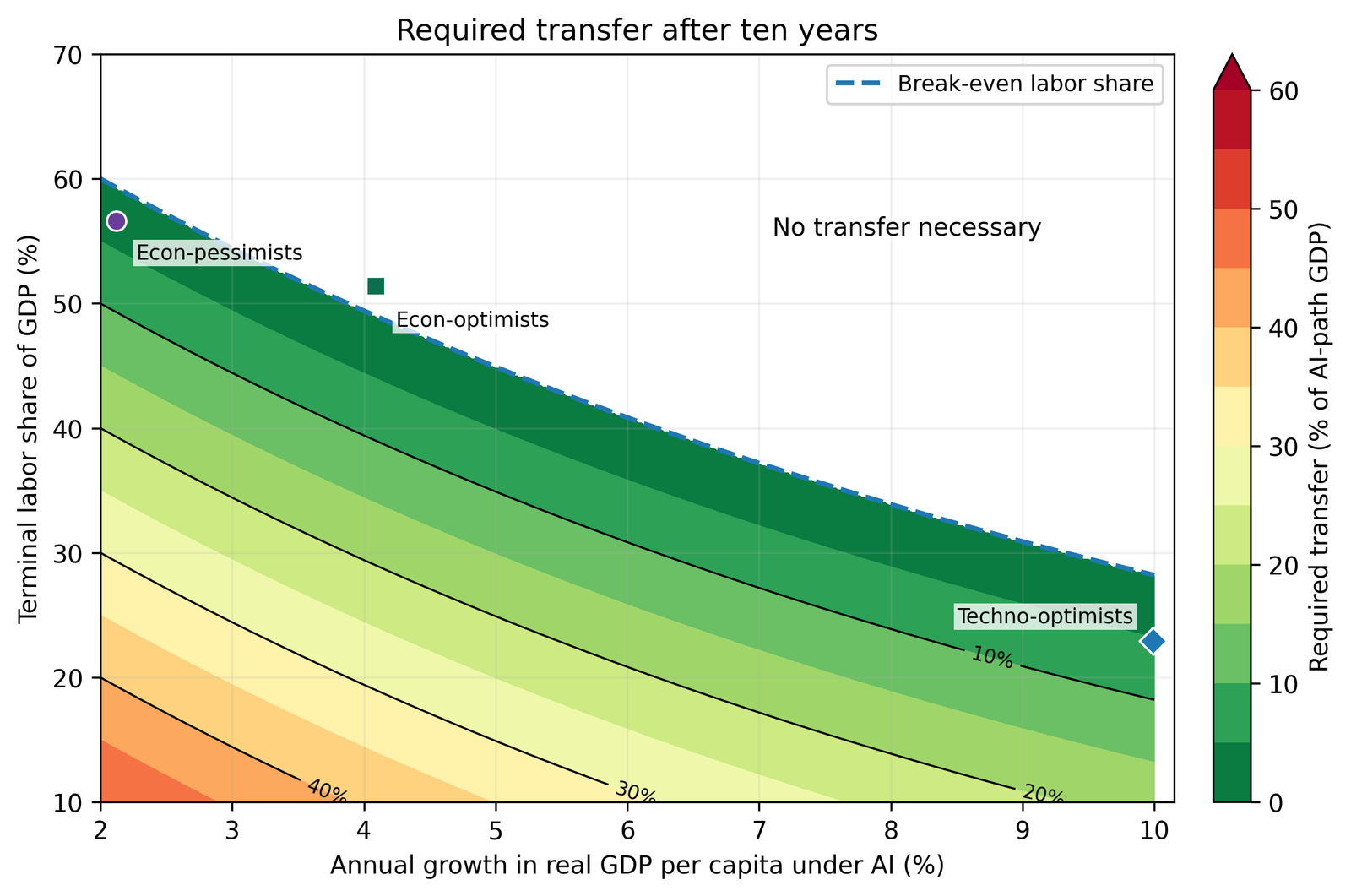
How much redistribution will AI require? A common scenario is that AI raises output enormously, but labor’s share of income collapses. GDP per capita goes up but workers get poorer, and making workers whole requires massive redistribution. In my latest paper, I run the numbers and conclude that this is probably incorrect.
The idea is simple. Labor income is GDP multiplied by labor’s share of GDP. What matters is the product. A smaller share of a much larger economy can still mean more income for labor. If the pie is growing, labor’s slice of the pie can shrink even as labor income rises.
Suppose that without AI, real GDP per capita grows at 2 percent a year and labor receives 60 percent of GDP. Now look ten years ahead. What is required to keep labor’s income growing at the same or higher rate?
If AI raises growth to 5 percent a year, GDP after ten years will be about 34 percent larger than on the no-AI path. Labor’s share can fall from 60 percent to about 45 percent and workers, in aggregate, will still have exactly as much real income as they would have had without AI.
If AI raises growth to 10 percent a year—the kind of number Satya Nadella and Dario Amodei talk about—GDP after ten years will be more than twice as large relative to the no-AI path. Labor’s share can then fall all the way to 28 percent without reducing aggregate labor income. Twenty-eight percent of an economy that has more than doubled is about the same as sixty percent of the smaller economy.
The figure shows how much redistribution is required after 10 years under a variety of scenarios.
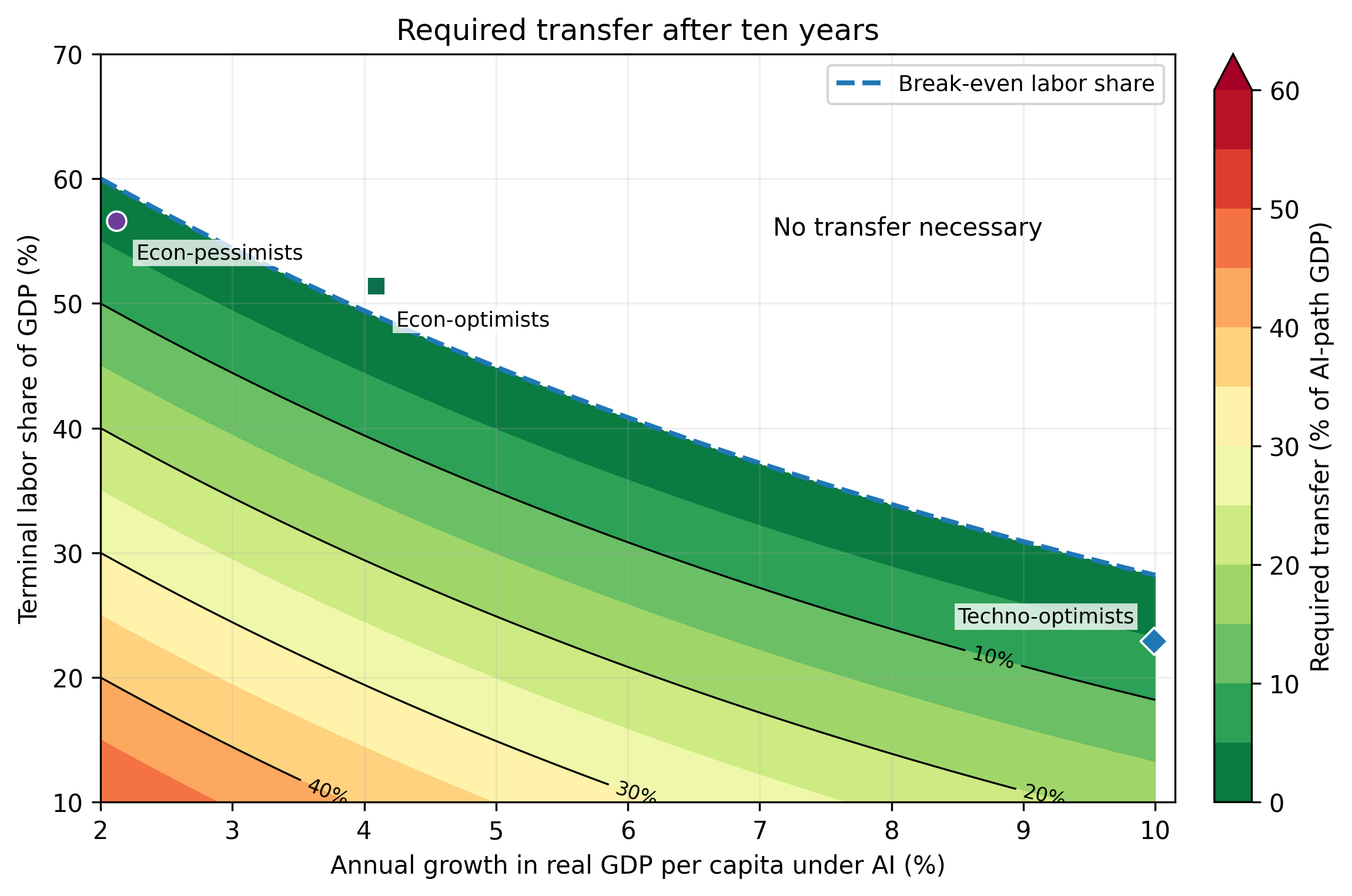
The white region above the dashed line requires no transfer. Which region are we headed for? Consider three “stylized” views.
The econ-pessimist, following Acemoglu, thinks AI displaces some but relatively few tasks because AI simply is not productive enough to replace much labor profitably. Growth is only 2.1 percent and labor’s share falls to 56.6 percent, although particular industries may still get hammered. The required transfer is 2.7 percent of GDP.
The econ-optimist, in the spirit of Tyler, myself, and Kevin Bryan, thinks automation also creates complementarities and new tasks for humans. Growth rises to 4.1 percent, labor’s share is 51.4 percent, and both labor and capital gain without any transfer.
The techno-optimist, following Amodei, has the superficially scariest labor-market scenario: three-quarters of labor income is displaced and labor’s share falls to just 22.9 percent. But productivity growth is also enormous, producing 10 percent annual growth. The transfer needed to keep labor as a whole on its no-AI path is only 5.3 percent of GDP.
That last calculation is the one I find most surprising. You can have something close to the techno-capitalist dystopia in terms of factor shares—labor gets less than a quarter of GDP—and still have a manageable redistribution problem because GDP has gotten so much larger.
Moreover, a transfer equal to 5 percent of GDP need not mean raising taxes by 5 percent of GDP. We already tax labor a lot. We could thus compensate labor by shifting from labor taxes to other taxes. Federal payroll taxes alone are about 6 percent of GDP. Cutting payroll taxes and replacing them with a broad consumption tax that also reaches spending from capital income and accumulated wealth is a form of labor compensation (plus we could have some transfers to those with no labor income).
Of course, keeping aggregate labor income whole does not mean every worker does well. There could still be enormous churn, big losses in particular occupations, and painful transitions.
Nevertheless, the larger point is that labor’s share by itself tells us surprisingly little about the distributional consequences of AI. We also need to know how much the economy grows.
If AI produces ordinary growth while dramatically reducing labor’s share, redistribution becomes very difficult. But if AI really does produce 5, 10, or 15 percent annual growth, the compensation problem is surprisingly modest even with very large displacement. As I have emphasized elsewhere, we could cut the working week in half under many scenarios and increase hourly wages above the non-AI benchmark and make both capital and labor better off.
Growth is a good problem to have.