dailynewsnblog
Display resolutions quickly become an alphabet soup that are hard to distinguish, but you can cut through the confusion.
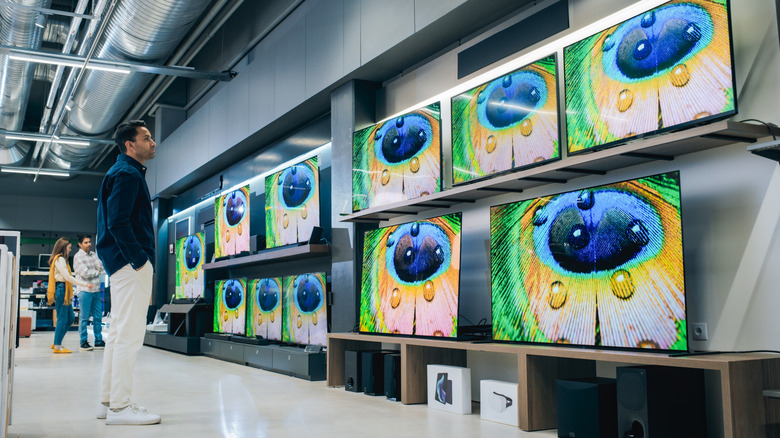
If you set out to become a display nerd, you’ll quickly realize you’re headed into a bottomless rabbit hole. You’ll start by trying to pick apart the difference between various resolutions, only to find yourself in a labyrinth of panel and backlight technology types, subpixel arrays, gamma and gamut and goblins and… wait, one of those seems wrong. The point is, it’s complicated.
Even something as simple as distinguishing between various resolutions quickly gets messy. At its core, resolution simply means how many pixels comprise a display or piece of media. If you’ve shopped for a TV, computer monitor or even a smartphone, you may have seen manufacturers refer to their products’ display resolutions using various terms.
By now, we’re familiar with 720p HD and 1080p full HD (FHD), but moving up in resolution, you’ll find 2K, QHD, and WQHD, as well as 4K and even 5K. Each of these is an umbrella term for a cluster of slightly different pixel counts, and can have different meanings depending on whether we’re talking about cameras, displays or media. For our purpose, we’ll focus on displays and how they interact with the content you view on them.
QHD and WQHD are both 2K, which is silly
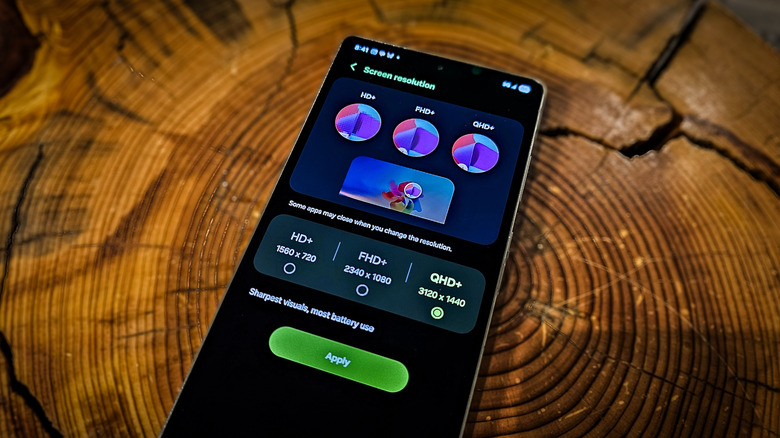
When looking at PC monitors or smartphones, you may have encountered products claiming their displays are QHD, while others boast WQHD. If the difference between the two seems hard to parse, that’s because there isn’t one. QHD stands for Quad High Definition, while WQHD stands for Wide Quad High Definition, but both refer to a resolution of 2,560 x 1,440 pixels. This is also known as 1440p or 2K.
WQHD is often used as a marketing term for monitors and phones with a widescreen 16:9 aspect ratio. Some devices, like the Samsung Galaxy Z Fold 8 (our review), do implement 2K resolutions at other aspect ratios (in the Fold’s case, 4:3). However, 16:9 is the industry standard ratio for widescreen 2K displays. Graduating to ultrawide 21:9 will put you into UWQHD (ultrawide quad HD) territory, which is 3,440 x 1,440.
2K resolutions are a sweet spot for many devices. Even though a smartphone could have a 4K display, most people would stress about the strain on its battery life before they noticed any visual improvement. And while PC gaming at 4K is rarified air for those privileged enough to afford a high-end graphics card, the best monitors for lower budgets are far more likely to pair with a system that can consistently render games at 2K.
Many productivity- and gaming-focused laptops still come with 1080p displays, with 2K being the step up. 4K laptops are still relatively rare (despite having been on the market for more than a decade) due to their prohibitive costs and limited use cases.
4K is perfect for cinema and high-end gaming
While 2K resolutions often opt for acronyms in their marketing, you’ll see fewer of these when moving up in resolution. 4K is most often sold as 4K, if for no other reason than because the public is broadly aware that the label means “very high resolution.” But many display resolutions that are accepted as 4K don’t actually hit 4,000 pixels along either axis.
Televisions are usually classified as UHD 4K, which is actually 3,840 x 2,160. This is also the resolution for 4K Blu-Ray discs. The “4K” comes from it being four times the resolution of 1080p. Meanwhile, actual 4K movies resolve at DCI (Digital Cinema Initiatives) 4K, a film industry standard of 4,096 x 2,160 pixels. That’s the resolution likely used for movies at your local theater.
This means that the 4K you’re seeing at home is a slightly lower resolution than what’s used in professional or cinematic settings. High-end gaming PCs also tend to pair well with 4K displays, as the latest and greatest GPUs (like the Nvidia GeForce RTX 5080 and 5090) can render games at high frame rates in UHD.
When is 5K the best choice?
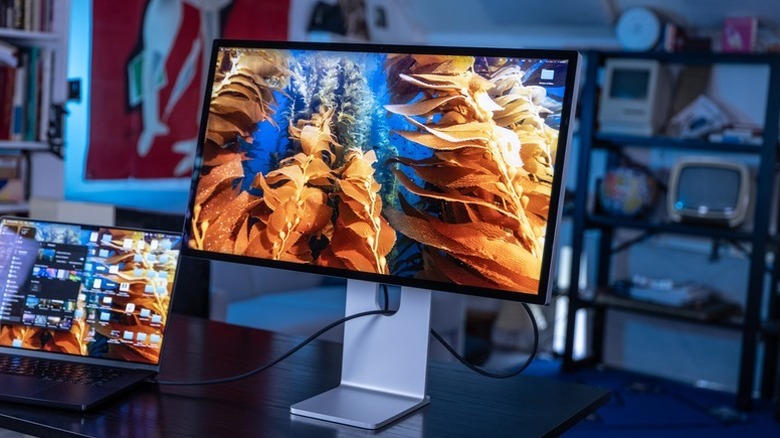
5K brings us back to monitors, as it’s a resolution often used for creative applications. There are two standard 5K resolutions: 5K UHD measures 5,120 x 2,880 pixels, while 5K Ultrawide measures 5,120 x 2,160. Others exist, but as with the variety of odd duckling resolutions included under the umbrellas of 2K and 4K, there’s no need to get bogged down in them all.
While editing photo or video, 5K monitors allow full-resolution editing of 4K content while leaving enough room onscreen for toolbars and other interfaces. The most prominent examples of 5K displays include the Apple Studio Display XDR (our review), as well as some Dell UltraSharp and LG FineGear models. These are marketed toward creative professionals rather than gamers, as gaming tends to top out at 4K for most high-end home builds.
While some 5K gaming monitors do exist, such as the LG 5K2K UltraGear evo OLED, they are far less common. These can only run games at full 5K when paired with extreme top-end consumer graphics cards, making it a prohibitively expensive setup for most.