dailynewsnblog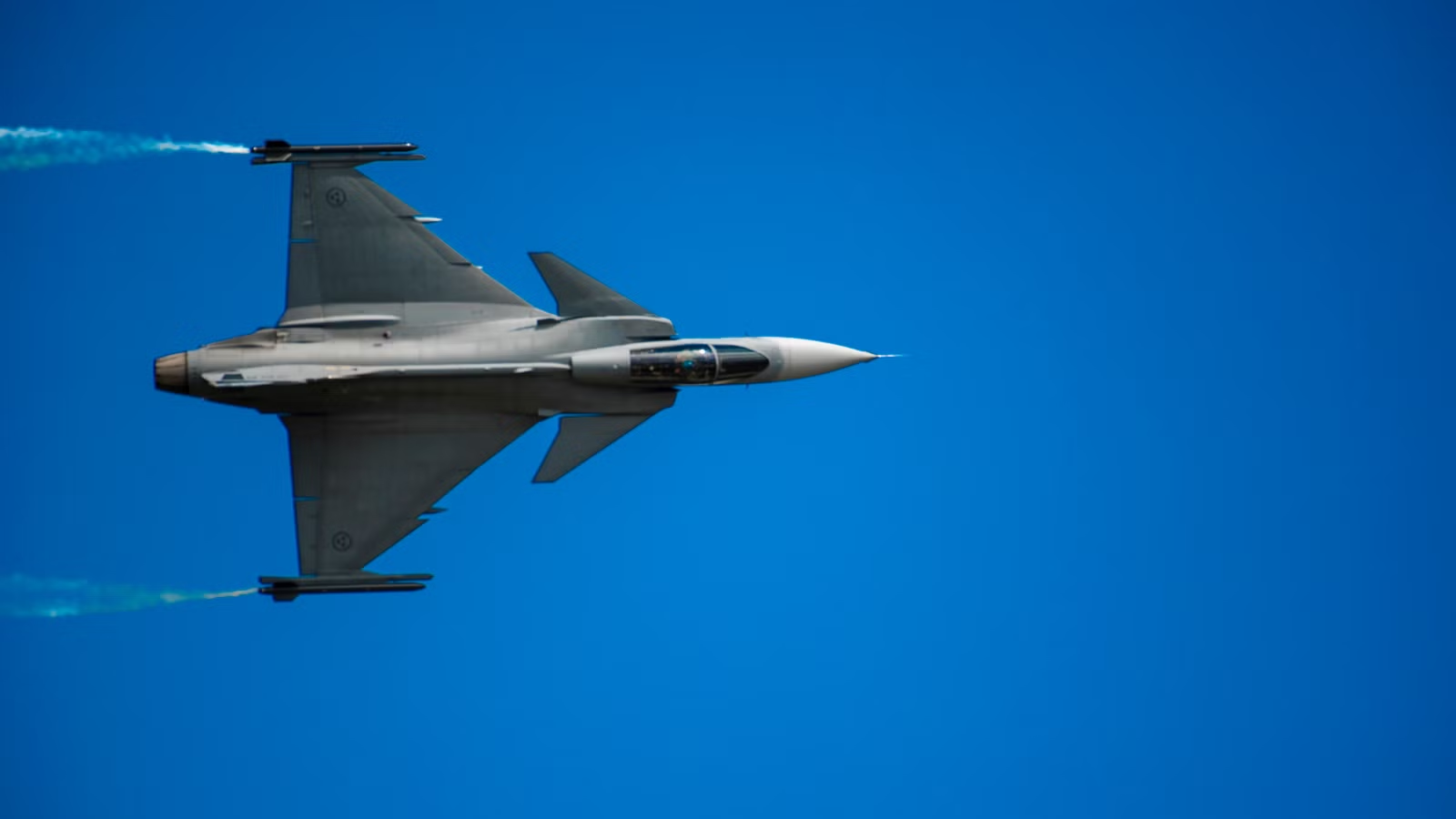
Sweden’s Saab has released a teaser trailer revealing its vision for a next-generation Collaborative Combat Aircraft (CCA), designed to operate alongside the Gripen E/F in a loyal wingman role. The concept is the clearest public glimpse yet of Saab’s plans for autonomous combat aviation as the company works to keep the Gripen family relevant well into the 2040s. With exports rising and European air forces increasingly embracing crewed-uncrewed teaming, a Swedish CCA has become the logical next step in the country’s combat aircraft strategy.
Saab’s revelation is expected, as it has previously spoken about its efforts to develop loyal wingman drones using its own funds. According to details reported by the German defense publication Hartpunkt, the unveiled aircraft is the most capable of three planned drone concepts and could enter service in the mid-2030s if it secures customers. More revealing than its existence, however, is its apparent philosophy: rather than prioritizing the low-cost, highly attritable approach being pursued in the United States, Saab’s design appears to target the higher end of the CCA capability spectrum.
12+ Advanced Western CCAs Under Development

It seems that every major aerospace contractor is developing advanced Collaborative Combat Aircraft (CCA) or loyal wingman drones. In the United States, nine companies have been identified as competing/being considered. This is known because the Air Force recognizes nine vendors competing for its CCA Increment 2 program. The Increment 2 program CCAs are to be much more advanced than the current Increment 1 CCAs (General Atomics FQ-42 and Anduril’s FQ-44).
Most of the nine vendors are known. These are Boeing (MQ-28 Ghost Bat), Lockheed Martin (Vectis), Northrop Grumman (YFQ-48 Blue Talon), Shield AI (X-Bat), Anduril, Hermeus, Kratos, and General Atomics, while the other one is not confirmed. In Germany, Airbus is developing the U760 Ravenstorm and other concepts, while the leading German project is likely to be the Helsing C-1 Europa.
In the UK, BAE Systems is developing the Brontanax, in France, Dassault is working on the nEUROn, while Turkey’s Baykar is developing the large Kızılelma. Even this is likely not an exhaustive list of advanced teaming combat drones under development across the United States and Europe. It is therefore no surprise that Sweden’s Saab has announced it too is building an advanced Collaborative Combat Aircraft.
Saab Releases Teaser CCA Trailer

In August 2026, Saab published a short video sequence on its LinkedIn account showing its concept for a CCA or loyal wingman drone. The drone is identified as A3-01. The unmanned fighter concept features a delta wing and low-observable shaping, and is designed to operate alongside crewed combat aircraft. Saab did not specify much, including its performance characteristics, development schedule, customers, or even its name.
That said, it’s reasonable to assume the Swedish Air Force could be a potential customer. Saab has released renders of CCA concepts since 2024. But the new video and the mock-up are as far as these have gotten so far. Saab is known to already be working on multiple uncrewed technology demonstrators and has presented a full-scale mock-up of an operational drone.
Rough categorization | Example CCAs in development |
|---|---|
Very high-end/stealth combat aircraft | Saab future CCA, Boeing MQ-28 Block 3, potentially Helsing C-1 Europa |
High-end CCA/loyal wingman | Early MQ-28 Blocks, Lockheed Vectis (potentially top category), Baykar Kızılelma, Northrop YFQ-48 Blue Talon, Future Anduril & General Atomics CCAs |
Medium/high end attritiable CCAs | USS CCA Increment 1 (FQ-42, FQ-44), Airbus U760 Ravenstorm |
Affordable tactical loyal wingman | German Jagdbomberdrohne concepts, possible US Navy lower-end concepts |
Interestingly, the drone appears to be on the higher end of the capability spectrum. What is often overlooked when aircraft are compared is that military aircraft are built for different environments. The US’s focus is on the vast distances of the Asia-Pacific and China. China can produce in mass quantities in a way Russia cannot. European concerns are much closer and focused on Russia, creating a very different set of requirements.
Why Sweden Has A Robust Aerospace Sector

For over 200 years, Sweden was neutral and managed to stay out of World War I (WWI), World War II (WWII), and, to a large extent, the Cold War. That said, the Cold War did see the country increasingly align with the Western bloc. Between 1945 and 1972, Sweden had a nuclear program. This was enormously expensive for a small country and controversial at the time.
One of the primary reasons why Sweden felt like it needed nukes was because it was unaligned, while the USSR was the clear threat. In other words, it had de facto enemies without formal friends. Eventually, Sweden canceled its nuclear program and channeled its limited resources into maintaining a large conventional military, with as much sovereign military industry as was practical.
This is a large reason why Sweden has invested so heavily in its military aerospace sector and why it is one of a handful of countries to design and manufacture advanced fighter jets today, with the Gripen E being its flagship product. In 2024, Sweden formally joined NATO, formalizing a NATO drift that had been going on for decades. While the country’s strategic situation has changed, it retains an impressively large military aerospace sector for a small country.
Saab’s Sixth-Gen Conundrum

Sweden is in a difficult position about where to go from the Gripen E. The Gripen E first entered service in 2025 and is set to remain in production through the 2030s, but Saab must already start planning its eventual replacement. The UK, Italy, and Japan are working to develop the sixth-generation GCAP/Tempest fighter jet to replace the Eurofighter and F-2 (Japanese F-16 derivative).
However, developing a true sixth-generation fighter is incredibly expensive for any country. GCAP is backed by three of the top ten economies and aerospace sectors, and even so, it strains those countries’ resources. Italy has repeatedly said it would like more countries to join to share the burden. The prospect of Saab and Sweden going it alone and developing a next-generation successor to the Gripen is daunting to outright infeasible.
Sweden has independently developed combat aircraft for decades. A potential lifeline has been the collapse of the Franco-German FCAS program. Germany is considering its options, which include joining GCAP or developing a new fighter in partnership with Sweden and/or Spain. But even here, Saab would likely be a junior to Germany’s Airbus and MTU Aero Engines. Additionally, one way for Saab to maintain a somewhat independent aero combat program is developing a Collaborative Combat Aircraft.
Saab’s Higher-End CCA

Sweden is known to be investigating the feasibility of developing a Gripen replacement. But little has been publicly released, and much may rest on what Germany does. However, developing a Collaborative Combat Aircraft is an obvious project. The barriers to entry are far lower than developing a next-generation manned frontline fighter jet.
Saab said, “The future of air combat is not just about a single aircraft – it’s about a seamless system of systems. We are proud to present our concept for a future Unmanned Fighter System. Building on Swedish aviation heritage, this platform is designed to operate in tandem with manned aircraft, ensuring maximum flexibility and safety in the most contested environments. Designed for multi-domain operations and cooperation across the air, land, maritime, space, and cyber domains.”
Saab is developing the autonomous combat aircraft with its own money. What’s noticeable is that Saab appears to be targeting the higher end of the capability spectrum. The USAF is currently targeting good enough with Increment 1 before moving on to Increment 2. However, core USAF requirements include range, affordability, and attritability. A Swedish CCA likely wouldn’t require the same range, since Europe is vastly smaller than the Asia-Pacific. Saab may be considering a more capable autonomous fighter-jet-like platform, such as the Boeing MQ-28 Ghost Bat, rather than smaller expendable autonomous drones.
Saab Is Working On Three CCA Projects

Saab is currently developing three different CCAs or ACPs (Automatic Combat Programs). The mock-up shown in the video is the most advanced of these three programs (ACP 03). But Saab is also developing ACP 01 and 02, which, according to Germany’s Hartpunkt, are intended for the Swedish Armed Forces. Of these, ACP 01 is expected to make its maiden flight in 2027, around 15 months from the time of writing (August 2026).
This will demonstrate Saab’s ability to successfully launch unmanned aircraft with stealth features. Importantly, Hartpunkt says that the aircraft is expected to use the same GE F414 engine found on the Gripen E/F. Externally, the ACP 01 is rumored to resemble the 03 design closely, though it will have outwardly sloping tail fins. The ACP 02 is set to be the odd one out. While it will use the F414 engine, it will not externally resemble the other two.
According to Hartpunkt, the ACP 02 will make its maiden flight in the late 2020s and will serve as a test platform for weapons deployment and other technologies. The ACP 03 is in a very early stage of development and depends on a potential customer order. The early 2030s are the likely start date for flight testing, which implies an in-service date in the mid-2030s.
Catch what other trackers miss
Emergency squawks, holds, NOTAMs — live signals, no signup.
Open tracker
Catch what other trackers miss
Emergency squawks, holds, NOTAMs — live signals, no signup.
Open tracker