dailynewsnblog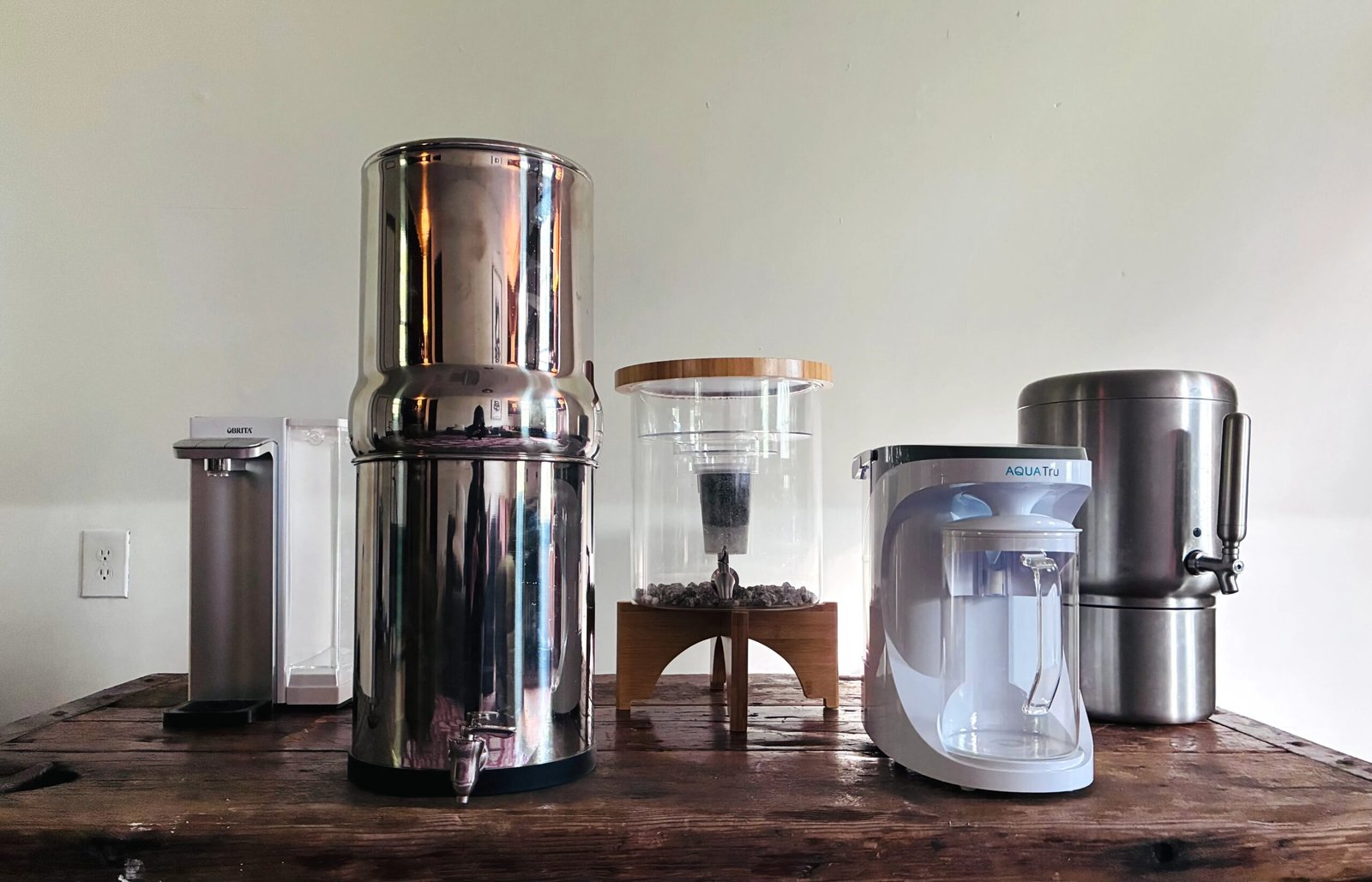
You can filter water at nearly any point in its path before it gets to you. There are whole-house systems, which filter water as is enters from the well or municipal pipes, but most are expensive and can be a hassle to install. Filter pitchers are easy but don’t hold much water, and they are limited in what they can remove.
Our Picks

Bottom Line
Plain and simple, AquaTru’s Carafe boasts the most impressive credentials among the countertop models we tested. The 4-stage reverse osmosis s…
Pros & Cons
-
Certified to remove the most contaminants of any countertop filter tested -
Small frame -
Pitcher can be kept in the fridge -
Long 300-gallon filter life -
Easy to operate
-
Hefty upfront cost -
Strips water of most minerals -
Requires electricity

Bottom Line
Of the many gravity countertop systems on the market, only Culligan’s is tested and certified to remove microplastics, lead, total PFAS and di…
Pros & Cons
-
One of the few gravity carbon filters certified to remove contaminants -
Sleek stainless-steel look with very little plastic used -
Large water tank -
Affordable upfront
-
Filters slowly -
Filters are expensive and have a relatively short lifespan

Bottom Line
Simply put, this was my favorite of the water filters I tested. Even though it doesn’t carry certifications like some of the others, it’s the …
Pros & Cons
-
Has a eye-catching keg design that always draws compliments -
I love the pour handle and removeable reservoir -
Easy to refill when empty, and changing the filter takes seconds -
Special filter is engineered to remove PFAS, lead and microplastics while preserving minerals -
The low profile and slim base won’t overpower your countertop -
Has a filter life indicator
-
Carries no official certifications -
More expensive than most gravity systems

Bottom Line
The Brita Hub packs a ton of certified water-filtering punch for the price. At under $200, it’s one of the more affordable units we evaluated,…
Pros & Cons
-
Budget friendly at under $200 -
Replacement filters are cheap -
Certified to remove 70 contaminants -
Filters and dispenses instantly -
The smallest, lightest unit we tested
-
Struggled with TDS -
Plastic build is cheaper than others -
Requires electricity to function

Bottom Line
Santevia’s activated charcoal filter system is an outlier among our picks. It not only filters out contaminants with activated charcoal, but o…
Pros & Cons
-
Remineralizes water after filtering -
Made from mostly natural materials -
Fast filter/flow rate -
Filters are cheap to replace
-
Not certified to remove contaminants -
Glass chamber requires diligent cleaning -
Expensive upfront cost -
Short filter lifespan

Bottom Line
The WaterDrop filter system uses a beefed-up 5-stage reverse osmosis filter and a UV feature to kill potential bacteria.While it’s not certifi…
Pros & Cons
-
Heats or cools water prior to dispensing -
Efficient for a reverse osmosis system (less wastewater) -
Longest lasting filter by far -
Performed well in Tap Score lab testing across all categories -
Sleek design
-
No contaminant removal certification -
Priciest unit on our list -
Getting the pitcher to fit securely takes practice -
Extra functions mean more elements that can break
A happy medium is countertop water filters. These small-ish tanks sit beside your toaster and often have more capacity than pitchers, but don’t require wrenches and screws — or, let’s be honest, a professional — to install.

We tested eight of the most powerful countertop water filter systems.
If you’re wondering if you even need a water filter, the answer is probably yes, but it depends on where you live and how old your plumbing is. Most municipal water in the US doesn’t represent an immediate health threat, but we’re still outside the top 25 for global water quality, according to the Environmental Performance Index.
Beyond harmful contaminants leached from old pipes and faulty systems, there are newer concerns about per- and polyfluoroalkyl substances (forever chemicals, also known as PFAS) and microplastics entering water supplies, as well as residues and byproducts from water treatment facilities.
Read more: The Best Water Filter Pitchers for 2026
To find the best, we relied on certifications from top regulatory bodies, including the National Sanitation Foundation and the American National Standards Institute. We interviewed water quality experts and partnered with Tap Score, a leading home water testing service, to test the efficacy of water filters not yet certified by regulatory bodies.
What’s the best countertop water filter?

The AquaTru is certified to reduce up to 84 water contaminants.
David Watsky/CNET
With more certifications than any other model and a slight, intuitive frame, the easy-to-operate AquaTru Carafe is the best and most complete countertop water filter. But the Carafe it might not be the perfect match for your home. (Spoiler: it’s not the one I use in mine).
Here are six of the best countertop filters for cleaner water in 2026.
Best countertop water filters for 2026
Best overall countertop water filter
AquaTru Carafe
-
Certified to remove the most contaminants of any countertop filter tested -
Small frame -
Pitcher can be kept in the fridge -
Long 300-gallon filter life -
Easy to operate
-
Hefty upfront cost -
Strips water of most minerals -
Requires electricity
Plain and simple, AquaTru’s Carafe boasts the most impressive credentials among the countertop models we tested. The 4-stage reverse osmosis system is certified by IAPMO to remove PFOA and PFOS, lead, fluoride, chlorine, and microplastics, among other contaminants (84 in total).
One attractive feature of this model is its size. Its modest build doesn’t disrupt your countertop setup as much as other RO systems on the market. It was easy to set up and use, and the water, slowly filtered and dispensed, tasted clean, if not a little flat. The glass pitcher can be stored in the fridge to chill after it’s been filled.
The filters are good for 600 gallons (roughly six months) before a replacement is required, though the three filters used with this system have different lifespans and will need to be replaced at different times. The carbon filters last 600 and 1,200 gallons, respectively, while the larger reverse osmosis filter lasts for about 2,400 gallons or two years. A replacement pack of carbon filters costs $54.
Reverse osmosis systems require electricity and a little more manual work than other systems. This filtering method produces wastewater, which is discharged into a back tank and should be discarded after each cycle.
This water filter strips the most contaminants from water with certifications to prove it.
- Filter type
- Reverse osmosis (4-stage)
- Certified to remove
- PFAS, lead, fluoride, chlorine, chloramine, microplastics, total dissolved solids, pesticides and emerging contaminants.
- Carafe capacity
- 64 oz.
- Flow rate (gallons per hour)
- 0.3 gph
- Filter lifespan
- 300 gallons
- Replacement filter cost
- $54
- Materials
- Plastic
- Price
- $375
Best budget water filter
Culligan Gravity with MaxClear
-
One of the few gravity carbon filters certified to remove contaminants -
Sleek stainless-steel look with very little plastic used -
Large water tank -
Affordable upfront
-
Filters slowly -
Filters are expensive and have a relatively short lifespan
Of the many gravity countertop systems on the market, only Culligan’s is tested and certified to remove microplastics, lead, total PFAS and disinfectant byproducts, which affect the taste and smell of tap water. All that filtering power is a steal at just $175 for the 2.5-gallon model.
If you prefer the refined look of stainless steel over plastic for a freestanding water filter that requires no electricity, the Culligan with MaxClear filter is the pick. Culligan’s MaxClear gravity filter uses a ceramic outer shell to trap large particles, followed by activated carbon to reduce chlorine and a core layer of high-flow carbon block to reduce or remove lead, PFAS, and pesticides.
The double filter system was one of the easiest to install and replace, which is good because they’ll need to be replaced more often than a reverse osmosis filter. A pair of Culligan’s MaxClear filters costs $128 and is good for roughly 100 gallons of filtered water — up to six months, depending on usage. There’s no automatic indicator for when filters need to be replaced, so you’ll have to keep track on your own.
The Culligan dispenser comes in two sizes, 2.5 and 3 gallons, priced at $175 and $199, respectively. The filters are designed to work with other dispensers, including most Berkey, Boroux and ProOne units.
An affordable gravity system with a few key certifications.
- Filter type
- Ceramic and carbon
- Certified to remove
- Microplastics, lead, PFAS, chlorine, pharmaceuticals and pesticides.
- Tank capacity
- 2.5 or 3 gallons
- Flow rate (gallons per hour)
- 0.3
- Filter lifespan
- 100 gallons
- Replacement filters
- $128 (2-pack)
- Materials
- Stainless steel
- Price
- $175 – $200

Rorra’s unique submicron filter removes microplastics and PFAS without stripping minerals. / David Watsky
A stylish option that leaves healthy minerals behind
Rorra
-
Has a eye-catching keg design that always draws compliments -
I love the pour handle and removeable reservoir -
Easy to refill when empty, and changing the filter takes seconds -
Special filter is engineered to remove PFAS, lead and microplastics while preserving minerals -
The low profile and slim base won’t overpower your countertop -
Has a filter life indicator
-
Carries no official certifications -
More expensive than most gravity systems
Simply put, this was my favorite of the water filters I tested. Even though it doesn’t carry certifications like some of the others, it’s the one I keep on my own kitchen counter and much of that has to do with ease of use and a snazzy look. The Rorra is sharp, with a keg-like design and an easy pull-handle spout. It sports a subtle and chic brushed stainless finish, and the slim base makes it easy to find room for it on the counter.
Beyond its aesthetic appeal, the Rorra is easy to use. I never mind carrying the reservoir, which detaches from the base, over to the sink for refilling, and changing the filter out is also simple. This is also one of the few gravity filters with a filter life indicator, which turns from white to yellow when you’re nearing the end — under 25 gallons left — and red when it’s time to change.
The $549 gravity filter uses a dual-layer pleated electrokinetic nanofiber filter that’s designed to remove PFAS, lead and microplastics while preserving minerals. This partial filter is not meant to strip water as completely as reverse osmosis; instead, it uses a positive charge to attract and trap negatively charged particulates at high flow rates.
The Rorra isn’t certified by the top regulatory bodies to remove contaminants — likely due to the expense — but it has plenty of third-party testing to demonstrate its filtering power. In our independent testing, it reduced fluoride from 26 ppm to 7 ppm and lowered disinfectant byproducts to below Tap Score’s reporting level. This system also added a harmless amount of aluminum, likely leached from the container.
A stylish plastic-free water filter that’ll remove contaminants and attract compliments.
- Filter type
- electrokinetic nanofiber
- Certified to remove
- N/A
- Tank capacity
- 2.5 gallons
- Flow rate (gallons per hour)
- 2
- Filter lifespan
- 200 gallons
- Replacement filter
- $65 with subsciption and $75 without
- Materials
- Stainless steel
- Price
- $449-$549
Best fast-flow water filter
Brita Hub
-
Budget friendly at under $200 -
Replacement filters are cheap -
Certified to remove 70 contaminants -
Filters and dispenses instantly -
The smallest, lightest unit we tested
-
Struggled with TDS -
Plastic build is cheaper than others -
Requires electricity to function
The Brita Hub packs a ton of certified water-filtering punch for the price. At under $200, it’s one of the more affordable units we evaluated, but it doesn’t shortchange on performance. The Hub is certified by the IAPMO and WQA to reduce over 70 contaminants, including lead, chlorine, pharmaceuticals and microplastics.
While the Brita Hub performed well in testing — it reduced fluoride from over 26 ppm to just 8 ppm — and boasts meaningful certifications, it did struggle to remove total dissolved solids in our Tap Score testing. Those include calcium, magnesium, potassium, sodium, bicarbonates, chlorides, and sulfates. Most aren’t considered harmful but can affect water’s taste, odor and hardness.
One of the Hub’s advantages is instant dispensing. Some filters take as long as 2 hours to filter a single gallon of water, but this Brita model pushes right through to your glass for immediate hydration.
The compact dispenser’s build is also cheaper and flimsier than that of other units on the list. That said, it’s more than $100 cheaper than the AquTru RO system, and its replacement filters are the second cheapest among the models we evaluated. A single Brita Hub filter lasts for 120 gallons and costs just $30.
Not big on looks but great for fast filtering at an approachable price.
- Filter type
- Pressurized carbon block
- Certified to remove
- Lead, chlorine, chloramine, total dissolved solids (TDS), PFAS and emerging contaminants.
- Reservoir capacity
- 96 oz.
- Flow rate
- Instant
- Filter lifespan
- 120 gallons
- Replacement filter cost
- $30
- Materials
- Plastic
- Price
- $195
Best for adding minerals to water
Santevia
-
Remineralizes water after filtering -
Made from mostly natural materials -
Fast filter/flow rate -
Filters are cheap to replace
-
Not certified to remove contaminants -
Glass chamber requires diligent cleaning -
Expensive upfront cost -
Short filter lifespan
Santevia’s activated charcoal filter system is an outlier among our picks. It not only filters out contaminants with activated charcoal, but once water passes through the filter stage, stones below remineralize it with calcium, potassium and magnesium.
Water that is completely stripped of minerals is thought to taste flat, and adding minerals back for taste and better absorption is where Santevia stakes its claim.
While the Santevia holds no official certifications for contaminant removal, it performed well in our Tap Score test. The gravity system specifically reduced fluoride from 26 ppm to just over 2 ppm. It also brought THMs (disinfectant byproducts) down to zero.
As expected, the remineralizing stones raised the water’s total dissolved solids from 221 ppm to 247 ppm. It also raised the alkalinity from 42 ppm to 123 ppm. Indeed, the water we sipped from the Santevia had a fuller taste than the water from others that strip minerals without adding them back.
For lovers of mineral water, this system adds in as much as it strips out.
- Filter type
- Activated carbon
- Reservoir capacity
- 2.1 gallons
- Flow rate (gallons per hour)
- 1
- Certified to remove
- N/A
- Filter lifespan
- 80 gallons
- Replacement filter cost:
- $21
- Materials
- Glass, bamboo, plastic
- Price
- $320
Best for dispensing hot and cold water
WaterDrop A2
-
Heats or cools water prior to dispensing -
Efficient for a reverse osmosis system (less wastewater) -
Longest lasting filter by far -
Performed well in Tap Score lab testing across all categories -
Sleek design
-
No contaminant removal certification -
Priciest unit on our list -
Getting the pitcher to fit securely takes practice -
Extra functions mean more elements that can break
The WaterDrop filter system uses a beefed-up 5-stage reverse osmosis filter and a UV feature to kill potential bacteria.
While it’s not certified to remove any contaminants, our testing showed the filter’s power, raising the Tap Score from 39 to 84 (out of 99). It removed the most fluoride out of any filter we ran our fluoridated water through. It also dropped the total dissolved solids from over 200 ppm to 20 ppm and THMs to 0, the best results of any filtered sample we sent to Tap Score.
The WaterDrop A2 has one advantage over the other units — the ability to dispense hot water for tea or pour-over coffee, in addition to room-temperature water. The A2 can deliver filtered water at six different temperatures between 59 and 203 degrees Fahrenheit, controlled via the unit’s digital controls.
Of the reverse osmosis systems we evaluated, WaterDrop’s has the biggest physical footprint, so you’ll need to make space on the counter. The pitcher, sleek and made of high-grade plastic, was difficult to pour from without spilling. The pitcher is also somewhat finicky when placed in the larger unit. If it’s not seated properly, there is leaking, or the various filter and flush cycles won’t engage.
Learning the controls and various functions on the A2 took some getting used to. The initial flush function, for instance, required a close reading of the manual to execute properly. If you’re looking for a simple plug-and-play filter system, the A2 might not be the best option.
Unlike the AquaTru Carafe, which utilizes three separate filters, WaterDrop runs its 5 stages of filtration through one composite filter with layers of cotton, a carbon block and a reverse osmosis membrane to catch impurities. A single filter is advertised to filter 1,100 gallons, the most of any filter system we evaluated. Replacements cost $70.
For instantly filtered water at any temperature.
- Filter type
- Reverse osmosis (5-stage)
- Certified to remove
- N/A
- Pitcher capacity
- 40 oz.
- Tank capacity
- 159 oz.
- Filter lifespan
- 1,100 gallons
- Flow rate (gallons per hour)
- 4.2
- Replacement filter cost
- $70
- Materials
- Plastic
- Price
- $499
Contaminant removal certifications
| AquaTru Carafe | Culligan MaxClear | Brita Hub | WaterDrop A2 | Santevia | Rorra | |
| Lead | ✅ | ✅ | ✅ | ❌ | ❌ | ❌ |
| Disinfectant byproducts | ✅ | ✅ | ✅ | ❌ | ❌ | ❌ |
| PFAS | ✅ | ✅ | ✅ | ❌ | ❌ | ❌ |
| Microplastics | ✅ | ✅ | ❌ | ❌ | ❌ | ❌ |
| Total dissolved solids (TDS) | ✅ | ❌ | ❌ | ❌ | ❌ | ❌ |
| Emerging contaminants | ✅ | ❌ | ✅ | ❌ | ❌ | ❌ |
| Flouride | ✅ | ❌ | ❌ | ❌ | ❌ | ❌ |
| Pesticides | ✅ | ✅ | ✅ | ❌ | ❌ | ❌ |
How we test and evaluate countertop water filters

We sent samples of filtered water to Tap Score, an independent water-quality lab, for evaluation.
David Watsky/CNET
To curate this list of countertop water filters, we relied on a combination of official certifications from regulatory bodies and lab testing with help from Tap Score.
Filters that earned certifications, including our top pick, the AquaTru Carafe, and the Culligan Gravity System, have already been through rigorous regulatory testing, so we saved lab testing for filter systems that haven’t been certified to see how they stack up against their claims.

Results were ready within a few business days.
David Watsky/CNET
To test six of the water filters, we fluoridated the city tap water by adding a small amount of sodium fluoride. We ran 1 liter of fluoridated tap water, all drawn from the same vat of source water, through each filter according to the filter’s directions. We then sent it to Tap Score for evaluation. Within a few days, results were ready in Tap Score’s portal for each sample. We reviewed the results of the filtered water, guided by Tap Score’s trained water quality experts.

Tap Score’s evaluation showed where the issues were in our prefiltered water and how well each filter improved its composition.
Screenshot by CNET
Tap Score’s comprehensive results were especially useful, as they highlighted specific areas of concern in the water. The baseline tap water sample, for instance, had concerning levels of disinfection byproducts, including chloroform, a known carcinogen.

In a separate test, we chlorinated tap water to further evaluate filter performance.
David Watsky/CNET
In a separate test, we chlorinated tap water using basic pool chlorine. We ran a liter of chlorinated water through each filter and tested it with strips to see how well each filter removed the common disinfectant. This test could not be performed by Tap Score’s lab since chlorine evaporates somewhat quickly.
We also smelled and tasted tap water filtered from each unit, side by side with unfiltered water, to see how the filtering process changed the profile. Reverse osmosis systems, including the AquaTru Carafe and WaterDrop, remove almost everything from water, leaving it with a clean, somewhat flat taste. The most noticeable change came from the Santevia filter, which remineralizes water with sodium, magnesium and potassium, imparting a salty, slightly earthy body.

The US is currently outside the top 25 for global water quality.
mrs/Getty
The baseline water was also high in fluoride since we added it. This allowed us to evaluate how well the filters, particularly reverse osmosis filters, remove fluoride, which can serve as a proxy for contaminants in water. Our tap water before filtering had an overall score of just 39 out of 99.
Countertop water filters compared
| AquaTru Carafe | Culligan MaxClear | Brita Hub | WaterDrop A2 | Santevia | Rorra | |
| Filter type | Reverse osmosis | Carbon, ceramic | Carbon | Reverse osmosis | Carbon | Electrokinetic nanofiber |
| Contaminant types reduced or removed (certified) | 84 | 13 | 70 | 0 | 0 | 0 |
| Replacement filter cost | $54 | $128 | $30 | $70 | $21 | $65 |
| Filter lifespan | 600 gallons | 100 gallons | 120 gallons | 600 gallons | 80 gallons | 200 gallons |
| Upfront cost | $325 | $175 | $195 | $409 | $320 | $549 |
Other filters we tested and liked
None of the filters we tested performed badly. The three filters below, while not at the top of our list, all performed well at removing tap water’s disinfectant byproducts and the fluoride we added.

None of the filters bombed our tests. Still, some didn’t make the cut.
David Watsky/CNET
Boroux: This $320 gravity filter system is the de facto successor to Berkey, the popular filters that were subject to an Environmental Protection Agency stop-sale order in 2023.
Boroux manufactures similar activated charcoal filters that are compatible with Berkey dispensers. These filters are WQA-certified to reduce disinfectant byproducts and emerging contaminants, including microplastics. The filter performed well in our Tap Score tests, removing any reportable levels of disinfectant byproducts and reducing fluoride from 26 ppm to 5 ppm. The system added a harmless amount of aluminum, likely leached from the metal container.

Rorra’s unique submicron filter removes microplastics and PFAS without stripping minerals.
David Watsky/CNET
Sans Water Purifier: This $380 compact reverse osmosis filter lacks official certifications, but it performed well in our testing. It brought fluoride down below Tap Score’s reporting threshold and THMs (disinfectant byproducts) to zero. It also brought total dissolved solids down from 221 ppm to 38 ppm — a good showing, but not as good as WaterDrop.
Water filtered by the Sans unit contained a trace amount of antimony (0.0069 ppm), which Sam Bear, senior research scientist at Tap Score, suggested was likely leached from the unit’s plastic components.
Water filter buying guide: Factors to consider
What’s in your water?
The best place to start is by testing your own water to identify the issues. Roughly 85% of homes in the US use municipal or city water, which is closely monitored, tested and treated. That said, the city has no control over what happens to your water once it reaches your home.
Old pipes and faulty systems within your home can leach harmful contaminants, including lead, copper, and plasticizers, into water. As water scientist Dr. Eric Roy explained to CNET, “Your neighbor might not have lead in their water, but that doesn’t mean you don’t.”
Getting your water tested through a reputable lab, such as Tap Score, can help you determine what’s in your water and decide on the best course of action, including which filter to use.

My city tap water had concerning levels of disinfectant byproducts.
David Watsky/CNET
You can also test your water for PFAS (forever chemicals), microplastics, agricultural pesticides, bacteria, disinfectant byproducts and other contaminants.
Those with well water are encouraged to test it once a year, as it is more susceptible to bacteria, nitrates and high levels of total dissolved solids. Tap Score offers an at-home test kit specifically for well water.
Type of filters

Knowing what’s in your water can help you pick the best filter.
David Watsky/CNET
Once you know what’s in your water, you can make an informed decision about the type of filter to buy.
- Reverse osmosis: Using a fine membrane, this is the most complete filter among consumer types. Reverse osmosis filters are also the gold standard for removing lead, PFAS and fluoride. They require electricity and generate wastewater during filtration.
- Charcoal/carbon: Not as powerful as reverse osmosis, carbon or charcoal filters are cheaper upfront, but typically have a shorter lifespan. Many systems use gravity instead of electricity to force water through carbon filters.
- Ion exchange: Specialty filter that uses electropositive charge to bind certain contaminants, while leaving some minerals and heavy metals in water.
Water filter certifications: Official certifications vs. filters tested to meet standards
Official water filter regulatory bodies set some of the highest standards, and there are currently four widely recognized certifications for water filters.
The National Sanitation Foundation and the American National Standards Institute (ANSI) are the two main drivers and developers of water filter performance standards. Water Quality Association and the International Association of Plumbing and Mechanical Officials are ANSI-accredited, third-party laboratories that test products against NSF/ANSI standards.
Water filter manufacturers can choose to submit their products for various contaminant-removal certifications with one of these four bodies. Because of the high cost — filters must undergo expensive testing for individual contaminants — many choose to test to NSF/ANSI standards in their own non-ANSI-accredited labs. These tests and results are not regulated and thus carry less weight than those from official, accredited laboratories.
Cost and usability
The best filter is ultimately the one that targets your water pain points and fits into your lifestyle. Water filter pitchers are the easiest and cheapest options, but most have limitations on what they can filter.
Whole-house systems filter water as it enters your home, not just the drinking water, so these are best if you’re concerned about hard bathing water or volatile organic compounds and disinfection byproducts entering the air through your shower. These systems are often the most expensive and require installation.

Whole-house systems are the most expensive and require installation to boot.
John Carlsen/CNET
Countertop models like the ones we tested are somewhere in between. Many offer more complete filtration than filter pitchers, but without the installation headache associated with whole-home filters. That said, they require cleaning and maintenance and take up real estate on your kitchen counter or elsewhere.
Are Berkey water filters safe to use?

We chose not to test Berkey units after the EPA ordered a stop sale of its black filters in 2023.
Berkey USA
In 2023, the EPA ordered a stop sale of Berkey Black Filters, labeling them as unregistered pesticides under the Federal Insecticide, Fungicide and Rodenticide Act. The filters were found to contain silver to prevent bacterial growth, although no testing has found that the silver leaches into drinking water.
Berkey claims the stop-sale is largely a classification issue, and its water filters are still generally considered safe to use despite the EPA’s intervention. Out of an abundance of caution, we’ve chosen not to test or recommend Berkey filters for this list.
Experts we interviewed for this article
Sam Bear – Senior research scientist, Tap Score
Johnny Pujol – Water quality engineer and CEO of SimpleLab
Dr. Eric Roy – Water scientist, founder of Hydroviv
Water filter FAQs
What’s the strongest water filter?
Reverse osmosis systems are generally the most powerful type of at-home water filter.
How often should you replace a water filter?
This depends on the filter type, quality and size. Some reverse osmosis filters can clean up to 2,000 gallons, while certain carbon filters must be replaced after 100 gallons or fewer.
What are the most common contaminants in tap water?
Lead, arsenic, PFAS, microplastics, and disinfectant byproducts such as chloramine are among the most common contaminants found in household water.
Is it OK to drink water with chlorine?
Low levels of chlorine and other disinfectant byproducts used to treat city water are commonly found in tap water. They can affect the taste and odor of water, but are not considered dangerous to consume.

See full bio