dailynewsnblog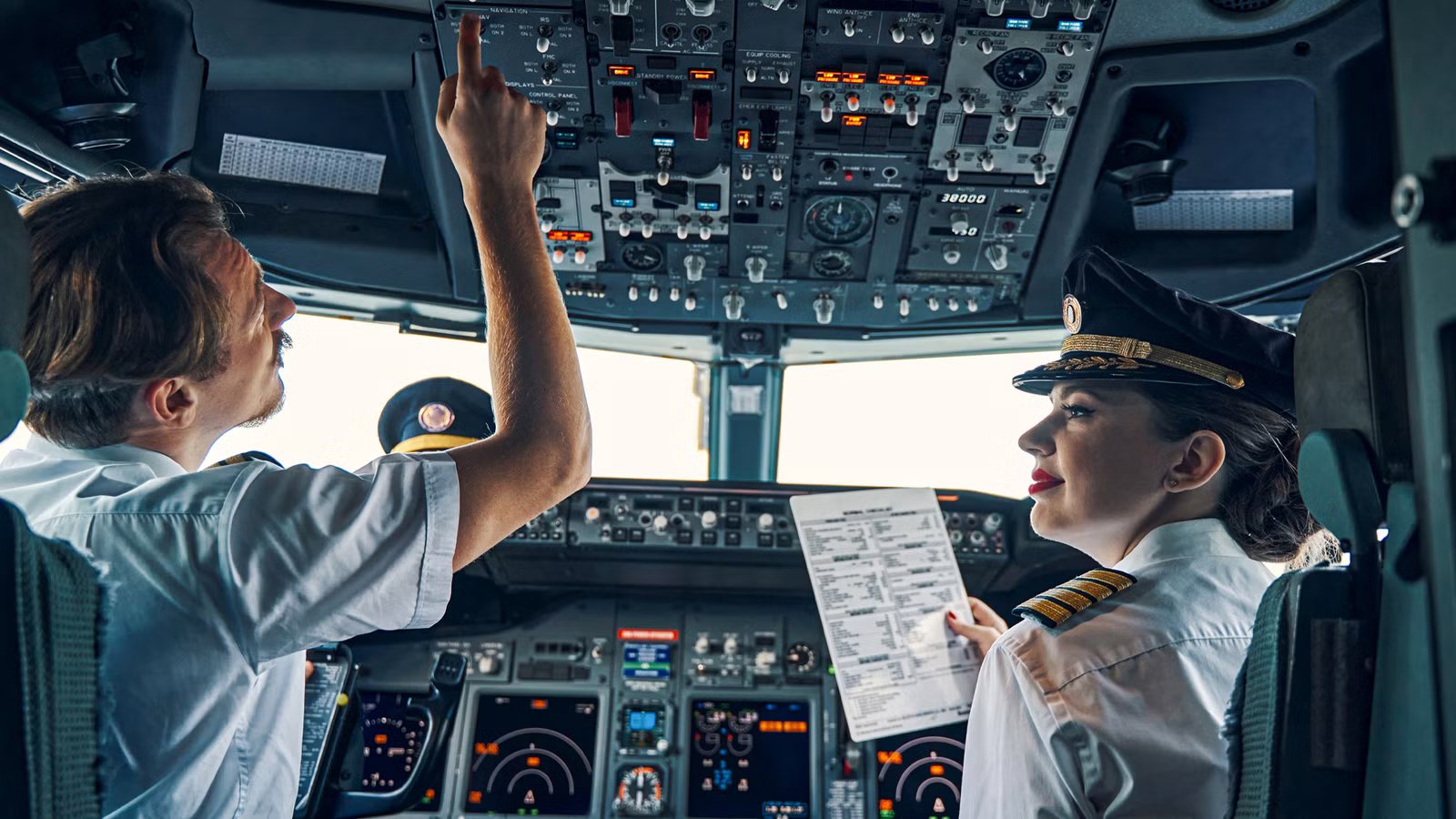
The most critical safety system inside a modern airliner cockpit is not an automated flight control computer or a redundant hydraulic backup, but actually the two highly trained aviators reciting rigid scripts out loud to one another. Every day, crews operating multi-million dollar widebodies are strictly forbidden from relying on informal conversation during high-workload maneuvers, bound instead to a mandatory regimen of fixed verbal triggers. These standardized vocalizations are a psychological circuit breaker, deliberately stripping human emotion and subjective interpretation out of time-critical decisions before an unnoticed error can escalate into a catastrophe.
If an engine fails during a high-speed takeoff roll or severe weather obscures a runway threshold, psychological biases can quietly blind even the most experienced captains to obvious flight path deviations. Looking into how regulatory authorities, airline standard operating procedures, and human performance researchers engineered these verbal routines, a complex mechanism emerges, one that reveals how simply vocalizing specific telemetry can make two separate minds a unified, error-resistant processing loop.
When Stress Is High, Mistakes Are Made

Under acute stress, human brains experience cognitive tunneling, narrowing focus onto a single alarm while ignoring surrounding telemetry. Looking at Human Performance and Limitations research, it is clear that passive visual monitoring fails during high fatigue, as pilots can look directly at misconfigured instruments without processing their meaning. Scripted callouts defeat this paralysis through dual-code processing, putting aviators in a position where they have to read displays and speak assigned phrases together.
As regulators evaluate single-pilot operations to reduce airline costs, safety statistics show the vital buffer provided by two pilots operating under Crew Resource Management (CRM) routines. In high-workload scenarios where conditions deteriorate in three seconds, a single pilot lacks a human mirror to catch subtle cognitive slips. Requiring a second crew member to vocalize challenge-and-response scripts builds a real-time verification loop, catching misread altitudes and airspeed deviations. Safety data from the Flight Safety Foundation shows over 70% of commercial accidents stem from human performance breakdowns where flight crews lost mutual oversight.
The vocalized firewall depends on total discipline during every phase of flight, but human minds remain vulnerable when standardized routines drop. When crews omit mandatory callouts, the shared mental picture collapses, leaving both aviators operating under separate assumptions about who holds control. The danger peaks during critical transitions when flight path responsibility shifts between pilots.
Not Calling Out A Handover Can Be Fatal

Failing to vocalize a control handover creates immediate ambiguity over who is actively flying the aircraft, allowing dual inputs or complete control abandonment to occur unnoticed. In high-stress situations, assumptions replace certainty unless flight crews use rigid, non-negotiable verbal transfers. Standard operating procedures help to remove this vulnerability by putting into rule some of the most important words in aviation: I have control, followed by the immediate verbal readback, you have control. Without this verbal sequence, both pilots can easily manipulate flight controls with opposing inputs, or conversely, each may assume the other is flying while the jet drifts unmonitored.
The fatal consequences of unspoken handovers are documented in major accident investigations. In 2009, during the loss of  Air France Flight 447 over the Atlantic Ocean, pitot tube icing caused the autopilot to disconnect at 35,000 feet (10,668 meters). The non-flying pilot attempted corrective nose-down inputs while the flying pilot held the sidestick fully back in a stall, with the asynchronous control sticks masking dual inputs because control was never explicitly transferred out loud. A similar breakdown occurred during the 2019 crash of Atlas Air Flight 3591, where spatial disorientation led to opposing control column forces between the captain and first officer because neither pilot clearly declared control authority.
Even when control of the aircraft is clearly defined, psychological traps continue to threaten safety during descent and approach phases. The natural human drive to complete an assigned task as quickly as possible often tempts flight crews to force unstable landings rather than execute a timely missed approach, leading to serious, costly runway excursions.
Not Giving Up On The Task

Pilots struggle to abort unstable approaches often because of plan continuation bias, a powerful psychological trap that convinces crews to salvage a flawed landing rather than go around. When an aircraft approaches a runway after hours of long-haul flight, the mental investment in completing the journey creates an emotional resistance to admitting defeat. Breaking this cognitive inertia can be possible with a bit of help from an unyielding verbal circuit breaker that forces the crew to acknowledge when parameters cross safety limits.
Catch what other flight trackers miss
Emergency squawks, holds, NOTAMs — live signals, no signup.
Open tracker
Catch what other flight trackers miss
Emergency squawks, holds, NOTAMs — live signals, no signup.
Open tracker
Flight Safety Foundation Approach and Landing Accident Reduction guidelines establish strict operational gates to combat this exact bias. Below 1,000 feet (305 meters) in instrument meteorological conditions, or 500 feet (152 meters) in visual conditions, a widebody must be fully stabilized, locked on target speed, configured for landing, on the correct glidepath, and following a stable sink rate. If any single parameter deviates, the pilot monitoring calls out the specific deviation, and if uncorrected, calls for an immediate go-around using the scripted phrase ‘go-around, flaps set’.
Approach Level | Operational Limit | Mandatory Verbal Trigger |
1,000 feet (305 meters) IMC | Airspeed deviation over 10 knots, sink rate over 1,000 feet (305 meters) per minute | Unstable / Go-Around |
500 feet (152 meters) VMC | Glidepath divergence or improper thrust setting | Unstable / Go-Around |
Structured verbal gates often successfully catch deteriorating flight paths close to the ground. But the decision window shrinks from minutes to mere seconds during the high-speed takeoff roll, and this is one of the main reasons why takeoff is considered such a critical and safety-critical stage of flight.
The Point Of No Return

During the high-speed takeoff roll, pilots have to work within strict speed corridors governed by V1 (takeoff decision speed), VR (rotation speed), and V2 (takeoff safety speed). Scripted speed callouts strip all hesitation out of engine failures or system warnings near the ground. Before V1, any severe malfunction leads to an immediate rejected takeoff. The moment the pilot monitoring calls out V1, stopping is reserved for only the most catastrophic of circumstances because the remaining runway length cannot safely absorb the kinetic energy. The decision is already set: the aircraft must take off regardless of an active fire or lost engine.
In the case of a Boeing 777-300ER departing at a maximum takeoff weight of 775,000 lb (351,534 kg), the margins for error are incredibly thin. At 80 knots (148 km/h), the pilot monitoring calls ’80 knots’ to verify airspeed indicator alignment and cross-check instrument health. As the twinjet accelerates toward a V1 of 160 knots (296 km/h), the callout creates a psychological line in the sand. If an engine fails 1 knot (1.8 km/h) after V1, hearing that single word prevents the flying pilot from reflexively applying full braking, meaning the crew must commit to lifting the aircraft into the sky.
This split-second verbal commitment demonstrates why rigid cockpit callouts are the key defense against human hesitation under pressure. Converting complex aerodynamic calculations into definitive spoken commands, flight crews stop any potential debate during the most hazardous seconds of flight. With manufacturers developing advanced cockpit automation aimed at reducing pilot headcount, industry leaders need to address whether digital monitoring systems can replicate this real-time psychological contract.
Are Single Pilot Operations Almost Here?

The push toward Reduced Crew Operations (RCO) all depends on replacing human vocal redundancy with advanced cockpit automation and digital safety monitoring. While software algorithms can analyze telemetry and trigger warnings, they cannot replicate the mutual psychological accountability that occurs when two human aviators recite mandatory scripts out loud. Without a second pilot actively speaking and listening to standardized callouts, single-pilot cockpits risk reintroducing cognitive tunneling once more, where an isolated aviator overlooks automated warnings during compound emergencies.
This friction defines the current debate surrounding Airbus Extended Minimum Crew Operations (eMCO) proposals for widebodies like the Airbus A350. Major aviator groups, including the Air Line Pilots Association (ALPA) and European Cockpit Association (ECA), strongly oppose single-pilot cruise concepts because digital alerts lack human psychological weight. An automated synthesized voice announcing a deviation is really just mere background noise on an Electronic Centralized Aircraft Monitor (ECAM) display, whereas a human colleague loudly vocalizing a mandatory callout gives an immediate, instinctual override.
As regulators evaluate AI flight management systems engineered to monitor pilot workload and health, the aviation industry faces an unresolved threshold for cockpit automation. The ultimate test for single-pilot viability is not whether an algorithm can detect an off-nominal flight parameter, but whether a digital system can exert enough psychological force to break a human pilot’s emotional attachment to a bad landing.
Nothing Beats Teamwork

Standardized callouts are far more than memorized checklists. These represent human performance engineering built to withstand cognitive failure under acute stress. As modern commercial airliners become increasingly autonomous and ultra-long-haul sectors push crew endurance beyond 18 hours, the insistence on physical, vocalized confirmation is now the last operational line between a routine flight and a catastrophic misunderstanding.
Whether cockpit callouts survive in their current form is not overly clear. The European Union Aviation Safety Agency (EASA) and Federal Aviation Administration (FAA) regulators are now evaluating certifiable frameworks for Airbus eMCO trials targeted for 2027, so at that point, a roadmap may be more set in stone. If regulatory bodies allow synthetic oversight or remote ground operators to replace the second pilot’s vocal checks during cruise, airlines will need to prove that digital algorithms can match the zero-latency error interception of a human colleague actively challenging a flight path deviation.
Automation is still not here yet, and until it can replicate the subtle psychological friction of two human minds holding each other accountable out loud, safety in commercial aviation will rely on two pilots speaking the exact same words in the exact same order when seconds count.