dailynewsnblog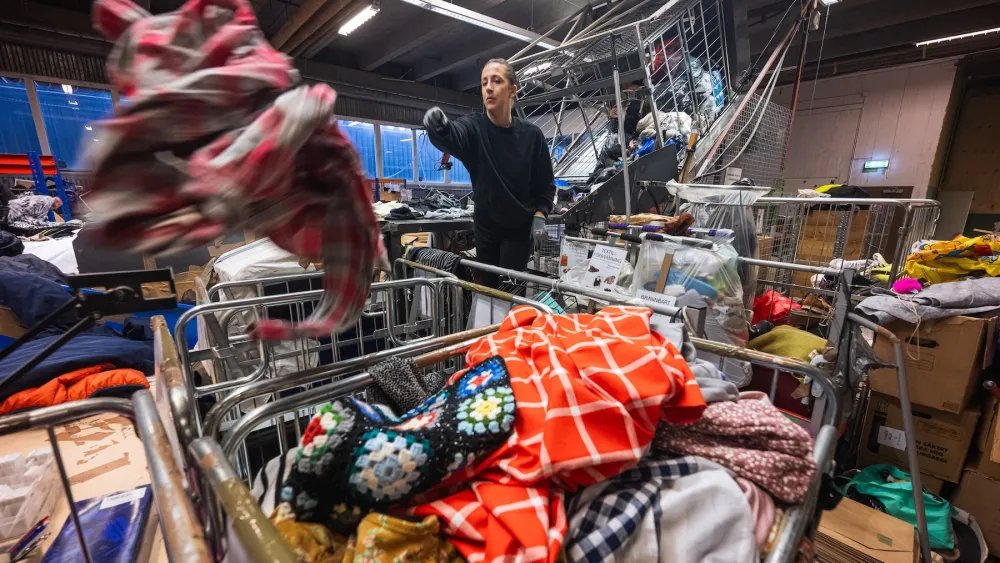
Europe may be preparing to mandate a circular textile economy. Financing the infrastructure needed to make one work is proving considerably harder.
Scaling textile-to-textile recycling in Europe to 15 percent by 2035 could require between 8 billion euros ($9.2 billion) and 11 billion euros ($12.7 billion) in incremental capital expenditures, according to analysis from ReHubs and Boston Consulting Group.
That money would support the collection of roughly 8 million metric tons of textiles and recycling of about 2.7 million metric tons back into new textile fibers annually. Today, less than 1 percent of textiles globally are recycled into new textiles.
The same ReHubs analysis estimates that operating the collection, sorting, preprocessing and recycling system would require another 5 billion euros to 6.5 billion euros ($5.7 billtion to $7.5 billion) in recurring annual expenditures by 2035.
Ultimately, most investment will have to come from companies, banks, infrastructure investors and equity providers seeking acceptable returns, according to Robert van de Kerkhof, CEO and board chairperson of ReHubs Europe.
“The challenge is that we do not have that business case today,” van de Kerkhof told Sourcing Journal.
Profitability under current market conditions can be “deeply negative” for some recyclers, he said. Public funding will consequently be needed to unlock private capital during the industry’s first phase through grants, guarantees, blended-finance structures and other mechanisms that spread the risk of moving from pilot to industrial scale.
The investment gap reflects an increasingly uncomfortable reality for fashion’s circularity ambitions: Developing technology capable of recycling old clothes does not necessarily make the plants using it financially viable.
First-of-a-kind textile recycling facilities can carry several risks simultaneously. Their technologies may not yet have operated at commercial scale. Feedstock volumes and quality can fluctuate. Recycled fibers must compete against cheaper virgin materials. And without commitments from brands to purchase what a facility produces, future revenue can be difficult to predict.
From ReHubs’ conversations with banks and investors, van de Kerkhof said two concerns stand out: technology risk and revenue certainty.
Even if a recycler can demonstrate that its technology works, he said, prospective financiers still want to know who will purchase its output, at what volume and under what conditions.
That leaves recyclers confronting something of a circular chicken-and-egg problem. Brands want lower prices and proven industrial capacity before committing significant volumes, while recyclers need predictable demand before investors will finance the capacity capable of lowering costs.
Long-term purchasing commitments could help break the stalemate.
Circ, which separates and recovers cotton and polyester from blended textile waste, has been working to aggregate demand from brands through what it calls its Fiber Club. The company is also qualifying its recovered materials with spinners, knitters and weavers ahead of a planned commercial-scale recycling facility in France.

An employee stands next to machinery at the French textile recycling company Nouvelles Fibres Textiles – Les Tissages de Charlieu, which produces secondary raw materials for textile companies, in Amplepuis, central France, on June 2, 2025.
OLIVIER CHASSIGNOLE / AFP / Getty Images
“Fiber Club is designed to turn fragmented brand interest into aggregated, meaningful demand,” said Kathleen Rademan, vice president of commercial strategy at Circ.
Participating brands align around a common fiber specification and supply chain, then provide indicative volumes that can be combined to meet minimum order quantities at the fiber and yarn levels. Brands subsequently test and validate the material through their own product-development processes.
“Indicative volume commitments are made as part of the process and convert to binding, long-term commitments,” Rademan said.
She did not say whether any Fiber Club participant has completed that conversion, how long the resulting contracts run or how much of the planned French facility’s output they cover.
Circ is also building commercial relationships further downstream. This week, the recycler announced an agreement with China’s Shenghong Chemical Fiber New Material under which Shenghong will purchase Circ’s recovered PET chip and manufacture it into recycled-content polyester filament yarn at commercial scale.
The agreement follows a five-year purchasing commitment announced last year with Acegreen Eco-Material Technology for Circ’s recycled pulp and with its parent company, Acelon, for recovered polyester. Together, the arrangements begin to create a network of manufacturers committed to converting Circ’s recovered materials into commercially usable fibers and yarns.
Circ would not disclose the duration, minimum volumes, pricing floors or take-or-pay provisions contained in its individual agreements.
The contracts are, however, “structured to include the components necessary to capitalize a facility, including volumes and pricing,” Rademan said.
In the short term, any difference between the price of Circ’s materials and virgin alternatives may be absorbed by different participants depending on the structure of the contract and the buyer’s goals, she said. Circ ultimately expects textile-to-textile recycled fibers to become cost-competitive with, or cheaper than, virgin fibers.
The consequences of misjudging the route to that point are already visible.
Swedish textile recycler Renewcell filed for bankruptcy in 2024 after struggling to ramp sales of its Circulose dissolving pulp quickly enough to support its industrial-scale facility. Its assets were subsequently acquired and the business relaunched as Circulose.
Circulose’s latest commercialization strategy shifts at least some of the scale-up burden toward the companies that ultimately want the fiber.
Marks & Spencer, which became Circulose’s first U.K. Scaling Partner, told Sourcing Journal that it views the license fee it pays through the program as an investment in building future textile-to-textile recycled fiber supply.
“The license model helps unlock the investment needed to bring this technology to commercial scale and supports the transition from pilot projects to industrial adoption,” M&S said.
The retailer said its fee supports the ecosystem and manufacturing capacity needed to make the material available at scale. In return, early participation helps M&S establish long-term relationships, preferential access and future sourcing opportunities as the market develops.
M&S has also committed to source Circulose through the program, with products incorporating the material planned for its autumn/winter 2027 ranges and beyond. It did not specify the volume it has committed to purchase.
“For M&S, this is not simply about purchasing a fiber today,” the company said. “It is about helping create the market conditions that will enable greater use of circular materials in the future.”
H&M Group has likewise made a multi-year sourcing commitment to Circulose and told Sourcing Journal that it intends to use “significant volumes” of the material, although it declined to disclose specific volumes or commercial terms.
The retailer said scaling textile-to-textile recycling requires brands, manufacturers, investors and policymakers to help create the conditions needed for commercial production. H&M has taken a different approach with recycled polyester through Syre, which it co-founded with Vargas Holding in 2024. Syre has since secured agreements with Nike, Gap and Target.
Upfront payments and long-term purchasing commitments can both support a recycler, but they do not affect a project’s financing in the same way.
An upfront license or scale-up payment can fund development and reduce the total amount a company needs to finance, said Jamie Corby, a fractional chief financial officer who advises venture-backed cleantech companies. It does substantially less to support debt capacity because lenders generally size debt against future contracted revenue rather than a one-time payment.
“Upfront money reduces what your borrowing need is, whereas a bankable offtake increases what you can borrow,” Corby said.
The creditworthiness of the buyer, duration of the contract and pricing mechanism can all affect an agreement’s value to lenders, he said. A price floor can protect revenue when cheaper virgin materials depress recycled-fiber prices, while the contract may need to run for as long as the corresponding debt.
Van de Kerkhof similarly said an expression of interest or letter of intent is insufficient for a first-of-a-kind facility seeking debt financing.
Investors instead want a multi-year agreement covering meaningful volumes and providing certainty around either the price or the mechanism used to calculate it, he said. In some cases, that commitment may need to approach a take-or-pay structure, requiring the buyer to pay for an agreed volume even if it ultimately takes less.

Employees sort second hand clothes receiving at ‘Le Relais’ recycling centre in Acigne, suburb of Rennes, western France, on July 21, 2025. France’s Ministry of Ecological Transition announced support of 49 million euros, to be provided by the eco-organization Refashion in 2025 to textile sorting stakeholders, an increase of 15 million euros compared to 2024, according to a letter sent to AFP on July 18, 2025.
Damien MEYER / AFP / Getty Images
“The purpose is not necessarily to transfer every risk to the brand, but to provide enough revenue visibility for a bank to finance the asset,” van de Kerkhof said.
Public policy is beginning to reshape the equation as well.
Under the European Union’s revised Waste Framework Directive, member states must establish extended producer responsibility programs for textiles and footwear. Producers will be required to help finance the collection, sorting, reuse and recycling of products they place on the market, with fees adjusted according to sustainability criteria including durability and recyclability.
The policy could create a more dependable stream of textile feedstock and funding. But whether it translates into investment in textile-to-textile recycling capacity will depend heavily on how national programs are designed.
Van de Kerkhof distinguished between the enormous upfront cost of building infrastructure and the continuing expense of operating a circular system.
EPR is particularly important for addressing that structural operating-cost gap, he said, because collection, detailed sorting, preprocessing and recycling add costs that the linear textile system does not currently pay. Producer fees should reflect those costs, reward more circular products and be reinvested into the textile system.
EPR revenues could also contribute to guarantees or concessional financing that helps de-risk infrastructure. But van de Kerkhof said the programs cannot by themselves finance the first generation of large-scale recycling plants.
“In many countries, the revenues will initially be too small and, more importantly, they will arrive too late,” he said.
Recyclers, sorters and technology companies need capital now, while ReHubs does not expect meaningful EPR revenue flows to be established across Europe until approximately 2028 to 2030.
“That is what I call the ‘pre-EPR valley of death,’” van de Kerkhof said.
H&M said clear EPR rules are essential to driving the transition but cautioned that implementation must be harmonized across EU member states. The company said it is preparing to work with individual governments as they transpose and implement the requirements.
Van de Kerkhof likewise said textile recycling must be developed as a European market rather than “27 isolated national systems.”
Collection can be local, but automated sorting, preprocessing and chemical recycling facilities may require material from several countries to operate at an efficient scale. If fees, permitted uses of EPR revenue and producer responsibility organizations differ substantially among national programs, he said, the resulting fragmentation could make infrastructure more difficult to finance.
Collection alone will not solve the problem.
Europe generates approximately 13.3 million metric tons of post-consumer textile waste, according to ReHubs, but only about 1.5 million metric tons are collected and sorted into the presently addressable pool. Recycling plants require sufficient volumes of predictable, high-quality feedstock, meaning investment in collection, sorting and preprocessing must occur alongside investment in recycling capacity.
If Europe gathers substantially more unwanted clothing without creating that accompanying infrastructure, greater volumes could instead flow into reuse exports, downcycling, incineration or disposal.
Nor is fiber-recycling technology the only constraint.
Garments made primarily from recyclable fibers can still contain labels, sewing thread, elastic, drawcords, buttons, snaps, zippers and coatings made from incompatible materials. Those additions can complicate sorting and downstream recycling or reduce the quality of the recovered material.

An employee walks past bundles of clothes at the French textile recycling company Nouvelles Fibres Textiles – Les Tissages de Charlieu, which produces secondary raw materials for textile companies, in Amplepuis, central France, on June 2, 2025.
OLIVIER CHASSIGNOLE / AFP / Getty Images
Raymond Randall, senior manager of textile recycling at WM, said components made from materials that differ from a garment’s main fiber create additional complexity. WM’s South Carolina facility uses robotics and near-infrared technology to sort and grade textiles by fiber type and color, but incompatible components can require additional preprocessing before the material enters an appropriate recycling stream.
Reducing material complexity and designing components so they can be more easily identified, separated and processed could help narrow the gap between what is technically recyclable and what can be economically recycled at scale, Randall said.
The challenge ultimately extends across the entire system: Garments must be designed so they can be recycled, collected in sufficient volumes, sorted into usable feedstock and processed by facilities capable of producing fibers that brands are willing to buy.
Other climate technologies have benefited from contractual conventions that fashion has yet to establish.
“Power financed itself on creditworthy offtakers and a decades-old PPA culture, whereas fashion buys in seasons, runs thin margins, and we do not yet have 10-year take-or-pay agreements as the norm,” Corby said.
Europe is increasingly building regulations intended to push the pieces of a circular textile system into place. Whether investors will finance the infrastructure connecting them may depend on fashion companies demonstrating that their circularity commitments extend beyond distant recycled-content targets.
For textile recycling to reach industrial scale, brands may have to do something considerably more consequential than promise to buy recycled fiber once it becomes cheap and plentiful: help make the plants producing it financially possible in the first place.