dailynewsnblog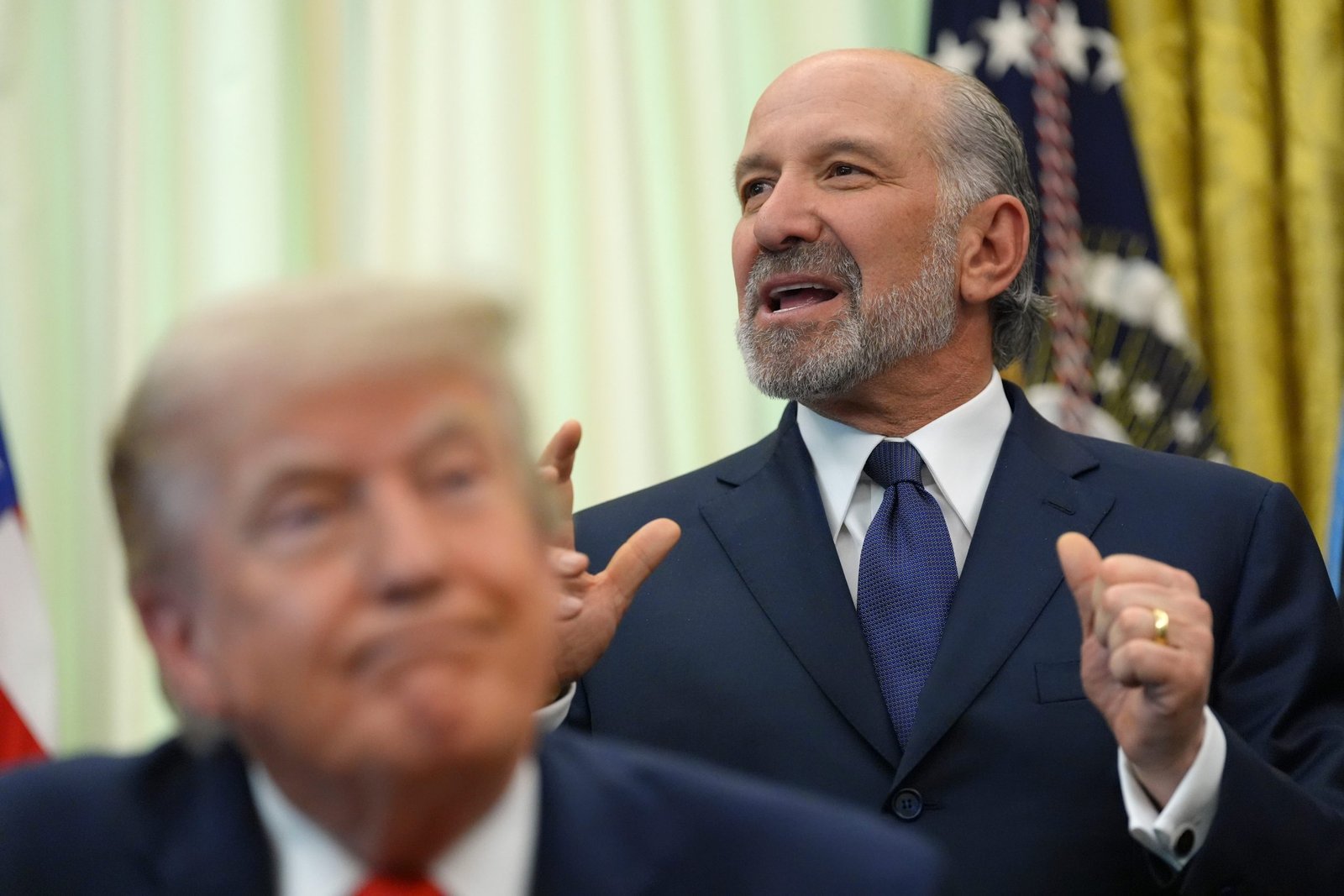
He told reporters on Thursday the Carney government was desperately seeking to create division with the Americans to justify walking away from the negotiating table.
U.S. Secretary of Commerce Howard Lutnick is accusing Canada of sabotaging trade talks by making last-minute demands to revise tariff rates for heavy duty vehicles.
He told reporters on Thursday the Carney government was desperately seeking to create division with the Americans to justify walking away from the negotiating table.
“When someone doesn’t want the deal, they make up and say, “Oh, I’ll do the deal with you only if you wear green. And you’re like, ‘But I’m wearing, I’m not wearing green.’ Oh, sorry, it’s not going to work out.”
Both Canada and the U.S. have traded accusations and tariff threats since the dramatic implosion of negotiations last week.
Prime Minister Mark Carney has accused the U.S. of negotiating in bad faith, while the Americans said the Liberal government wanted to score political points by scuttling trade talks.
The Trump White House has aggressively pushed back against claims that it wanted Canada to eliminate French-language protections, saying it was only calling for an end to discoverability rules for U.S. streamers for French-language and Canadian content.
Lutnick said Carney was looking to undermine support for the sovereigntist Parti Quebecois in the upcoming Quebec election, and expected talks to resume after key federal byelections on Aug. 31.
“They wanted to walk away. This is politics only. If you think I ever said the words French, do I care about how the Quebecois speak? I mean, what could matter less to America? We don’t care. So the fact is, we never thought those words up.”
Canadian trade sources have blamed the break down of talks on last minute demands from the U.S., such as the application of different tariff rates for vehicles produced by Canada.
They say Canadian negotiators believed the Americans’ offer to reduce auto tariffs from 25 to 15 per cent applied to all vehicles, but found out on Friday the U.S. offer excluded heavy duty vehicles, such as pickup trucks manufactured in Oshawa and eventually, Oakville.
One source told iPolitics that Canadian negotiators made it clear in earlier talks that the reduced tariff rate had to apply to all vehicles, labelling it as a “very big issue.”
The source, who asked not to be identified because they weren’t authorized to speak publicly, said the heavy vehicle duty was one of several changes made after U.S. Trade Representative Jameison Greer presented the terms of the prospective deal to Lutnick.
This was a necessary step as the so-called s. 232 tariffs levelled on Canadian autos, steel and aluminium fall under the discretion of the Commerce Department.
The source said the Canadian team found out about the tariff differences by going through the “fine print” of the offer from the Americans.
Lutnick claimed it was Canada who inserted medium and heavy duty trucks into the conversation at the last minute.
“The words medium and heavy-duty trucks were raised in these trade negotiations on Friday at 4 o’clock,” he said.
“I met with [Canada-U.S. Trade Minister Dominic] LeBlanc 10 times… [and] these were not raised. These were not part of it. It’s a different thing. This is medium and heavy trucks… That’s a construction product. That’s a different. It’s a whole different category. It was never raised. These were things they put in in order to make it end.”
A spokesperson for LeBlanc said the minister’s office wouldn’t comment on Lutnick’s latest accusations.
The Canadian trade source said the disagreement over automotive tariffs was a major factor in killing negotiations, and not the reluctance from some premiers to end their boycott of U.S. booze.
The New York Times reported earlier this week that Ontario Premier Doug Ford said the prospective deal wasn’t good enough to end his province’s ban on American booze in provincial liquor stores. Manitoba Premier Wab Kinew said publicly that he was unsure his province would end its boycott based on the terms of the deal shared by the federal government.
But the source said the premiers never had the opportunity to make a decision on a prospective deal because after the U.S. made several late changes, Prime Minister Mark Carney “saw enough to say I got to walk away.”
LeBlanc’s office confirmed to iPolitics that the premiers weren’t offered an update on trade talks on Friday.
Ford defended his role in the negotiations when asked on Wednesday if he helped kill the latest prospective deal.
“At the end of the day, the prime minister is the person in charge. I work very well with him. I have a great deal of respect for the prime minister, and just compare to the last prime minister, night and day. He’s doing a great job. He’s a fighter. He’s standing up to President Trump, and again, at the end of the day, it’s his choice, and he made the right choice,” he said.
The source said it’s clear that autos loomed more heavily than alcohol for the Canadian team, pointing to the massive discrepancy in the size of the industries. While pre-Trump Canadian alcohol imports from the U.S. was valued at $1 billion, Canada’s automotive manufacturing industry generates over $100 billion in annual shipments.

Ford also took a shot at Lutnick on Wednesday, accusing the Americans of “moving the goalpost on the prime minister” and saying the PM did the “right thing” in ending talks.
“I appreciate that decision because we’re going to fight like we’ve never fought before against President Trump, we’re going to create the climate and conditions in collaboration with municipalities in the country and the federal government to attract more investment.”
Can Canada’s auto sector handle U.S. tariffs?
The auto industry’s ability to tolerate new tariffs from the Americans remains a major point of contention.
Some industry players have said the proposed lower 15 per cent tariff is a non-starter that would eliminate their tight profit margins and permanently establish tariffs for the sector.
Others have argued that rate would fall into the low single digits for a completed vehicle as they contain parts made in the U.S., which are tariff-exempt. Any additional costs would then be absorbed into the final sticker price, while manufacturers could turn to governments for additional incentives to stay competitive.
Flavio Volpe, president of Canada’s Automotive Parts Manufacturers’ Association, said this argument doesn’t make sense because it would mean governments spending billions each year to subsidize foreign car companies and would “legitimize” the Trump’s administration’s tariffs.
He said auto manufacturers were averaging a 6 per cent profit margin before Trump — a number he warned has shrank since 2025. With 1.5 million cars produced each year in Canada at a cost of roughly $50,000, it would total roughly $2.25 billion each year in government support just to keep existing plants operating.
“So, every time you make a car, you’re going to lose 6 per cent? Six per cent is $3,000. So, every car that rolls off the seven line in Canada loses $3,000. How many cars do you think you’re gonna make?” Volpe asked.
He said Canada must get the “tariff down to a point where you can grind it down” when coupled with tax incentives similar to those offered in the Great Recession of the late 2000s.
Another industry source, who spoke to iPolitics on the condition of anonymity due to the sensitivity of negotiations, said it was important to secure a new deal that would bring stability to the sector, even if that meant tolerating some tariffs.
“We need immediate relief. If if there is a deal to be had that lowers the effective tariff rate now, then I say take it,” the source said.
“But we’re never going to abandon the message that this industry is based on duty-free trade, like that’s what we’ve done over the past 60 years, and we have to eventually get back to that. That just may take longer.”
Despite calling for a new deal, the source cautioned that every manufacturer had a different comfort level for those tariffs as they all vary in terms of where they source content. For example, there may be more content sourced from outside the U.S. in a vehicle from an Asian automaker compared to one of the Detroit Three.
The source also dismissed the argument that accepting a deal with tariffs would represent a point of no return for the industry, saying the Trump administration is notorious for reversing course.
“Show me evidence of any deal that the U.S. has done recently [that has been] permanent. Sometimes they change the terms the day after,” the source said.
“I wouldn’t accept this idea that if we were to do an agreement, we’re suddenly locked in a new trade arrangement for decades to come. I don’t think that’s realistic.
It’s unclear if Canada can force the Americans to change their tune on auto tariffs, a key component of Trump’s successful 2024 election campaign.
U.S. Ambassador Pete Hoekstra told iPolitics‘ No Talking Points podcast on Wednesday the Trump administration wouldn’t back down from demands for tariffs on imported vehicles.
“There will be a tariff rate coming in on autos coming into the United States of America,” he said, adding that Canada seemed to accept the terms of a 15 per cent tariff that would fall further when factoring in U.S. content.
“You’re getting the best deal possible for your people, as we are for the American people, and the end result now is we don’t have a deal, and we’ll see exactly where we go, but there will be tariffs.”
Hoekstra said this was necessary to achieve Trump’s goal of reversing decades of job losses in manufacturing, but Volpe said those plants moved to China and not Canada, which has lost half of its auto jobs since 1998.
He said U.S. car companies made the decision to shift production to China after it was admitted to the World Trade Organization in 2001, and auto workers on both sides of the border are paying the price.
“Decisions made in the U.S. by Detroit have hurt Michigan and Ontario equally. But to look at those decisions and see that you lost that market share to Chinese manufacturers, you lost that market share to Japanese manufacturers, Korean manufacturers, and blame Canada is either ignorant or malicious, and both of them fail the test of good faith.”
After talks broke down over the weekend and Canada vowed dollar-for-dollar retaliatory tariffs, Trump threatened to impose 50 per cent tariffs on Canadian auto imports starting on Jan. 1.
Canada’s retaliatory tariffs, which were detailed in an announcement on Tuesday, are set to go into effect on Sept. 8.
Volpe said while the U.S. may have the upper hand when it comes to the auto sector, Canada must use all the tools at its disposal to force the Americans to back down, including leveraging access to desperately needed Canadian products such as potash and aluminium.
“It’s like going into a fight with somebody who clearly is a stronger puncher than you and just agreeing that the only thing we’re going to do is punch,” he said of refusing to use other tools to force U.S. concessions.