dailynewsnblog
When I hear ‘Nvidia,’ I still think ‘gaming’. But after scrubbing through the company’s latest earnings call, I’m not sure Nvidia is thinking much about gaming these days at all. In fact I had to go back through the records an entire year to find a time when it made one mention of it in an earnings call. That’s how little impact it seemingly has on the company’s bottom line.
None of Nvidia’s board members so much as uttered the word ‘gaming’ to investors once again. But with the data centre segment bringing in $89 billion this quarter alone, accounting for almost 93% of the company’s total revenue, it’s not hard to see where the company’s priorities now lie, and why.
Nvidia made $96 billion in total revenue in the second quarter of 2026, doubling what it made during the same period last year. Nvidia CFO Colette Kress told investors, “The surge in AI demand is driving a global infrastructure buildout, supported by an expanding and diverse set of growth opportunities, spanning hyperscalers, AI labs, AI natives, enterprises and sovereign customers.”
Latest Videos FromPC Gamer
For those unclear, I’ll explain the last part of this comment: hyperscalers handle massive AI workloads so need a lot of infrastructure like data centres. AI labs are at the tech’s bleeding edge in terms of research and development. ‘AI natives’ refers to workflows, products, or companies that are built from the ground up around AI—in other words, it’s an inextricable aspect from the start. Enterprise customers may have otherwise bolted on data-centre-dependent AI products at a later date. Finally, sovereign customers can represent either businesses or even entire countries that want to retain full control over an AI technology’s entire lifecycle.
The really brain-melting thing though is that Kress adds that the company expects “to grow revenue by approximately 70% in fiscal 2028,” even in the midst of the RAMpocalypse. In fact, Nvidia feels it would be making a whole lot more money if it weren’t for the memory crisis it’s contributing to. Still, even in a “supply-constrained” landscape, Nvidia is not expecting the demand for AI or data centres to slow down any time soon. That leaves gaming out in the cold.
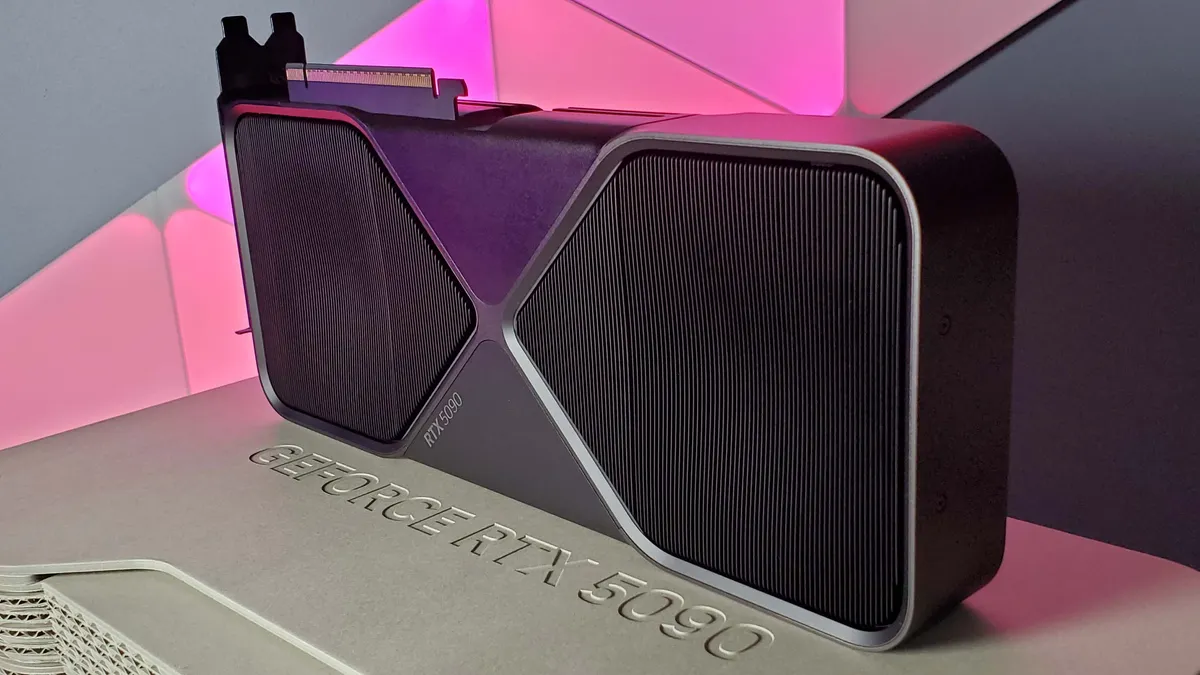
In fact, Nvidia no longer reports on gaming as its own separate segment. Instead, this has apparently been bundled up into the Edge Computing segment, which itself made $7.2 billion. Kress comments that these “increases were driven by strong sales of Blackwell workstations, partially offset by slower consumer PC sales that were tempered by elevated memory and systems prices.” The Edge Computing segment saw a 27% year-over-year increase, though this win still pales in comparison to all things AI at Nvidia.
Obviously, Nvidia hasn’t stopped selling its very shiny RTX 50-series GPUs—so shiny in fact, that it would have been genuinely cheaper for me to fly to QuakeCon and buy an RTX 5090 at the Nvidia booth than pick up the GPU absolutely anywhere else. But even though the RTX 5090 costs a small fortune, gaming is clearly not the priority it once was for Nvidia, nor has it been for a while.
The last time I remember Nvidia mentioning gaming in an earnings call was this time last year, and even then AI was already making 10 times as much as gaming. De-emphasising the gaming segment even further is something we could all have seen coming. With that in mind, hearing ‘Nvidia’ and still thinking ‘gaming’ before ‘AI’ or ‘data centres’ puts me firmly behind the times.
Best graphics card 2026