dailynewsnblog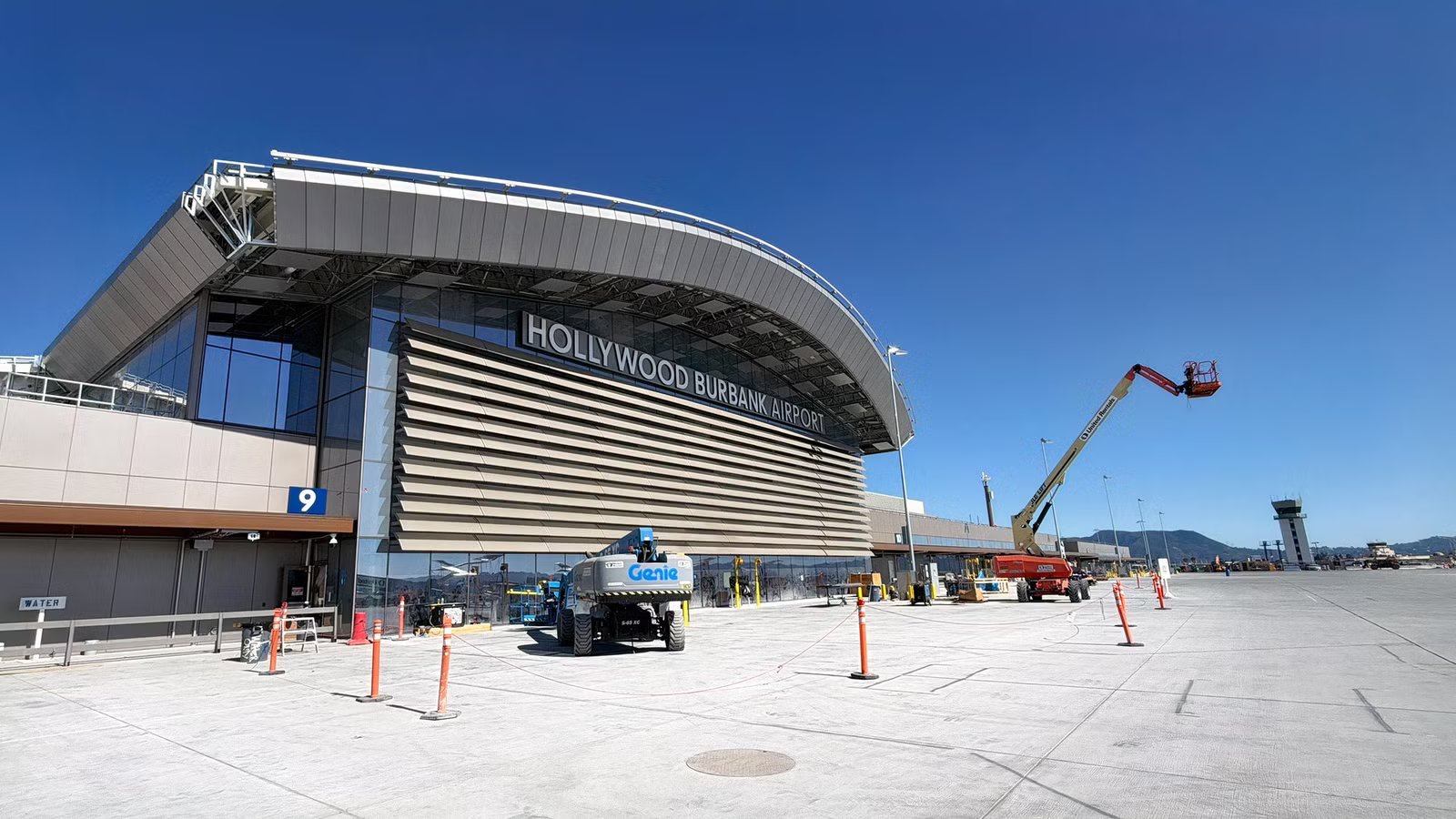
Hollywood Burbank Airport (BUR) is nearly a month away from debuting its new $1.3 billion terminal. After breaking ground on the facility in early 2024, crews are in the final phase of construction, while officials prepare to usher in a new era at the airport, which first opened in 1930.
The terminal, sitting on the northeast corner of the airfield, is set to debut on October 13 alongside a new state-of-the-art parking structure for passengers. Its positioning provides a sweeping view of the Verdugo Mountains directly east of the airport – a welcome scene for passengers arriving in Southern California.
New Terminal Designed With History In Mind

While the facility replaces the aged, outdated original terminal on the southeast side of the airfield, it features touches of Hollywood glamor and nods to the airport’s origins. Large steel beams supporting a futuristic canopy between the terminal and the parking structure protrude outwards to emulate the iconic look of searchlights pointing into the sky. This concept also appears inside the terminal, with stripes in shades of blue and gray running across the floor against the white tiles.
The metal canopy itself, referred to as the “Silver Screen,” features a perforated pattern. It is inspired by the dress worn by American actress and model Marilyn Monroe. In 1962, Monroe wore the ensemble, known as the “Happy Birthday, Mr. President” dress, while serenading President John F. Kennedy.
As passengers enter, they will be met with a large ticketing area with several kiosks for check-in. The security checkpoint is situated in the grand hall between the ticketing area on the north side and baggage claim, which is on the south side.
Complementing the terminal’s open, airy architecture, large windows provide natural light. Passengers will also see views of the airfield following security in an open area featuring a bar and other concessions. Baggage claim will be a major upgrade for passengers, as all carousels will be indoors.
Runway Proximity & Safety Is Key

Among the multitude of reasons why the new terminal is a necessity is its compliance with standards set by the Federal Aviation Administration (FAA). The current facility is too close to the runways, creating safety concerns. Oftentimes, aircraft arriving on Runway 8 pull straight into the gate immediately after exiting the runway. Between the new terminal building itself and the nearest runway – 15/33 – the separation is reportedly around 800 feet, which increases the safety of operations. The current terminal also does not meet safety standards for California’s seismic activity.
While the new facility will feature the same number of 14 gates, the tarmac is more expansive. Simple Flying previously reported that the gates will be large enough to accommodate aircraft such as the Boeing 737 MAX 10 and Airbus A321. No airline currently operates those aircraft at BUR, although  Alaska Airlines, the airport’s second largest carrier, has the MAX 10 on order and currently deploys the 737-900ER and MAX 9 at the airport. It is unclear if the Seattle-based airline has plans to operate the yet-to-be FAA-certified plane at BUR.
Similarly,  American Airlines has the A321 and A321neo in its fleet, but mainly schedules regional aircraft at BUR or mainline aircraft such as the A319, A320, 737-800, or 737 MAX 8.
  Southwest Airlines, the largest operator, flies all variants of the 737 in its fleet to and from BUR – the 737-700, -800, and MAX 8.
A Brand New Terminal, But Not 1 Jetbridge In Sight

Notably, the new terminal has no jetways. While it allows for more space, airport officials say it fits the tradition that passengers have always loved at BUR. Mobile stairs are not as common at most commercial airports, but they can be less expensive to operate and, in some cases, can expedite boarding and deplaning.
The new terminal was built on the site of what was once a parking lot. According to airport officials, the ground has a slight incline – the north side is slightly more elevated than the south side. To avoid the hefty cost of resurfacing the entire ground, the terminal’s flooring follows the gradual change in elevation with ramps instead of steps, making it more accessible and inclusive. Regardless, airport officials say passengers may not even notice an incline or decline as they travel throughout the facility.
With less than two months until its debut, crews are putting their final touches on the facility. Additionally, the airport will conduct at least two passenger trials. Once it opens, the work will not be complete, however. Officials say crews will have limited time to demolish the current terminal. Plans for the future use of the space where the current facility is have not been announced.