dailynewsnblog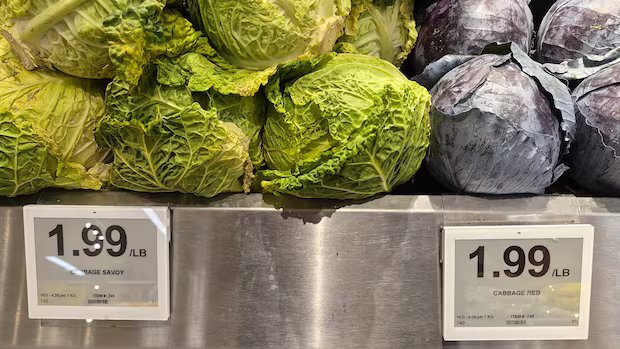
Loblaw has reversed its decision to drop country-of-origin labelling on produce signs in stores, following widespread customer backlash.
The outcry began earlier this month after shoppers noticed the area on produce displays, which used to indicate where food was grown, had been left blank.
“We should know what we’re eating,” said Karla Hennig of Penticton, B.C. The committed “Buy Canadian” shopper says she was disappointed when she discovered the missing information last week at her local Superstore.
“I just think it’s terribly disrespectful of my time and my money,” she said. “They want me to support them, but they are not giving me what I’ve asked for.”
Produce signage at Loblaw stores across Canada reflected the same change, except in Ontario and Quebec; Canada’s largest grocer continued providing origin details in those two provinces because provincial regulations mandate certain types of labelling transparency.
But in other provinces, many Loblaw shoppers took to social media to denounce the policy change — which the grocer initiated just before Canada-U.S. trade talks collapsed, sparking a fresh trade war and renewed interest in buying Canadian products.

After noticing that produce at his local Real Canadian Superstore lacked country-of-origin labelling, Edmonton resident Karl Mueller posted a complaint on Facebook and fired off a letter to the chain’s head office.
He said on Monday that recent trade tensions have only strengthened his resolve, suggesting this is the wrong time for Superstore to cut back on in-store food labelling.
“There’s an economic attack on us,” he said. “As just an ordinary citizen, my only way of fighting back is to support Canadian businesses, to shop local.”

On Monday, agricultural economist Ellen Goddard suggested Loblaw may now be second-guessing its decision.
“They’re probably thinking, ‘Boy, we picked the wrong [time] to pull the labelling,’ ” said Goddard, a professor at the University of Alberta in Edmonton.
“The emotion is much higher now.”
Goddard’s prediction turned out to be accurate. Following a CBC News inquiry to the grocer, Loblaw responded by email that, “as Canada enters another period of trade uncertainty with the United States,” the grocer is taking steps to help shoppers buy Canadian products.
The grocer said those efforts include reintroducing country-of-origin information in produce aisles and a “T” symbol on shelf labels for American products affected by U.S. tariffs.
The news was met with cautious optimism by some shoppers.
“If Loblaws has actually changed their policy, I think that’s wonderful,” said Mueller. “It shows you the power that ordinary people can have if they put their money where their mouth is.”
He says he won’t fully rejoice until he sees produce country-of-origin labelling return to his local Superstore.
Loblaw’s previous response
Despite reversing its produce labelling policy on Tuesday, Loblaw had defended its initial decision just one day earlier, citing the challenges of the task.
“Sourcing can change frequently due to seasonality, supplier changes and availability,” said the grocer in an email on Monday.
Loblaw did not explain why it could still provide the source country for produce in Ontario and Quebec stores, despite these hurdles.

The grocer also said that shoppers can find “the most current” source country details on individual produce stickers or the packaging, or by asking a store employee.
But Hennig said when she tried to shop for broccoli and lettuce last week at the Penticton Superstore, she couldn’t find the information on the products.
“There was no indicators whatsoever.”
And when she asked two employees for help, Hennig said neither knew where the produce was grown.
“I was very frustrated,” said Hennig, who walked out of the story without buying anything.
“I felt that I was just being dismissed,” she said, adding that she didn’t blame the store staff who had nothing to do with the policy change.
What prompted the change?
Loblaw’s decision to initially drop produce labelling followed regulatory troubles for the grocer. Earlier this year, the Canadian Food Inspection Agency (CFIA) handed out two $10,000 fines and two warnings to four different Loblaw stores for incorrectly promoting imported food — including produce — as Canadian.
The penalties, particularly the fines, made news headlines. Goddard, the agricultural economist, says the coverage likely influenced the grocer to initially remove country-of-origin signage for produce.
“I think the last thing they want to do is be on the front page of the newspaper for doing something that may imply they are misleading customers,” she said. “Their business rests on trust.”
Goddard says she doubts Loblaw set out to mislead shoppers, and had likely decided that offering produce labelling to shoppers — given the challenges — wasn’t worth the risk.
“They may be exhausted trying to make it work,” she said.

Loblaw isn’t alone in scaling back source country information after regulatory scrutiny.
Earlier this year, grocer Sobeys stopped adding maple leaf symbols to store shelf signs to promote Canadian products. The move followed accusations that the grocer had promoted imported food as Canadian and a subsequent CFIA investigation.
Is it legal?
Despite growing criticism, the CFIA has clarified that federal regulations do not require grocers to list a product’s country of origin on store signage, and allow the sale of bulk produce without any source country disclosures.
This position has prompted calls from some consumers for new federal rules mandating that grocers provide origin information for bulk produce.
“I would like to see legislation that requires country of origin labelling, so that it’s very clear to consumers where the product is coming from,” said Mueller in Edmonton. “We should be making this easy for Canadians, not difficult.”