dailynewsnblog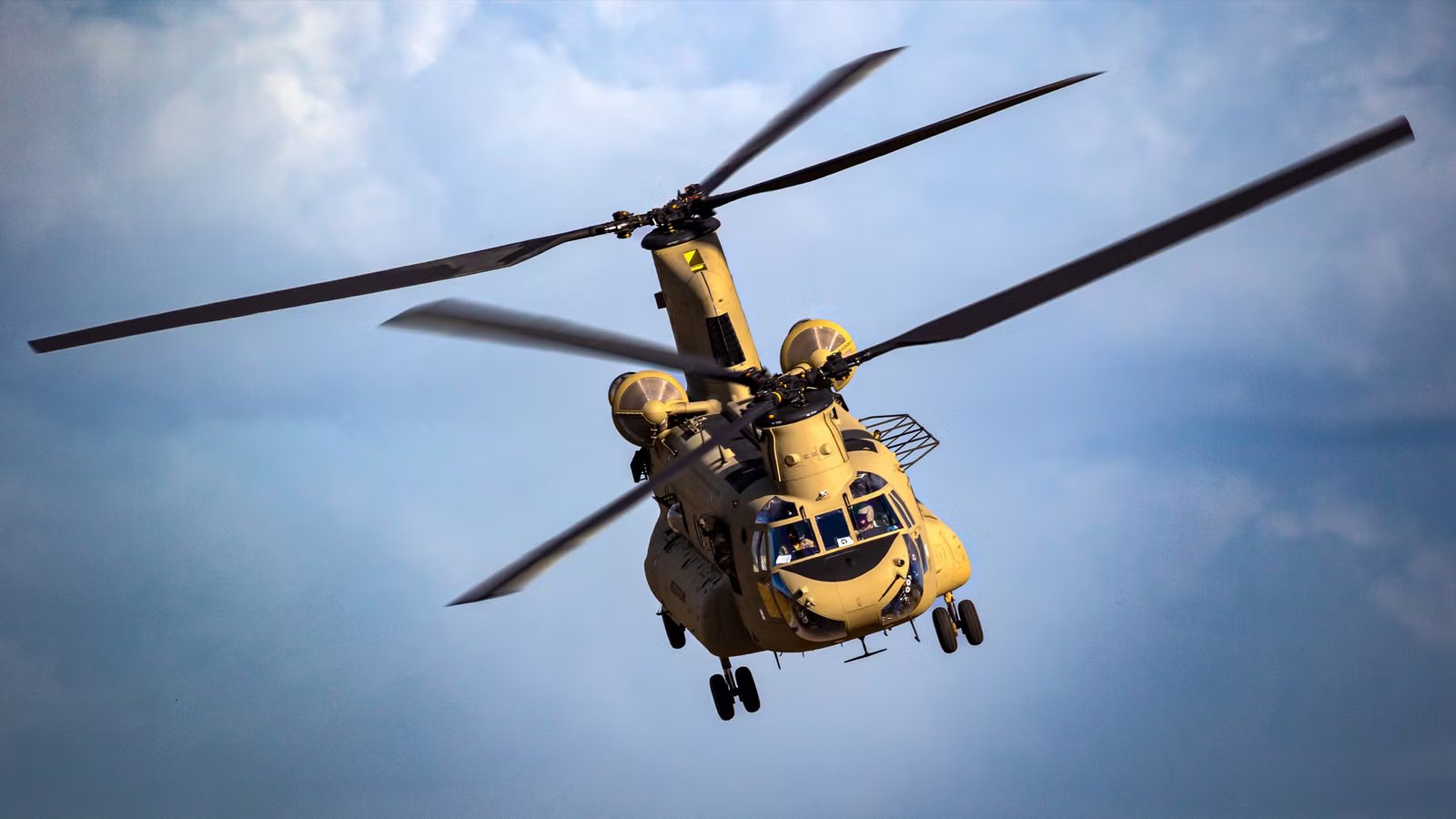
The Boeing CH-47 Chinook is the US Army’s only tandem-rotor heavy-lift helicopter and is the US’ second-largest after the Sikorsky CH-53. Vertol initially developed it, but it is now built by Boeing. Over 1,200 examples have been built, of which around 500 are in US Army inventory, with many others exported or retired. The Chinook first flew in 1961 and entered service in 1962, making it one of the older widely used designs in the US military.
There will not be a replacement for the Chinook for a long time, and so the Army is working to renew its fleet and keep them flying into the 2040s. The CH-47F Block II program upgrades existing CH-47F aircraft and procures common hardware for both the CH-47F and the MH-47G variants. The $472 million contract in the title is just one part of a larger, roughly $20 billion modernization effort for the helicopter. Here is what to know about the modernization and future of the CH-47 Chinook in the US Army.
The US Army’s CH-47F Block II Upgrade Program

The CH-47F Block II upgrade program is an effort by the Army to renew and modernize its Chinook fleet and keep it flying for decades to come. While the service was reported to have started preliminary investigations into an eventual replacement, that replacement will be many years away. To keep the Chinooks flying, the Army is preparing to roll out its CH-47F Block II upgrade.
These upgrades will strengthen the Chinook’s airframe, improve fuel consumption, as well as provide electrical, rotor, and drive system upgrades to the copter. Collins is essentially working on the digital side of the smaller Block II modernization effort. The contract to Collins (discussed below) is part of the broader CH-47F Block II modernization effort, but it is not the Block II upgrade itself.
There are essentially two things running in parallel. One is the mechanical and structural recapitalization, and the other is continuous digital and avionics modernization. The broader modernization includes strengthening the airframe, improving the drivetrain, increasing the torque capability, redesigning and improving the fuel system, and improving the rotor system. The Collins contract focuses on avionics, open architecture (to allow for future upgrades), future technology insertion (explicitly part of Block II), commonality, and improvements to cyber, comms, and navigation.
Reduced Number To Be Upgraded

The latest Army FY2027 budget says the approved Army Acquisition Objective (AAO) is 501 H-47 aircraft. Of these, 432 are CH-47F Block II aircraft, and 69 are MH-47G helicopters. The MH-47G effort is a separate Special Operations program with its own acquisition strategy, although it will use common Block II components. This represents a reduction from the 539 CH-47F aircraft planned for the Block II program in earlier years.
The Collins contract is just a small part of this effort to keep the Chinook fleet flying for decades to come. In Fiscal 2025, budget documents showed the program to have a cost of around $22 billion for 539 copters, or around $41 million per airframe. It’s unclear what the total cost would be now, although the overall cost could be lowered, given that the number of CH-47F aircraft in the Block II acquisition objective has been reduced by around 20%.
The US Chinook inventory has been reasonably stable for the last few decades. In 2009, the Army stated, “The Army requirement is 513 Chinooks, which includes 452 CH–47F and 61 MH–47G aircraft. The current inventory is 458 Chinooks.” Currently, the number of specialized MH-47G helicopters is lower, but is planned to increase to 69. The Army’s standard CH-47F fleet appears set to shrink to 432, or even lower depending on upcoming reviews.
US Army Awards Collins $472 Million Chinook Contract

In August 2026, RTX reported that its subsidiary, Collins Aerospace, has been awarded a contract by the US Army for up to $472 million to “provide engineering services that support the modernization and sustainment of the CH‑47 Chinook fleet.” Under the agreement, Collins will provide engineering services for avionics upgrades. Collins Aerospace is a notable Chinook subcontractor; the prime contractor is Boeing.
These will help integrate new capabilities and “more efficiently address obsolescence and strengthen the aircraft’s avionics architecture to support continued mission readiness in a rapidly evolving operational environment.” Jenny Miller, vice president and general manager of Vision and Sensing Systems at Collins Aerospace, said that Collins is responsible for equipping the Chinook with advanced avionics that integrate communication, navigation, and mission subsystems into a flexible and modern cockpit.
The work will be carried out in Huntsville, Alabama, and in Cedar Rapids, located in Iowa. The effort seeks greater platform commonality across the US Army’s aviation by using open and reusable avionics architectures that can be integrated across various aircraft. RTX says that the approach helps to streamline technology insertion, reduce integration complexity, and help reduce costs and delays as the fleets are upgraded.
The Army’s Justification For Upgrades

The Army says that the CH-47F Chinook is the Army’s only heavy-lift helicopter and is “critical to achieving the heavy lift capability in support of Transformation in Contact (TiC) and Continuous Transformation objectives.” The type comes with an increased maximum gross weight to 54,000 lb (24,493 kg), with an extended reach, improved sustainability, and increased payload. Its critical missions include transporting troops (air assault), supply and resupply, casualty evacuation, and other cargo operations. They also come with secondary missions like parachute drops and search and rescue.
The Army writes that it currently expects the CH-47F and MH-47G aircraft to remain the Army’s lone heavy lift helicopter for the next several decades. It then claims that the CH-47F Digital Cockpit Support & Sustainment (DCSS) funding is needed to maintain fleet readiness by procuring the needed hardware, software, and services for the fleet.
US Army Chinook | Quantity | Note (per budget documents) |
|---|---|---|
Current Block II AAO, FY2026 | 501 | 432 CH-47F & 69 MH-47G (Army Acquisition Objective) |
Current Block II program FY2027 | 93 | 24 CH-47F & MH-47G (FY2027 budget has sharply reduced the conventional CH-47F quantity from the previous 432-aircraft objective) |
CH-47F Block II rapid-fielding target | Up to 24 | Completion by 2030 |
MH-47G Block II renew/new-build program | 69 | Special Operations |
FY2027 divestment | 35 | Six Active Army, 17 Army National Guard, and 12 Army Reserve aircraft |
It adds that the funding manages aircraft obsolescence and integrates needed technology insertions and improvements. The documents add, “These solutions include Assured Positioning, Navigation, and Timing (APNT), crypto modernization, and enhanced and integrated Aircraft Survivability Equipment (ASE).”
Ongoing Chinook Retirements & Modernization

The US Army describes the process of rebuilding old Chinook airframes into the Block II standard as ‘Renew and New Build.’ When it comes to the Army getting Block II Chinooks, these are coming from two avenues. The Army’s Fiscal 2027 documents show 24 CH-47Fs (part of the Rapid Fielding tranche) to be rebuilt/renewed to the Block II configuration by 2030 and 69 MH-47Gs to be rebuilt/replaced under a separate Special Operations program.
Boeing’s documents show it delivered three renewed CH-47 Chinooks and five new Chinooks in the first half of 2026. That said, ‘renewed’ is Boeing’s terminology for existing airframes that are being returned to service after substantial refurbishment/modernization, and so these may not actually be renewed to Block II standard. At the same time, the Army is reducing its overall CH-47 fleet size.
In its 2027 budget request, the Army says it plans to “divest 76 AH-64D/E Apache helicopters and 35 CH-47F helicopters and retire 75 UH-60L Black Hawks, to be replaced by modernized UH-60M and UH-60V models.” The FY2026 budget documentation described a broader H-47 Block II Renew and New Build program covering 432 CH-47Fs and 69 MH-47Gs, for a total Army acquisition objective of 501 aircraft. The FY2027 documents instead identify only 24 CH-47Fs alongside the 69 MH-47Gs, while the GAO reports that the Army is reconsidering the previously planned 432-aircraft CH-47F quantity.
Eventual Chinook Replacement

In 2024, Simple Flying reported on an exclusive piece by The War Zone that detailed the US Army’s early moves to develop a next-generation heavy-lift rotorcraft to replace the CH-47 Chinook. At the time, The War Zone reported that the plans were still very much in their infancy, and there has been little subsequent information in the two years since then. For now, it appears that the Army is focusing on bringing its Future Long-Range Assault Aircraft (FLRAA), now called the MV-75, into service by the early 2030s.
While the replacement of the Chinook appears to be in its early conceptual stages, it is reasonable to assume that the Army will seek to build on the MV-75 tiltrotor. The CV-22 Osprey remains the only manned tiltrotor in active service around the world. The Osprey has also frequently gotten into the news for all the wrong reasons, with it taking time to mature the tiltrotor design.
Like the F-35, Osprey mishaps are typically heavily publicized. However, it is looking like tiltrotors are a significant part of the future of military aviation. Air taxi companies like Archer and Joby use tiltrotor designs and are developing military versions of them. At the same time, numerous manned and unmanned tiltrotor designs are emerging in China. But it will be a long time for any aircraft to be developed and fielded, with the Army set to continue to rely on the Chinook for decades to come.
Catch what other trackers miss
Emergency squawks, holds, NOTAMs — live signals, no signup.
Open tracker
Catch what other trackers miss
Emergency squawks, holds, NOTAMs — live signals, no signup.
Open tracker