dailynewsnblog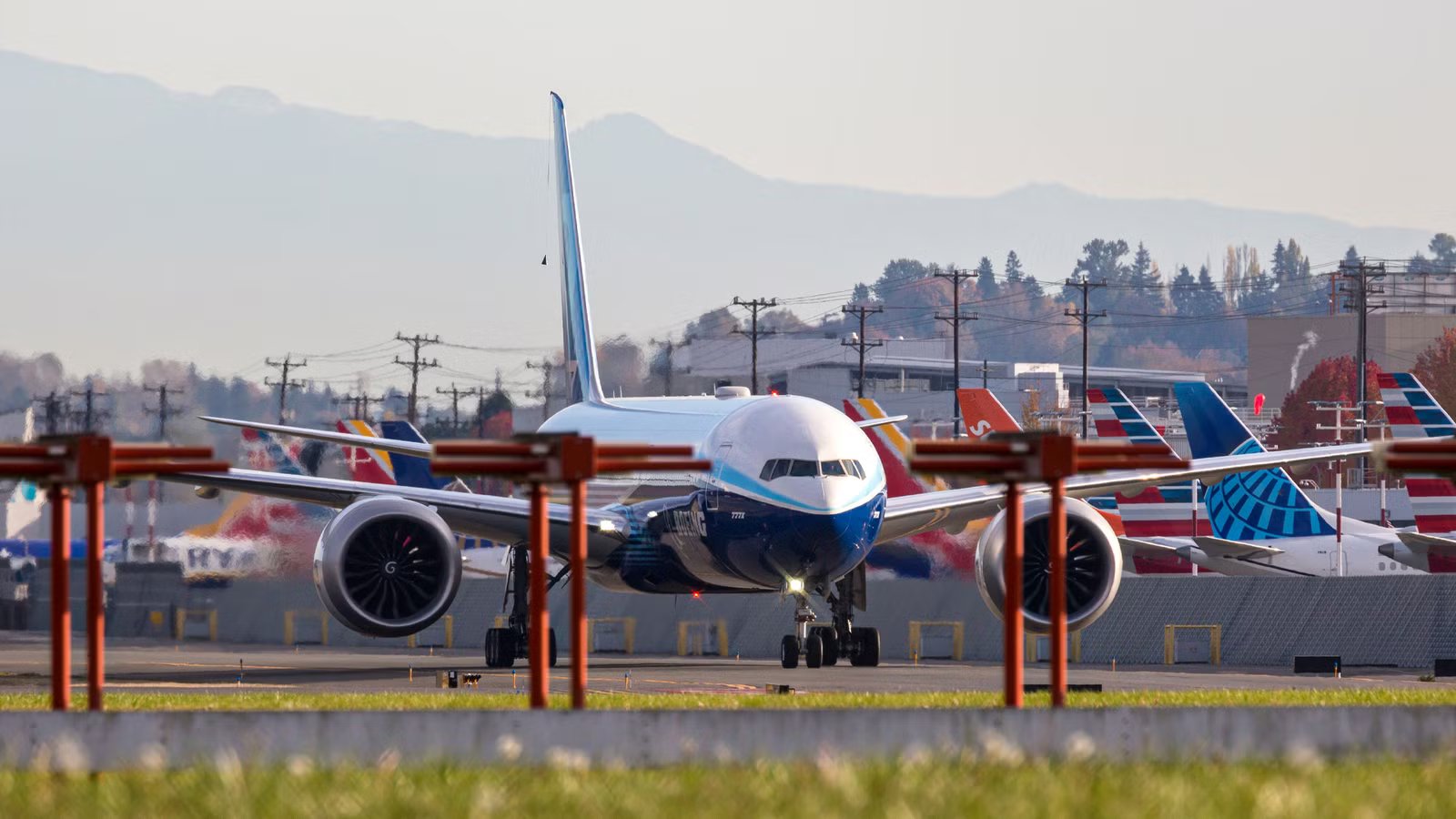
It has been more than a decade since  Boeing launched the 777X family. The planemaker launched the program with a strong order book, with roughly 250 orders and commitments from four customers across Europe and the Middle East. At the time, the 777X looked like a relatively straightforward development of the successful 777 family, but the program has taken a much more complicated path than Boeing originally expected. The aircraft family is still not certified; the certification is now expected sometime next year.
Over the years, the program has faced several setbacks, including changes to regulatory requirements and increased scrutiny following the 737 MAX crisis. Along with that, Boeing has also had to deal with a number of technical problems during the flight-test program. One of the most recent ones came in 2024, when a problem with the 777X’s thrust link forced the company to ground its entire test fleet. To investigate what had happened, the company’s engineers turned to an unlikely tool: a leaf blower.
How The Problem First Appeared

Indeed, finding the root cause was a challenge for Boeing’s engineers. But before we look at how they were eventually able to work out what was happening, it is worth rewinding a little and looking at how the problem first emerged. In 2024, during a routine inspection following a test flight in Hawaii, Boeing detected a severed thrust link on its third 777-9 test aircraft, WH003. Subsequent inspections of the other test aircraft also revealed cracks, which prompted the planemaker to immediately halt flight testing and ground its test fleet.
Thrust links are a critical part of the engine mounting system; they transfer the loads generated by the engine into the aircraft structure. On the 777-9, these components are responsible for transferring the nearly 21,000 lb (9,525 kg) engine load, along with the substantial forward force generated by the GE9X, into the aircraft’s aft lower engine mount. The 777X’s larger size meant Boeing needed to develop a thrust link larger than any it had previously designed.
At 10 feet long (3 meters), the titanium thrust link was the largest the manufacturer had ever designed, according to Tresha Lacaux, the 777-9 Vice President and Chief Project Engineer, as reported by Boeing News Now (BNN). Lacaux explained that a titanium tube of this size could exhibit “unique behaviors,” but that a very specific combination of conditions had to come together for this to occur.
How The Problem First Appeared

During the inspection, Boeing found that the damage was limited to the left thrust link. Engineers discovered that the cracks were appearing under a very specific condition involving a protective blanket fitted around hydraulic tubes near the thrust link. The blanket is there to protect the hydraulic tubes from the heat and other conditions around the engine. Normally, there is some space between the blanket and the thrust link. In this case, however, the blanket was sitting within three-tenths of an inch (0.76 cm) of the left thrust link.
Catch what other flight trackers miss
Emergency squawks, holds, NOTAMs — live signals, no signup.
Open tracker
Catch what other flight trackers miss
Emergency squawks, holds, NOTAMs — live signals, no signup.
Open tracker
That small gap turned out to be very important. A cooling port near the thrust link directed high-speed air across it, and when the blanket was so close to the component, the airflow was forced through the narrow space. This changed the pressure around the thrust link and caused the long titanium component to vibrate. When the right conditions came together, the vibration could develop into a resonance, eventually leading to the cracks Boeing had found.
Engineers now had an explanation for the damage, but they still needed to prove it. They had to recreate the same conditions and see whether the airflow could produce the same effect. This was where the leaf blower came in. The engineers used powerful leaf blowers to replicate the high-speed airflow from the cooling port and tested what happened when the gap became very narrow. The results supported their theory.
How Boeing Fixed The Issue

Following this, Boeing worked on a modification that would prevent the same conditions from occurring again. Initially, the planemaker developed straps to secure the protective blanket to nearby hydraulic tubes. This kept the blanket away from the thrust link and left enough space for airflow. Later, it made further changes to the thrust link itself for extended operations testing and aircraft that will eventually be delivered to customers.
It closed the cooling port that directed air towards the left thrust link, which removed the airflow that had contributed to the problem. In addition, the manufacturer increased the thickness of the thrust link wall by about two-hundredths of an inch to eliminate the possibility of a vibratory response. By December 2024, the modified thrust link components had been integrated into the test fleet.
Boeing then conducted static and dynamic tests in early January 2025 to verify the modified components. In mid-January, after receiving Federal Aviation Administration (FAA) approval, it finally resumed flight testing. The changes have since performed as intended during flight testing. The company said the thrust links had “performed without issue” since flight testing resumed.
777X Delays Have Cost Boeing Billions

Furthermore, the thrust-link problem was just one of the setbacks Boeing has faced with the 777X. Since the program was launched, the manufacturer has dealt with several issues that have pushed the certification schedule further out. Initially, the development and testing of some of the aircraft’s new technologies took longer than expected. Over the years, the program also faced multiple technical problems. For instance, in 2019, a cargo door blew off the aircraft inside a Boeing hangar while the manufacturer was conducting an extreme pressurization test under FAA supervision.
This halted testing and forced engineers to reassess parts of the aircraft’s structure before the program could move forward. In January 2020, the 777X eventually made its first flight, but this came soon after the Boeing 737 MAX crisis, which had changed the way the FAA approached the certification of Boeing aircraft. The regulator increased its oversight and required more direct validation of systems, software, and structural performance. By December 2020, the 777X program was effectively paused again after concerns emerged over its flight control systems.
Meaningful certification testing did not fully resume until July 2024, and just weeks later, Boeing discovered the thrust-link problem, bringing flight testing to another halt for about five months. Indeed, these delays had a major financial impact on Boeing. The expected cost of completing and delivering the 777X increased, and the company recorded a series of reach-forward losses on the program. Last year, during the third quarter, Boeing recorded an additional $4.9 billion pre-tax charge, taking the total charges on the program beyond $15 billion.
When Will The 777X Finally Be Certified?

Overall, the 777X has now completed thousands of test hours and gone through extensive systems evaluations and major certification milestones. But the aircraft is still well behind the schedule Boeing set when it launched the programme in 2013. The planemaker originally expected the 777X to enter service in 2020. It is now expected to receive certification in 2027.
In June, FAA Administrator Bryan Bedford said the 777X would be certified after the remaining two 737 MAX variants, the MAX 7 and MAX 10. The MAX 7 has since received certification, while the MAX 10 is still going through the process and is expected to be certified by the end of this year. Indeed, this puts Boeing’s plans for early 2027 deliveries under pressure. According to ch-aviation, the manufacturer has received more than 500 orders for the 777X from airlines around the world.
Boeing 777-9 orders | |
|---|---|
Operator | Aircraft Order |
All Nippon Airways (ANA) | 16 |
Air India | 10 |
British Airways | 24 |
Cathay Pacific | 35 |
China Airlines | 15 |
Emirates | 235 |
Ethiopian Airlines | 8 |
Etihad Airways | 15 |
Korean Air | 20 |
Lufthansa | 20 |
Qatar Airways | 90 |
Singapore Airlines | 30 |
Unassigned | 22 |
The German flag carrier  Lufthansa is the launch customer and had been expecting its first aircraft in early 2027. In May, the first production-standard 777-9 built for the airline completed its three-hour maiden flight in Everett, Washington. However, with certification still to come, it remains to be seen whether those deliveries can begin as planned.
Will 2027 Finally Be The Year For The 777X?

The 777X is now completing its primary flight testing, which Boeing expects to conclude by the end of 2026. ETOPS testing will continue into 2027. Until that approval is secured, the aircraft cannot fully operate the ultra-long-haul routes that are an important part of its business case.
After certification, the 777X can finally enter commercial service. It has been a long process for Boeing, with development delays, regulatory changes, and technical problems all adding time to the program. The thrust-link problem was another major interruption, which stopped flight testing for several months while engineers worked to identify the cause and develop a fix.
Boeing’s engineers used leaf blowers to recreate the airflow around the thrust link and confirm what was causing it to vibrate. The solution did not come from the leaf blower itself, but the simple tool helped the engineers reproduce the conditions they were investigating and confirm the source of the problem.