dailynewsnblog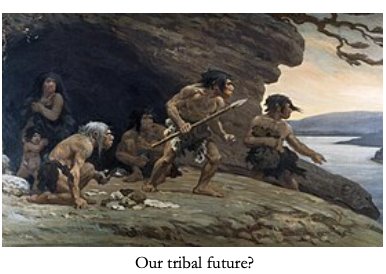
Tribalism: a strong identification with and loyalty to one’s tribe or social group, often accompanied by an “us vs. them” mentality

Back in the old days, the really old days, like the Stone Age, we lived in societies that evolution designed us for. Today we don’t. Today we live in societies that bear little resemblance to those that resulted from natural selection.
Up until about ten thousand years ago, yesterday in geological time, we lived in small, homogeneous groups of hunter-gatherers. We lived similar lives, doing similar work and similar play and holding similar beliefs.
Modern societies couldn’t be more different, more opposed. They are vast in size and complexity. We each belong to numerous tribes: our ethnic group, our religion, our profession, our community, our country, our favourite hockey team, and so on. Myriad tribes with myriad, often conflicting, loyalties. We feel a bond with our fellow members in each of these tribes, and reserve toward those not one of us.
Our genes design us to be this way. Our individual and collective survival in small groups living in raw nature depended on close co-operation. We have always reinforced this genetic imperative with culture—myths, music, rituals, traditions, modes of dress, and so on—to solidify the group.
All of this togetherness defines us as human beings. More than a good thing, it is essential to us as a social animal. It guides our attachment to family, community, country, religion, profession, and all the other tribes we belong to.
But like all good things it has its downside. Our reservations about those not of our tribe often lead to suspicion, hostility, even to violence, to a host of evils: racism, religious bigotry, political violence, exploitation, war.
In the past, societies, indeed civilizations, have succumbed to those ills. But humanity has persevered, creating new societies, new civilizations, as old ones disappeared. Now however we may have reached a place where that resilience is no longer possible. Today we all, all individuals, all tribes, live within a global society, something that has never existed before. And if it collapses, there may be no new society, or at least not one to our liking.
Our greatest challenges, our greatest threats, today are not tribal matters, they are global matters. We have to deal with them not as tribes, but as a species. Threats such as global warming, the exhaustion of the Earth’s resources, nuclear war and runaway technology.
Yet, just as we face a need to function as one society—a global civilization—tribalism at its worst finds a new energy and threatens new and dangerous divisions. Russia yearns for its imperial past and invades its neighbours to regain it. China seeks to unite its peoples in a new Han dynasty under Emperor Xi. The United States, which was leading and promoting a liberal world order, albeit clumsily, has retreated into narcissistic foreign and economic policies under a narcissistic president, and now leads the world into tribal chaos.
Here at home, Canadian tribalism stirs in response to the threat from the south, in this case hopefully to constructive ends. Yet separatist tribes in Alberta and Quebec grow restless.
The world, which has seen great progress toward unity over the past 80 years, has, in the word of our prime minister, ruptured. Tribalism is triumphing, just when it has never been more important to rise above it.
In my younger days, I had thought one quirk of aging I would like to avoid was becoming a grumpy old man. I didn’t want to spend my declining years wandering about mumbling that everything was going to hell. Then in my old age, the Americans elect Donald Trump and everything really does start going to hell.
The world is facing a crossroads. Humanity is challenged with greater threats than it has ever faced before and it is not dealing adequately with them. If we can’t escape our tribal instincts and think as a species, at least to deal with our greatest challenges, the future darkens.
Can humanity do this? There was much promise, but now it fades. These are not days for optimism.