dailynewsnblog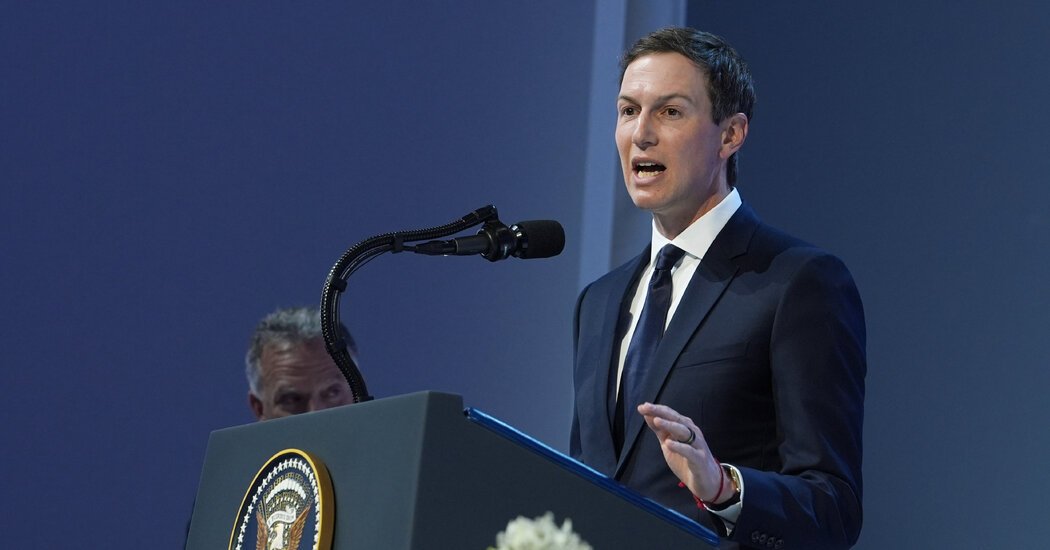
Jared Kushner, President Trump’s son-in-law and senior aide, met for several hours with Prime Minister Benjamin Netanyahu of Israel in Jerusalem on Monday in an effort to break a logjam over Mr. Trump’s plan for the future of the war-ravaged Gaza Strip.
Mr. Kushner traveled to the region with representatives of Mr. Trump’s Board of Peace after Mr. Netanyahu rejected a deal for Hamas to disarm. A 15-point “road map” that Hamas agreed with the Board of Peace called for the militant group to lay down its weapons and for Israeli forces to withdraw from Gaza.
Mr. Trump’s announcement last month that the Board of Peace had secured Hamas’s agreement to disarm briefly raised hopes for progress. The president’s plan had been stalled for months over Hamas’s resistance to disarming and Israel’s continuing airstrikes and military operations in Gaza. Israel has also failed to meet its commitments to allow specified amounts of fuel and other necessities into the territory under the terms of a cease-fire agreed with Hamas in October 2025.
It was not clear how much progress had been made in the meetings on Monday.
Mr. Netanyahu’s office said in an English-language statement that the two sides had “deep and constructive” discussions and agreed to set up working groups on disarming militant factions in Gaza and the demilitarization of the territory, as well as on sanitation, clean water and other public health issues.
Israel and the Board of Peace, the prime minister’s office added, were “determined” that disarmament and demilitarization precede any reconstruction of Gaza, where cities and towns remain in ruins and many people live in dilapidated tents.
A Board of Peace official, speaking on the condition of anonymity to discuss sensitive matters, said it had agreed there would be no Israeli “redeployment” from Gaza before disarmament and demilitarization. Israel, the official said, has the right of self-defense if Hamas resorts to violence or attempts to rearm.
The Board of Peace told Mr. Netanyahu that Hamas has committed to disarm and cease all military activity, the official added.
The Israeli government issued a separate Hebrew-language statement on the meeting to the domestic news media, that was more strongly worded. Part of the statement, to be attributed to an anonymous “diplomatic official,” said that the first step in disarming Hamas would be for the group to hand over all its weapons to be destroyed under the supervision of U.S. Maj. Gen. Jasper Jeffers, the commander of the International Stabilization Force, which would be deployed to Gaza.
The statement said that Mr. Netanyahu had made clear to what it called “the American side” that Israel would not retreat from the so-called Yellow Line described in the October cease-fire agreement, which was to mark the extent of the Israeli deployment in Gaza.
In late July, Nickolay Mladenov, a senior Board of Peace official, said Israeli withdrawal “must move in lock step” with Palestinian disarmament. Days later, however, the Board of Peace said withdrawal from the Yellow Line would take place following the completion of disarmament.
The government statement also said Israel would not accept limits on its freedom of action in thwarting attacks from Gaza or the targeted killings of people there that it says participated in the Oct. 7, 2023, attack on Israel.
Another part of the Israeli government’s readout of the meeting that was to be attributed to an “Israeli official” sought to characterize a key difference in opinion between Israel and the Board of Peace. “Deep down, official Israel does not believe that Hamas will disarm. The Americans say they believe that it can happen,” it said.
Mr. Kushner and members of the Board of Peace flew to Israel for Monday’s meeting after holding talks with representatives of Hamas, including its political leader, Khalil al-Hayya, on Sunday in El-Alamein, Egypt. The board was represented at the meetings by Tony Blair, the former British prime minister, and Mr. Mladenov, a former Bulgarian diplomat.
Hamas officials presented Mr. Kushner with a list of what they said were Israel’s violations of the cease-fire, according to a Hamas official and two people briefed on the talks, and he promised to speak to Mr. Netanyahu about Israel upholding its end of the agreement.
Mr. Kushner asked the Hamas representatives to move ahead with disarmament, the two people said. But they said that Israel first needed to keep its commitments under the cease-fire, and they warned that the road map they agreed to last month was not open for changes.
The Board of Peace’s deal with Hamas says that, as part of the disarmament process, Israel should first uphold its side of the cease-fire. But political considerations are widely believed to be preventing Mr. Netanyahu from upholding all of Israel’s commitments under that deal.
The Israeli leader faces a tough campaign in elections to be held on Oct. 27, and his right-wing coalition is behind in the polls. Any concessions to Hamas or perceived softening of his posture toward Gaza could subject him to attacks from allies he considers vital.
Political considerations are also important for the Board of Peace and for the Trump administration. With the U.S. midterm elections approaching in November and the anniversary of the cease-fire in early October, a failure to reach an agreement could be embarrassing for the board and for the White House and its approach to the Middle East.
Aaron Boxerman and Abu Bakr Bashir contributed reporting.