dailynewsnblog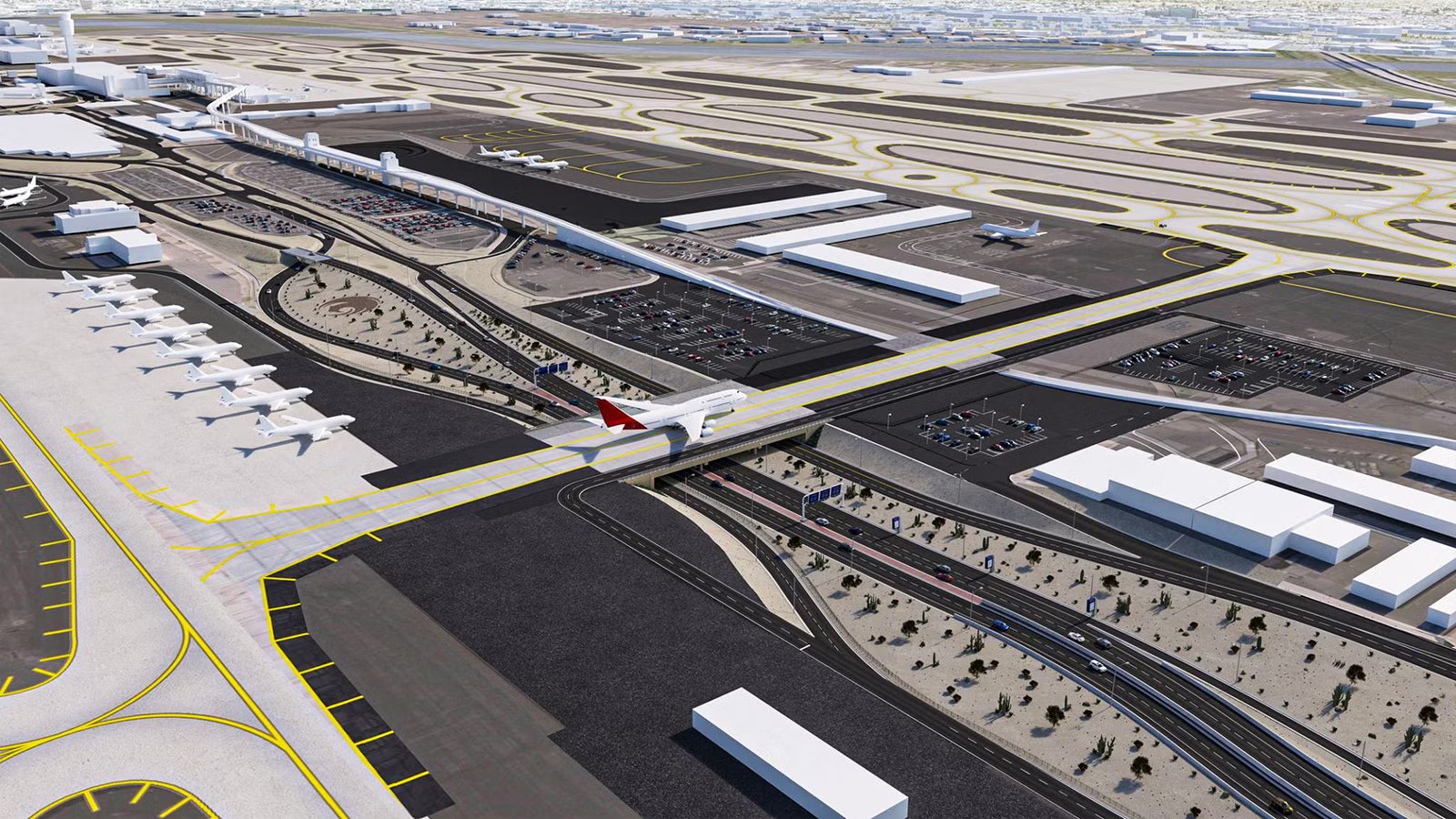
 Phoenix Sky Harbor International Airport (PHX) is building a bridge that, on the surface, looks like a fairly straightforward piece of airport infrastructure. Taxiway Uniform, or Taxiway U, will span roughly 2,060 feet across the western end of the airport, connecting the north and south airfields and giving aircraft a second way to move between the two runway complexes. The project is expected to be completed in 2027 and carries an overall budget of $332.9 million.
Yet the most important part of Taxiway U may have little to do with the bridge itself. Sky Harbor is effectively testing a funding model that has become increasingly important to large airports across the US, combining federal infrastructure grants with Passenger Facility Charges and airport revenue-backed debt. With billions of dollars of airport construction underway nationwide and a major federal funding deadline approaching, the way the airport pays for one taxiway could offer an early indication of how sustainable the wider model will be.
A Bridge Designed To Fix A Ground Problem

The operational case for Taxiway U is relatively easy to understand. PHX currently has taxiways connecting its north and south airfields primarily on the eastern side of the airport, meaning aircraft that need to cross between the two areas can face longer ground movements than they otherwise would. The new western connection is intended to give aircraft another route, improving traffic flow and reducing unnecessary taxiing.
The new structure will not simply be a bridge placed over an otherwise empty section of the airport. Construction involves roadway realignment, utility relocation, changes to airport facilities, and substantial enabling work before the main taxiway infrastructure is complete. According to the airport, the initial phase includes modifications to Sky Harbor Boulevard and Buckeye Road, illustrating how even an apparently simple airfield project can expand into a much larger infrastructure undertaking.
For airlines and passengers, the hoped-for benefit is measured less in concrete and steel than in minutes saved on the ground. Faster taxiing can improve aircraft utilization, reduce fuel burn, and make the airport more resilient when traffic builds up. Phoenix Sky Harbor International Airport also handles substantial cargo activity, so the operational benefits extend beyond passengers, making Taxiway U an investment in the airport’s broader transportation role rather than simply an aviation convenience.
The $332.9 Million Price Tag

The headline figure for Taxiway U is $332.9 million, although that number covers the overall project rather than only the bridge structure. PHX places the construction budget at $279.5 million, with the remainder covering other project costs associated with delivering the complete program. That distinction matters because airport infrastructure often involves roads, utilities, engineering, and operational changes that can significantly increase the cost of the central facility.
Approximately $200 million of the project funding comes from the Bipartisan Infrastructure Law, which Congress approved in 2021. A particularly visible portion arrived through an $84.3 million Airport Infrastructure Grant from the Federal Aviation Administration (FAA), announced as construction was already underway. The grant therefore represents a substantial federal contribution to a project whose total price is considerably larger than the individual award.  Southwest Airlines is currently the largest operator at Sky Harbor, followed closely by
  American Airlines, according to the latest data from the Bureau of Transportation Statistics (BTS).
Ranking | Airline | Market Share |
|---|---|---|
1 | Southwest Airlines | 34.5% |
2 | American Airlines | 32.8% |
3 | Delta Air Lines | 6.9% |
4 | SkyWest Airlines (American Eagle & Delta Connection) | 6.3% |
5 | United Airlines | 6.2% |
That federal contribution changes the project’s economics for the airport. Instead of financing the entire bridge through airport-generated cash or debt, Sky Harbor can use federal money to cover a significant share of the capital requirement while relying on Passenger Facility Charges and airport revenues for the balance. It is a familiar formula, but Taxiway U provides a particularly clear example because federal funding represents such a large portion of the total project cost.
The Federal Money Is The Real Story

The political attention surrounding the $84.3 million grant is understandable because federal infrastructure awards are tangible and easy to communicate. Local officials can point to a major project, federal investment, and the prospect of shorter taxi times, while passengers can understand the promise of a more efficient airport. But the more consequential question is what happens when airports can no longer depend on the same scale of supplemental federal infrastructure funding.
The Bipartisan Infrastructure Law’s supplemental authorization expires after fiscal year 2026, creating an estimated federal funding cliff of roughly $3.9 billion per year for the next authorization cycle. The figure does not mean that every airport will suddenly lose money, but it does underline how different the financing environment could become once the current infrastructure program winds down.
For airports planning projects that will take years to design and construct, timing is therefore critical. A project that can secure federal assistance before the current authorization expires may require less airport borrowing than an identical project beginning later. That creates an incentive for large airports to advance eligible projects and capture available grants while they can, particularly as construction costs remain high and airport capital plans continue expanding.
A National Airport Building Boom

PHX becomes more significant when viewed against the size of the US airport construction cycle. Across the country, 31 large hub airports have roughly $130 billion to $140 billion of announced capital activity in the public record. About 25 of those airports issued airport revenue bonds in 2024 and 2025, showing how heavily the sector still relies on debt markets.
Some of the individual programs are enormous. For example,  Denver International Airport (DEN) has a $12.8 billion 12-year capital plan, while close to $12 billion has been authorized for
  Chicago O’Hare International Airport (ORD). These projects are vastly larger than Taxiway U, but they operate within the same basic financial world, where airport revenues and bonds provide the foundation and federal grants can reduce the burden on local airport finances.
The comparison also shows why Sky Harbor matters despite the project’s relatively modest size. The facility does not need to demonstrate that one $332.9 million bridge can transform the national aviation system. Instead, it demonstrates how a large airport can layer different sources of capital onto one project. Multiply that approach across dozens of airports and thousands of projects, and federal grants become an important variable in the overall cost and timing of America’s airport modernization cycle.
Why Revenue Bonds Still Matter

Federal grants cannot finance every airport requirement, which is why revenue bonds remain central to the system. Airport revenue bonds allow major airports to borrow against future airport revenues, spreading the cost of large infrastructure projects over many years rather than requiring passengers and airport users today to provide the entire amount upfront.
Passenger Facility Charges provide another important funding source because they are collected from eligible passengers and can be dedicated to approved airport improvements. At PHX, those charges are helping finance the portion of Taxiway U that is not covered by federal infrastructure money. Airport revenues provide another layer, allowing the facility to assemble a financing package without depending entirely on federal appropriations or placing the full project cost into the bond market. The airport processed around 51 million passengers last year, according to BTS data on the busiest routes.
Ranking | Destination | Passengers |
|---|---|---|
1 | Denver International Airport (DEN) | 1,193,000 |
2 | Seattle-Tacoma International Airport (SEA) | 922,000 |
3 | Chicago O’Hare International Airport (ORD) | 852,000 |
4 | Dallas/Fort Worth International Airport (DFW) | 800,000 |
5 | Los Angeles International Airport (LAX) | 789,999 |
The attraction of this layered approach is flexibility. Federal money can reduce the amount that must be borrowed, Passenger Facility Charges can provide a dedicated passenger-funded stream, and airport revenues can cover remaining costs. The weakness is that every source has limits. Federal grants depend on congressional authorization, passenger charges depend on traffic and statutory rules, and bonds ultimately depend on an airport’s ability to generate enough revenue to satisfy investors over the long term.
Taxiway U Is A Test For What Comes Next

Taxiway U will ultimately be judged by whether it improves Sky Harbor’s operations, but its financial significance will last beyond the bridge’s expected 2027 completion. The project shows how airports can use federal infrastructure programs to reduce the capital they must commit to major improvements, while still relying on airport-based funding for the majority of costs not covered by grants.
The looming federal funding deadline makes that lesson more important. If the federal government does not replace the expiring supplemental authorization at a comparable scale, airports will have to choose among larger bond programs, slower construction schedules, higher reliance on passenger-generated revenue, or smaller capital plans. For airports already managing multibillion-dollar programs, even a relatively modest reduction in federal participation could become significant when repeated across many projects.
PHX therefore offers a useful real-world snapshot of a much larger US airport finance question. The bridge itself is designed to move aircraft more efficiently across the airfield, but the money behind it is moving through a system that is being tested nationwide. With $332.9 million committed to Taxiway U, approximately $200 million supplied through the Bipartisan Infrastructure Law, and the remaining costs supported by Passenger Facility Charges and airport revenues, Sky Harbor is showing what the current funding model can accomplish before the federal government decides what comes next.