dailynewsnblog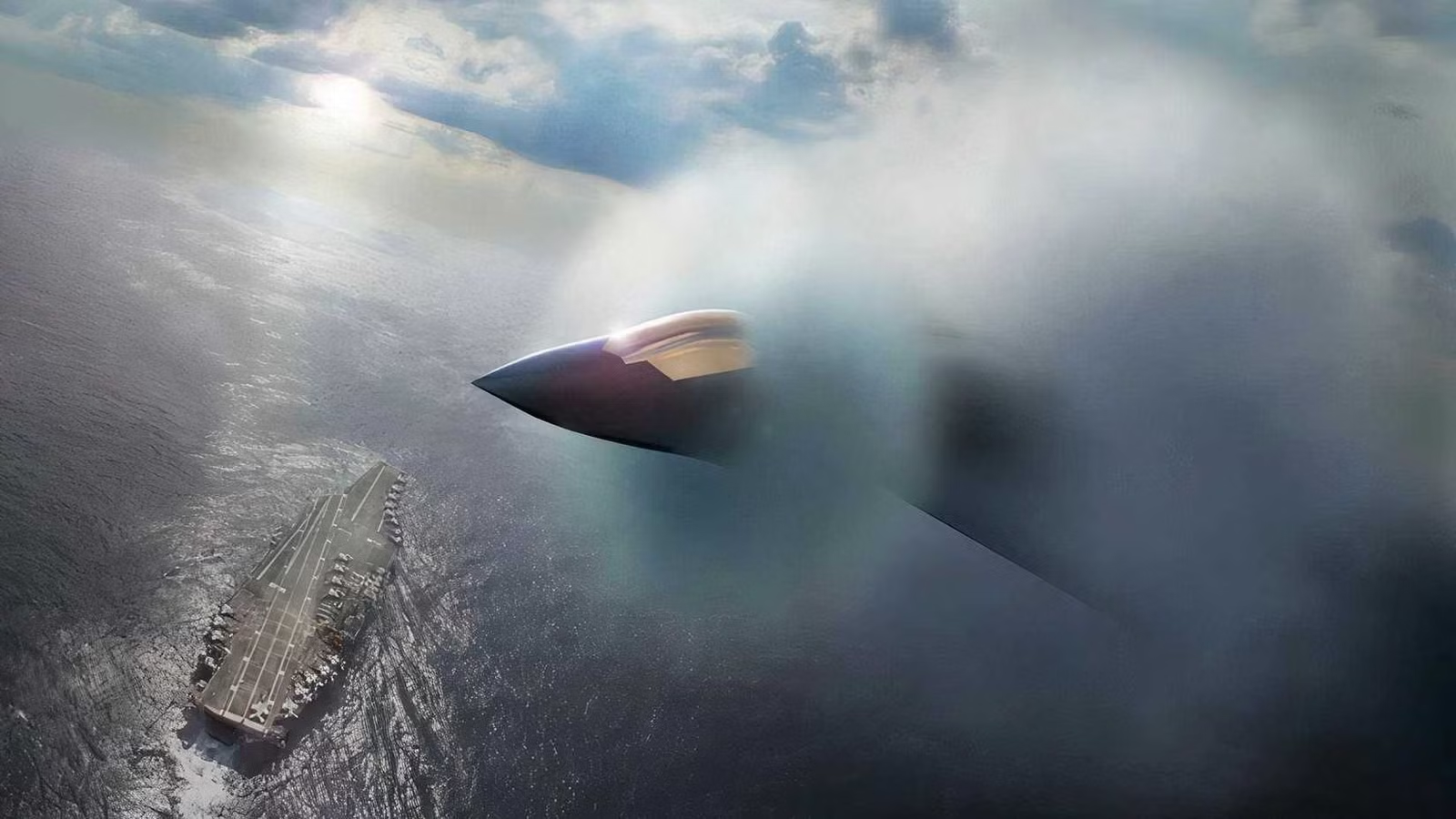
As the United States races towards its first sixth-generation fighter jet, the Next Generation Air Dominance Program of the US Air Force has taken the spotlight, but it is not the only endeavor underway. The US Navy F/A-XX stealth carrier fighter was expected to be shelved, but lawmakers decided to resuscitate the program with an enormous funding injection.
Congress officially added $897 million to the original Navy budget request to do more than just keep development moving, to rapidly accelerate it. Capitol Hill multiplied the F/A-XX budget 13-fold, skyrocketing up from just $74 million to just over $971 million. It is now expected that the down-select will decide between Boeing and Northrop Grumman sometime this year to produce the first sixth-generation USN aircraft.
Notably, although Boeing was selected to build the NGAD, it has struggled with production over the past several years while the NG B-21 Raider sixth-generation bomber program has been a nearly flawless procurement program. So while it’s possible a carrier variant of the F-47 could win, the extensive amount of rework required to make a land-based jet into a tailhook Strike Fighter still leaves an opening for NG to clinch the contract.
The Power Of The Purse: Congress’ Take on The Navy’s Budget

Although the budget for next year has been dramatically raised for the F/A-XX, it was not due to frugality on the part of the Navy. According to Legis1, the $377 billion 2027 budget request is the largest in the history of the Department of the Navy. It is not a routine increase either, as it represents a 23% jump over the 2026 funding proposal. The announcement was also punctuated by the dismissal of the Secretary of the Navy the day after it was released. John Phelan was fired following reported disputes with Defense Secretary Pete Hegseth.
Owing to the situation, the Acting Secretary of the Navy appeared before Congress to defend the budget with less than a month on the job. Acting Secretary Hung Cao, Chief of Naval Operations Admiral Daryl Caudle, and Marine Corps Commandant General Eric Smith testified to Congress that the Navy needed to “restore American maritime dominance.” They emerged with a very different spending plan than he originally took to Capitol Hill.
It was not formally announced where the additional $900 million came from to raise the F/A-XX budget, but the planned improvements to the Virginia-class submarine program have likely been either dramatically reduced or eliminated. It has also been speculated that funding came from the decommissioning of older ships and aircraft to redirect sustainment funds for research and development of new systems.
The Navy Gets New Top Brass In The Pentagon

Since replacing Phelan, Cao has focused his vision for the Navy on “more ships” and a force that he describes in public remarks as composed of “alpha males and alpha females.” Going into the Congressional hearing over the budget, there was already significant concern over the 84% reduction of the F/A-XX program budget and the strong emphasis on shipbuilding, which is known to have an existing industrial capacity bottleneck.
The original 2027 Navy budget aims to nearly double submarine production, so diverting funding away from this investment into the F/A-XX would not be unexpected. It is especially likely since Phelan designed the funding request but was not in the room to defend it before lawmakers. The ambitious automation program for the Virginia-class submarine yards that Phelan championed was slated for around $900 million, matching up with the F/A-XX funding boost.
Still, just last week the House Foreign Affairs Committee’s East Asian Pacific Subcommittee held a hearing to examine how China has come to dominate the global shipbuilding industry. So while many members of Congress may share Cao’s desire to raise shipbuilding capacity, it seems many are more concerned with naval aviation’s future.
Pivoting To The Pacific: The Strike Fighter Of The Future

Paralleling the F-47’s expected technical features, the core qualities of the F/A-XX are expected to be significantly extended range, multispectral stealth, and integration with advanced uncrewed aircraft. Some analysts, using a roughly 600 nautical mile (1,100 km) baseline for the F-35C and F/A-18E/F, calculate an F/A-XX unrefueled combat radius beyond 750 nautical miles (1,220 km), while other assessments cite a higher figure near 1,250 nautical miles (1,930 km). That speculation is based on statements by Rear Admiral Michael “Buzz” Donnelly, then director of the Air Warfare Division within the Office of the Chief of Naval Operations.
Donnelly told the 2025 Sea-Air-Space Symposium that the aircraft would deliver “over 125 percent of the range” of existing strike fighters. The heavy emphasis on combat radius is due to the view that extended range is a core attribute driven by the need to operate against China’s anti-access/area-denial missile threat in the Pacific. The Indo-Pacific theater is rapidly becoming the main focus of the entire US Armed Forces, but especially the Navy. Thus, the F/A-XX will be tailored to a conflict with a near-peer adversary in the first island chain.
Alongside that significant performance increase, most likely expected to be delivered through variable-cycle engines like the NGAD, will be massively increased electrical power generation in order to support emerging technology. The advanced systems expected to be included in the F/A-XX arsenal are advanced beyond visual range air-to-air weapons, as well as over-the-horizon standoff air-to-surface missiles, and even directed energy weapons, aka lasers. The other crucial system will be its ‘supercomputer’ suite to control collaborative combat aircraft, or loyal wingman drones.
The Next Era Of American Naval Aviation

The F/A-XX will be much more than a simple upgrade in hardware over the outgoing Boeing F/A-18E/F Super Hornet. The greatly enhanced range of the next-gen fighter will allow the carrier strike group to project power from much further over the horizon than ever before. Additionally, the Advanced Data Link Technology inside the F/A-XX will allow it to be a command and control node in the new combat cloud ‘killweb’ pioneered by the Lockheed Martin F-35 Joint Strike Fighter.
Catch what other flight trackers miss
Emergency squawks, holds, NOTAMs — live signals, no signup.
Open tracker
Catch what other flight trackers miss
Emergency squawks, holds, NOTAMs — live signals, no signup.
Open tracker
The USN Tailhook Community has prided itself for decades on some of the most exceptional ‘stick and rudder’ skills of any professional aviation organization in the world. However, the skill set of future Naval aviators will be more heavily focused on systems and tactics than actually flying the plane. The F/A-XX is envisioned as a kind of ‘quarterback’ on the battlefield, just like the current F-35C, which was the first stealth fighter ever flown by the USN Air Wings.
Under the F-35 Lightning II Joint Program Office, thousands of stealth fighters have been delivered to 19 partner nations around the world to greatly extend the interoperability of Allied air powers across the globe. Both the F-47 and the F/A-XX will take that to the next level when they enter service. With a fully functional kill web already established, the sixth-generation aircraft will dramatically increase the lethality of every interconnected weapon system and combat unit connected to the data link.
Roadmap To A Watershed Moment For America’s Navy

Now that the budget has been approved, the work begins to make the F/A-XX a reality. Admiral Daryl Caudle confirmed that the Navy will select the prime contractor in August of this year. The terms of the funding increase also dictate that a single contractor shall be chosen. Since Lockheed Martin was eliminated previously, that leaves the down-select between Boeing and Northrop Grumman. Once a winner is awarded, the prototype is hoped to take flight by the early 2030s.
The F-47 is hoped to take flight in 2028 as the US Air Force has a head start on its own sixth-generation fighter jet development. However, a major obstacle to the aircraft’s entry into service is the supposed delay of the Next Generation Adaptive Propulsion, or variable-cycle engines, which will be crucial to its extended range and electrical power generation. Both Pratt and Whitney and General Electric are competing to be the builder of these radical three-stream afterburning turbofan engines. Yet the complexity of the power plants has allegedly induced a delay of three to four years already.
Despite being over a year behind the USAF’s NGAD, the timeline of the NGAP power plant program may see the two fighter jets enter service around the same time. Current projections have the Navy estimating initial operating capability in the mid to late 2030s with full production slated for approximately 2040. That is less ambitious than the Air Force schedule, which is not unexpected given that the program has a later start date.
The harsh conditions of operating aboard a ship on prolonged deployments at sea induce numerous additional design challenges. Those extra engineering hurdles are another reason why Boeing is not a surefire winner despite being selected by the USAF. Boeing is the incumbent as the builder of the Navy’s current Rhinos, as the Super Hornets are affectionately known, but NG has a strong case with the recent success of the B-21. Regardless of the winner, when the Navy picks the builder of its first sixth-generation jet in August, it will be a historic moment in the history of US Naval Aviation.