dailynewsnblog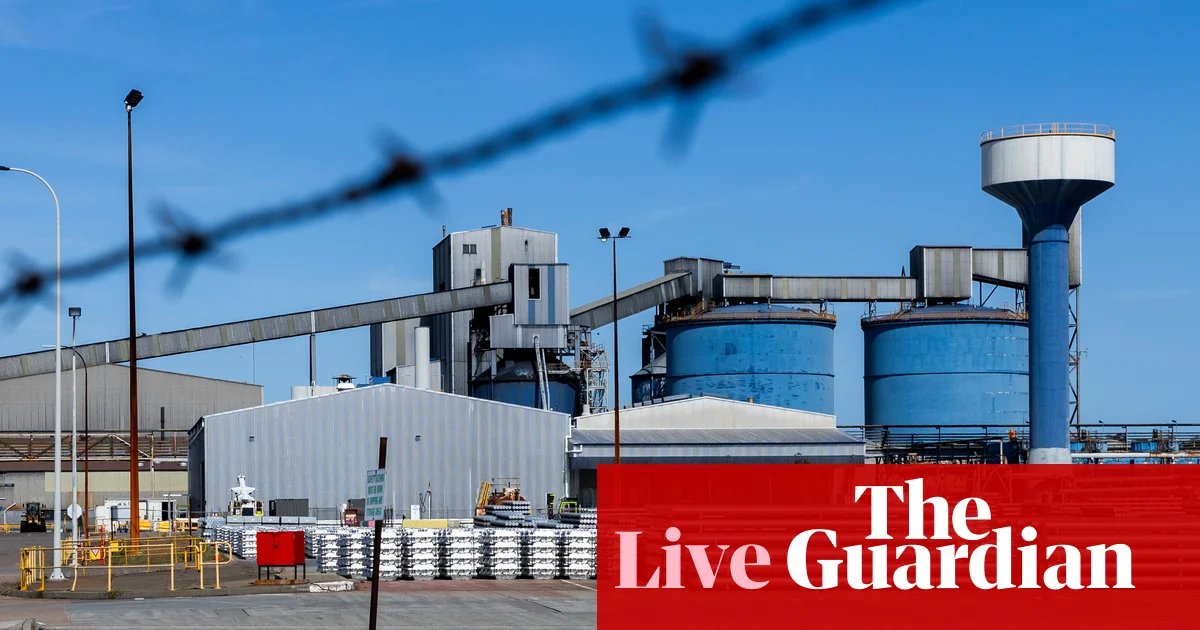
Rio Tinto given $2.5bn bailout for Australia’s largest aluminium smelter
The industry minister, Tim Ayres, is in Tomago, in the NSW Hunter region today announcing a bailout of Australia’s largest aluminium smelter.
The $2.5bn bailout – shared by the commonwealth and state government – means the facility will remain operational until 2039, when its owner Rio Tinto had previously warned it could shut down at the end its current electricity supply contract.
Ayres, donned in some high vis, is doing the media rounds this morning and says the project will be more viable with extra renewables coming online to power it. He tells ABC News Breakfast:
The owners of this facility have made very clear is it’s the high cost of coal power that is the problem for this facility. And that the only solution was to bring forward investment in new renewables, wind and solar, backed by storage and gas, to deliver lower cost efficient electricity for this system.
This is the latest in a series of bailouts by the government for smelters around the country, but Ayres says they’re all in the national interest.
We are operating in an environment where Australia’s industrial capability, our heavy manufacturing capability, is vital for our future national security, for our national economy resilience.

Key events
Bragg was sharing ‘personal views’ in press club speech, says Paterson
Shadow defence minister, James Paterson, says his party will take a “careful” approach to migration planning, and that Andrew Bragg was speaking in a personal capacity at the press club.
Yesterday Bragg told the press club the Coalition would reduce net migration to 180,000 – which would see a cut in international student, backpacker and unskilled worker visas.
Paterson tells News24 that the number isn’t set and the policy is still being worked on.
Andrew was sharing his personal views in his speech, the National Press Club, we are going through our policy development process. We’re doing it carefully. We’re doing it deliberately.
Climate group calls renewable investment to power Tomago a ‘lightbulb moment’
The Climate Council has welcomed the government’s decision to underpin nearly three gigawatts of new renewable generation and firming capacity to accelerate the decarbonisation of the Tomago facility as part of the bailout.
A senior adviser for the council, Ben McLeod, calls it a “lightbulb moment” for the clean energy industry.
Powering our single-largest electricity user with wind, solar and storage is a lightbulb moment for clean industry. This deal to lock-in the future of the Tomago smelter shows what renewable power makes possible: secure jobs, a stronger grid and less climate pollution.
Will the public see any return in revenue from the bailout?
Continuing his rounds, Tim Ayres speaks to ABC AM radio and is asked whether Australians will get a return from the bailout.
Ayres says there is a revenue sharing agreement that could see some return when aluminium prices are really high – but he doesn’t say how much we’re likely to see, and what that threshold is.
It’s a potential return to the taxpayer that means that we’ve got a shared interest in the success of this facility. It’s not a simple bailout package. This is a complex undertaking that means we’ve got shared interests in delivering for the electricity, the power purchasing agreement, the investment in new generation and transmission between the governments.
I don’t want to make predictions about the future. You’d have to have some confidence, I think, with global demand for aluminium so high. This is a crucial product.
Asked what this means for other smelter projects that might also be struggling with energy prices, and whether the government has signalled that it’s always willing to intervene, Ayres says:
We’re determined to secure our current capability and our Future Made in Australia agenda in critical minerals and metals and steel and iron is unrolling out before Australians now because it’s vital for Australia’s national interest that we deliver it.
Rio Tinto given $2.5bn bailout for Australia’s largest aluminium smelter
The industry minister, Tim Ayres, is in Tomago, in the NSW Hunter region today announcing a bailout of Australia’s largest aluminium smelter.
The $2.5bn bailout – shared by the commonwealth and state government – means the facility will remain operational until 2039, when its owner Rio Tinto had previously warned it could shut down at the end its current electricity supply contract.
Ayres, donned in some high vis, is doing the media rounds this morning and says the project will be more viable with extra renewables coming online to power it. He tells ABC News Breakfast:
The owners of this facility have made very clear is it’s the high cost of coal power that is the problem for this facility. And that the only solution was to bring forward investment in new renewables, wind and solar, backed by storage and gas, to deliver lower cost efficient electricity for this system.
This is the latest in a series of bailouts by the government for smelters around the country, but Ayres says they’re all in the national interest.
We are operating in an environment where Australia’s industrial capability, our heavy manufacturing capability, is vital for our future national security, for our national economy resilience.

Krishani Dhanji
Good morning,
Krishani Dhanji here with you for the final sitting day of the week, thanks to Martin Farrer for getting us started.
It’s going to be another busy day in the big House so lets get straight into it!
Australia joins condemnation of Iran’s use of capital punishment
Australia has joined more than 30 nations, including France, the United Kingdom and Canada, in condemning Iran’s use of capital punishment, saying in a joint statement the Islamic republic was executing protesters to “silence dissent”.
AFP reports that the countries, joined by the European Union’s top diplomat, “condemn in the strongest terms the ongoing executions of protesters and use of the death penalty” by Iran.
“The use of capital punishment to silence dissent, intimidate communities and punish individuals exercising their human rights can never be justified,” the statement said.
New Zealand, Ireland, Italy, Germany and numerous other European nations were also among those calling for Iran “to immediately end the use of the death penalty and release all those arbitrarily detained”.
The statement joins growing alarm from the United Nations and rights groups over a surge in executions in recent months.
According to the UN, since 19 March, at least 56 people have been executed on national security-related charges, including 27 people in cases linked to the protests.
The UN and rights groups have warned of a lack of fair trials and forced confessions.
Students to rally against Pauline Hanson
Thousands of students are expected to rally in Students Say No to Pauline Hanson protests across major cities and towns, AAP reports.
“I’m hoping this will be the start of a real kind of movement,” said Australian National University student Yerin Park, who is organising the Canberra protest.
“We want to make sure we lay the best basis for … an anti-racist, anti-sexist, anti-bigot response in Australia.”
Rally flyers distributed by the National Union of Students include calls to “fight against racism” and “stand up against the far right”.
Hanson, the leader of One Nation, used her June National Press Club address to call for a monocultural Australia before appearing on a podcast hosted by British far-right activist and convicted criminal Tommy Robinson during a work trip to the UK last month.
Hanson’s track record shows she has voted against pro-education policies such as free Tafe and increasing funding for public schools, the union’s general secretary, Akash Nagarajan, said.
“Pauline Hanson actually doesn’t stand for things that benefit students’ lives … [and] a lot of students are galvanised by that,” the 21-year-old said.
Rikkie-Lee Tyrrell, One Nation’s only member in Victorian parliament, said everyone had the right to protest but expressed concern about who was behind the movement.
“Students really should be focusing on academics and I think the Socialist party getting involved with students is the wrong way to go,” she told reporters.
News bargaining incentive bill to pass parliament

Josh Butler
The news bargaining incentive bill will pass parliament after a deal between Labor and the Coalition, which will see tech giants forced to make more total deals with news publishers and a special deal for the Australian Associated Press newswire.
The NBI, which is designed to force tech companies such as Facebook and TikTok to pay media outlets for the value they derive from news on their platforms, will be introduced into parliament today.
After negotiations with the opposition, Labor will amend the bill to require tech giants to make a minimum of eight deals with news publishers – up from the previous six. The design of the scheme will also mean big tech platforms can only offset a maximum of 25% of their exposure to the levy with each deal, which is to incentivise deals being made with a range of outlets.
Additionally, 5% of funds will be directed to AAP, the news wire service.
“The Albanese government is delivering for journalists and ensuring they get their fair share from digital platforms that benefit from Australian news,” said the communications minister, Anika Wells.
The assistant treasurer, Daniel Mulino, called it a “significant day for the future of Australian journalism.”
“We want to see deals between digital platforms and a diverse range of media organisations to ensure fair recompense for the use of content,” he said.
Welcome
Good morning and welcome to our live politics blog. I’m Martin Farrer with the top overnight stories and then it will be Krishani Dhanji with the main action.
The news bargaining incentive, which will see tech companies forced to make more deals with news publishers to compensate them for using their material, will be introduced to parliament today. More coming up.
New investor home loans have plummeted since the May budget but the treasurer, Jim Chalmers, insists house prices will continue to grow over the next two years.
And overnight Australia has joined more than 30 nations, including France, the United Kingdom and Canada, in condemning Iran’s use of capital punishment.