Canada could lose more than 100K jobs if CUSMA dies: report


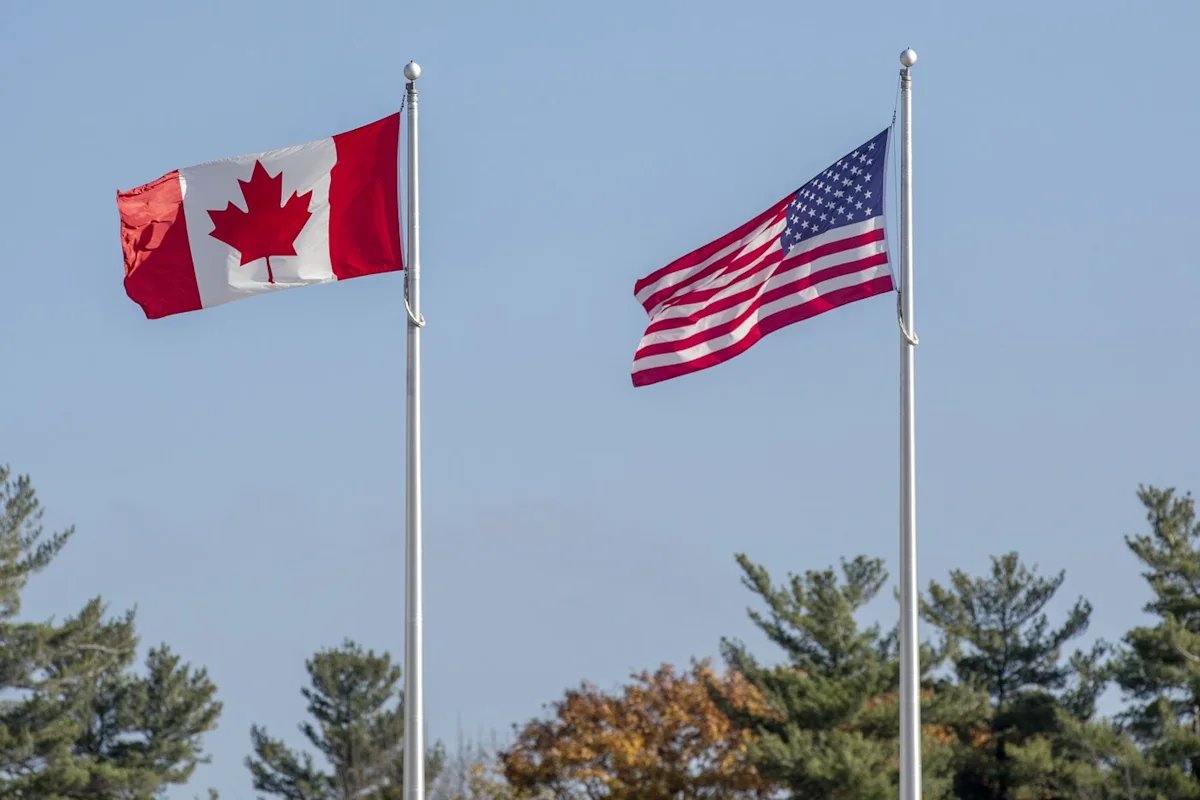
The Canadian and American flags flap in the breeze at the Thousand Islands border crossing in Lansdowne, Ont., on Monday Nov. 8, 2021. THE CANADIAN PRESS/Lars Hagberg – The Canadian Press

OTTAWA — Canada could lose 102,000 jobs if the Canada-U.S.-Mexico agreement on trade breaks down, a new report warns.

The report, prepared for the Canadian American Business Council by Oxford Economics, studied the potential economic consequences of various CUSMA scenarios, including termination of the deal.

The report says the United States would lose 214,000 jobs in 2027 if CUSMA died.

“Many of these jobs would be in manufacturing industries directly impacted by tariffs, but the service sector would also feel the impact as lower disposable income causes households to reduce consumer spending and lower trade, and investment reduces demand for transportation, construction and professional services,” says the report.

The successful renegotiation of CUSMA, it says, would create 137,000 American jobs and 98,000 Canadian jobs.

Bea Bruske, president of the Canadian Labour Congress, said in an email that Canadian workers can’t be a bargaining chip in a trade war they didn’t start.

“There are real jobs on the line, and the government needs to be ready to defend them,” she said. “But protecting Canadian workers cannot mean signing a bad deal because Donald Trump threatens to walk away. Canada needs to know what it is fighting for, where the red lines are, and what the plan is to protect workers and communities if the U.S. walks away.”

The report says the provinces and states affected most by the loss of CUSMA would include Ontario, Quebec, Manitoba, New Brunswick, Michigan, Indiana, Washington and Iowa.

For Canada, the industries facing the deepest impacts from the loss of CUSMA would include autos, metals, machinery, electronics, chemicals, wood products and paper products, the report says.

“The economic consequences are real and we should go into any negotiation with eyes wide open,” Beth Burke, CEO of the Canadian American Business Council, said in an interview Tuesday.

The report said a successful renegotiation of the deal would be worth approximately $516 per U.S. household and $846 in Canadian dollars per Canadian household each year.

“That’s not insignificant, especially in a time where affordability is pinching everyone,” she said.

A new round of 50 per cent American tariffs on a range of Canadian goods is set to take effect on Aug. 19.

Unlike most of U.S President Donald Trump’s other tariffs, these would have no exemptions for goods that comply with CUSMA.

Canada-U.S. Trade Minister Dominic LeBlanc and Janice Charette, Canada’s chief trade negotiator, are back in Washington this week for another round of trade talks.


LeBlanc said on social media Tuesday that they met with United States Trade Representative Jamieson Greer.

“Discussions remain ongoing, and we continue to engage at the negotiation table to firmly advance and defend Canadian interests,” he said.

On Sunday, LeBlanc’s spokesman Gabriel Brunet said talks have broadly covered the threatened new duties, existing sectoral tariffs and renegotiations of CUSMA.

Burke said she’s “very cautiously optimistic” as officials continue to meet.

“Every time they get together and hash out and have more meaningful substantive conversations is another step towards getting to the right place on an agreement,” she said.

The report says an estimated 1.4 million American jobs and 2.5 million Canadian jobs depend on the bilateral trade relationship.

“Reversing this integration would not merely remove its direct benefits but would also impose substantial transition costs on businesses forced to rebuild intricate supply chains created over decades and incur long-run efficiency losses,” it says.

The report says current tariffs represent a “significant departure” from pre-2025 levels.

“However, the termination of (CUSMA) would result in large increases in both countries’ tariffs,” the report warns.

“A successful renegotiation of (CUSMA) would cause bilateral tariffs to fall close to their pre-2025 levels of around one per cent, as in this scenario only limited additional tariffs are assumed to remain on steel, aluminum and Canadian dairy.”

This report by The Canadian Press was first published Aug. 11, 2026.

Catherine Morrison, The Canadian Press


Source link

  • Related Posts

    Britain’s Andy Green sets another speed record, this time in a hydrogen-powered car

    WENDOVER, Utah (AP) — The only person to break the sound barrier in a car earned another world record Tuesday in a show of force for hydrogen power. British driver…

    An autopsy of the voluntary carbon market

    The voluntary carbon market was built on a single promise: that one credit cancels one tonne. Most scrutiny has asked whether that promise holds on the supply side – whether…

    Leave a Reply

    Your email address will not be published. Required fields are marked *

    You Missed

    Star Wars Zero Company Is Good But Seems To Play Things Too Safe – Preview

    Star Wars Zero Company Is Good But Seems To Play Things Too Safe – Preview

    Planning a trip this summer? What you need to know about how the situation in the Middle East is affecting travel abroad

    Planning a trip this summer? What you need to know about how the situation in the Middle East is affecting travel abroad

    Britain’s Andy Green sets another speed record, this time in a hydrogen-powered car

    Britain’s Andy Green sets another speed record, this time in a hydrogen-powered car

    CanLit: The dog days of fiction

    History has a brutal warning for J.J. McCarthy and Anthony Richardson

    History has a brutal warning for J.J. McCarthy and Anthony Richardson

    'Verity' Trailer

    'Verity' Trailer