dailynewsnblog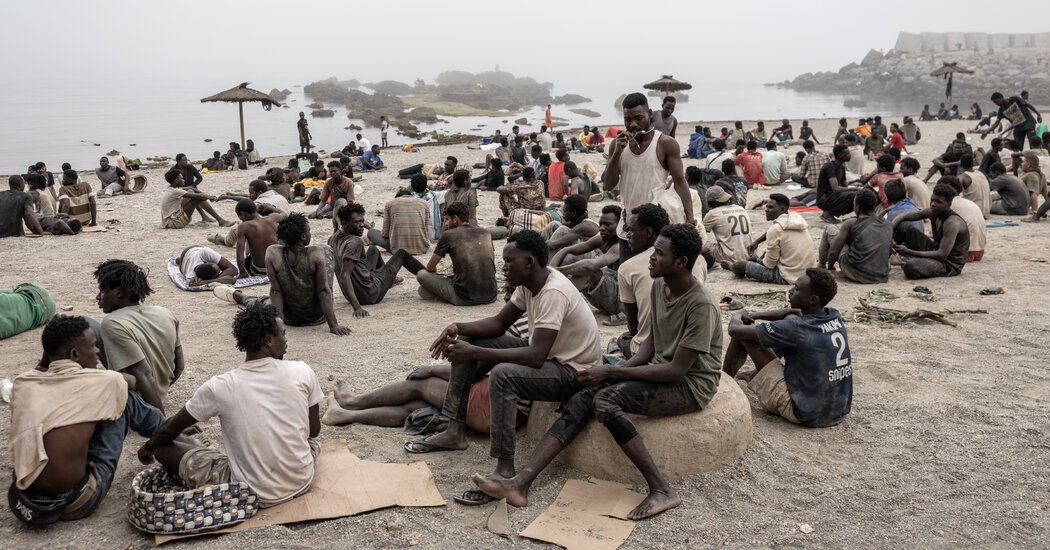
The actor Javier Bardem wondered if Israel had something to do with the rush of over 70,000 migrants last month from Morocco to Spain. Marjorie Taylor Greene, the former Republican congresswoman and veteran conspiracy theorist, suggested the Republican Party was behind it. Others said King Mohammed VI of Morocco had set off the crisis to mess with Spain.
Experts have said that there is no evidence that any state played a role in masterminding the unprecedented migration to Ceuta, a Spanish exclave in North Africa. The Spanish and Moroccan governments blamed the surge, which killed about 90 migrants before most of the people involved had retreated to Morocco, on a viral social media misinformation campaign by smugglers.
But that hasn’t stopped all sorts of conjecture about what really happened. That speculation is partly rooted, analysts said, in the deeply complicated relationship between Spain and Morocco.
Spain occupied parts of Morocco for much of the 20th century, and many Moroccans still contest Spain’s control over its African territories, including Ceuta. Yet the two countries are also interdependent for intricate economic, political and geopolitical reasons.
They have conflicting positions on Algeria, Israel and the Trump administration. Spain has a fraught relationship with Washington and Jerusalem, but a warming one with Algiers. Morocco, however, sees Algeria as a rival but is improving ties with Israel and the United States.
People of all ideological stripes have seized on all those layers of complexity to develop the mystery, or conspiracy, of their choosing.
“We are seeing the simplification of a very complex reality,” said Pol Morillas, director of the Barcelona Center for International Affairs, an independent research organization. “This is where all the different theories come in.”
In an era of rising nationalism and misinformation, Mr. Morillas said, the Ceuta situation fed the wildest of imaginations. “It’s a sign of the times,” he said.
For the most part, Mr. Morillas added, the Spain-Morocco relationship is managed smoothly. Spain is Morocco’s main trading partner in Europe. Morocco also accounts for the largest source of legal migrants to Spain. It also usually prevents unauthorized migrants from reaching Spain, even if it has in the past, experts say, weaponized migrant flows for geopolitical benefit.
In 1975, as the Spanish dictator Francisco Franco lay on his deathbed, Morocco sensed weakness and sent 350,000 people, as well as military forces, into the Western Sahara territory that Spain had controlled for nearly a century. The move, known as the Green March, helped to prompt Spain to withdraw.
“Quite a few people in Ceuta are already comparing it with the Green March,” said Enrique Avila, a retired political scientist in Ceuta who served as an artillery soldier for Spain in the Western Sahara during the withdrawal. “You feel threatened, and it is constant.”
In Spain’s absence, a conflict escalated in the Western Sahara between Algerian-backed separatists, who supported self-determination for its residents, and Morocco, which argued that it had a historical claim to the lands. Spain, seeking functional relations with both Algeria and Morocco, remained neutral.
In 2020, the Trump administration, helped persuade Morocco to normalize its relations with Israel in exchange for American recognition of Moroccan sovereignty over Western Sahara. Israel later did the same.
Spain refused to follow their example, even allowing a separatist leader to be treated for the coronavirus in a Spanish hospital.
It was amid those heightened tensions in 2021 that Morocco loosened border controls and let about 10,000 migrants cross the border into Ceuta. Many in Spain saw the move as a clear geopolitical flex to punish Spain for its neutrality on Western Sahara.
A year later, Spain reversed its position and backed Moroccan control over the territory — pleasing Morocco but angering Algeria, the separatists’ backer.
This year, Spanish leaders tried to improve ties with Algeria, hoping to import more Algerian gas but potentially antagonizing Morocco.
On July 20, Spain’s prime minister, Pedro Sánchez traveled for the first time in four years to Algeria for talks to improve relations. The surge from Morocco happened days later.
The confluence of events was, for some, proof enough of a Moroccan plot, even as Moroccan experts cautioned that such a deadly disaster was unlikely to have been orchestrated by the kingdom.
“It’s hard to believe this caught the authorities completely by surprise,” Juan Jesús Vivas, the leader of Ceuta’s government, said recently when asked if he thought Morocco had had a hand in the surge. “You can’t hide 80,000 people in a trunk. I would have expected a movement of people on that scale to have been detected.”
Such doubts were amplified by the fact that Morocco has grown increasingly friendly with Israel and the United States, which have both had tense relationships with Spain recently.
Mr. Sánchez has clashed with President Trump over migration and Iran, as well as with Israel over its conduct in Gaza. By contrast, Morocco announced in July that it would name a major highway after Mr. Trump, and it has been talking publicly about helping to secure Gaza.
Then, as the Ceuta crisis unraveled, Israeli officials appeared to relish Spain’s discomfort.
Israel’s ambassador to the United Nations, Danny Danon, took a dig at the Spanish government by asking why Spain had criticized Israeli actions in Gaza when it has a colonial legacy of its own.
“Maybe before it continues lecturing us,” Mr. Danon wrote on social media, “it’s time it explained to the world why it still maintains colonial enclaves in Africa.”
That appeared to have fueled speculation from some of Mr. Sánchez’s own allies, who now seemed to think something big was going down. On July 31, Spain’s transport minister, Óscar Puente, seized on Mr. Danon’s post as evidence of, well, something.
“Well,” Mr. Puente wrote, “it’s all starting to become quite clear.”
When asked by The Times to explain what had become clear, Mr. Puente forwarded government talking points that contradicted the idea of a state-led conspiracy.
Still, similar doubts simmered across the Spanish left. “The Moroccan dictatorship, in the service of the U.S. and Israel, is once again blackmailing Spain and Europe this summer by turning its own people into disposable cannon fodder,” wrote Gabriel Rufián, a prominent member of the Spanish Parliament.
Irene Montero, the former leader of the far-left party Podemos, wrote on social media, “If you pay a dictatorship like Morocco to do the dirty work, when Morocco wants more — or when the US and Israel order them to — they stop doing it to blackmail you.”
The post was shared by Mr. Bardem, one of Spain’s most celebrated actors and a vocal critic of Israel’s war in Gaza.
Figures from the American far-right made similar claims.
Ms. Taylor Greene seized on a recent congressional report, connected to a House bill, that recommended $40 million in security assistance to Morocco. The report, produced by a Republican-led committee, referred to Ceuta as a “Spanish-administered” land “located in Moroccan territory.”
That was enough for Ms. Taylor Greene to conclude in a post on X: “Republicans paid $40 MILLION of your tax dollars to Morocco to invade Spain.”
There is no evidence for any of those theories.
But the “increased chaos” in the world, coupled with Morocco’s strategy of “calculated ambiguity,” had made everything seem plausible, said Haizam Amirah-Fernández, director of the Center for Contemporary Arab Studies in Madrid.
“Was this planned? Was this orchestrated?” he asked. “So many different layers.”
Carlos Barragán contributed reporting from Ceuta, Spain, and Madrid, and Aaron Boxerman from Jerusalem.