dailynewsnblog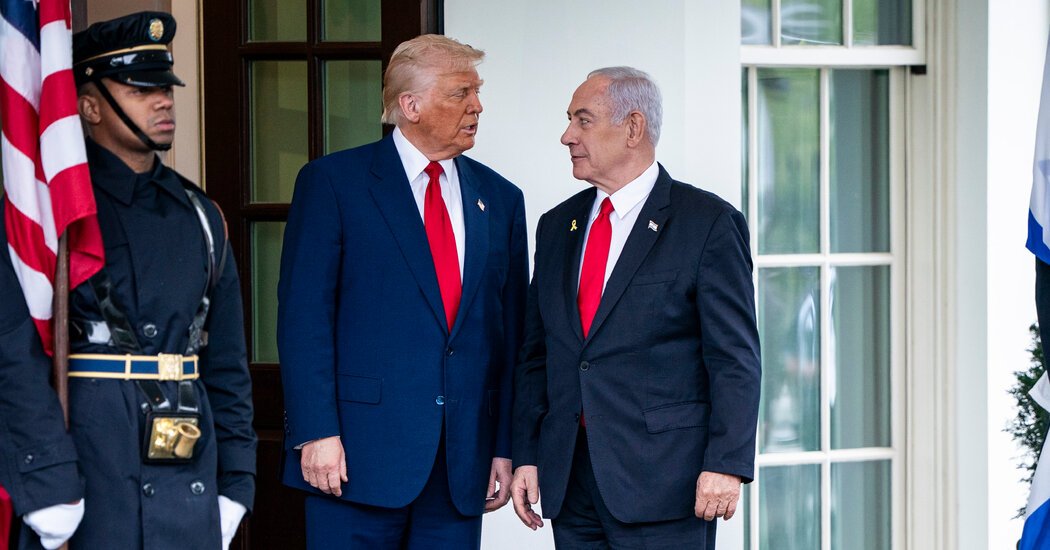
Prime Minister Benjamin Netanyahu, who is months away from his first national elections since the Hamas-led attack on Israel, faces an increasingly difficult challenge: how to placate President Trump, his most important ally, without alienating voters in his right-wing base.
That challenge was on full display after Mr. Trump announced last month that his Board of Peace had reached an agreement to disarm Hamas. The deal was quickly met by Israeli skepticism. Then on Sunday, Mr. Netanyahu openly rejected Mr. Trump’s plan in a rare public break with the American president.
The dispute shows how Mr. Netanyahu, who faces one of the biggest political fights of his career to win re-election in October, is being pulled in opposite directions at home and abroad.
Mr. Trump’s plan calls on Mr. Netanyahu to deliver concessions, such as pulling back Israeli troops in Gaza, which would be unpalatable to hawkish members of his constituency. At the same time, political pressure is intensifying on the prime minister as he lags behind in public opinion polls in the run-up to the election.
“He’s walking on a political tightrope,” said Shira Efron, chair of Israel policy at the RAND Corporation, a research group. “On the one hand, he needs to cater to his base and coalition, which he has promised ‘total victory’ over Hamas. On the other hand, he doesn’t want to upset President Trump.”
Mr. Netanyahu attempted a similar balancing act after the United States and Iran signed a cease-fire deal in June, despite Israeli objections to the agreement. At the time, Mr. Netanyahu heeded Mr. Trump’s demand that Israel abide by the truce, while trying to mitigate domestic blowback. It is unclear whether Mr. Trump or Mr. Netanyahu’s base will hold more sway as the Israeli prime minister debates how to move forward in Gaza.
More than 10 months after a cease-fire agreement between Israel and Hamas that was brokered by the Trump administration last year, many Gazans are living in tents and rubble, as Israel has barred full-scale reconstruction there as long as Hamas refuses to disarm. Over 1,250 people have been killed in Israeli strikes in that period, according to the Gaza health ministry, which does not distinguish between civilians and combatants.
The Israeli leader appears to have made some limited concessions, like holding back on near-daily Israeli airstrikes in the enclave. In the days after Mr. Trump announced the Hamas deal, the Israeli military continued its strikes in Gaza, killing at least 20 people and damaging warehouses full of medical supplies, according to Palestinian officials.
On Aug. 2, Mohammed Dahlan, an influential Palestinian exile and a confidant of the president of the United Arab Emirates, wrote on social media that Jared Kushner, Mr. Trump’s son-in-law, had told him he was “working with the Israeli side to stop the attacks on Gaza.”
The next day, Mr. Netanyahu met with senior officials from the Board of Peace, including Nickolay Mladenov, a veteran Bulgarian diplomat who is the organization’s high representative for Gaza.
Following the pressure, Mr. Netanyahu agreed to order the military to halt its strikes, according to three people briefed on the conversation, who spoke on the condition of anonymity to discuss sensitive details.
The last Israeli strike on Gaza was last Monday evening, said Mahmoud Basal, an official in Gaza’s civil defense, an emergency response service under the Hamas-run interior ministry. That was the same night when the Board of Peace officials met with Mr. Netanyahu. It was unclear how long the respite in attacks on the enclave would last.
“I think what we’re seeing is Netanyahu flexing his muscles internally, while taking baby steps toward accommodating some of the administration’s demands,” said Nimrod Novik, a former senior Israeli official and now a fellow at the Israel Policy Forum, a New York-based research group.
But as part of the agreement with Hamas, Mr. Netanyahu would have to make further moves with a higher political cost. He has already rejected any retreat of Israeli forces in Gaza before Hamas fully disarms.
Many Israelis are skeptical that Mr. Trump’s Board of Peace can actually disarm Hamas and destroy its tunnels and weapons depots.
“That strikes me and the vast majority of Israelis as an extraordinarily optimistic assumption about Hamas’s cooperation,” said Eli Groner, a former director general of the prime minister’s office.
The deal also stipulates that Israel first uphold its part of the truce agreed last year to halt airstrikes, pull back its forces within Gaza and allow more aid into the devastated Palestinian enclave.
The timing of Mr. Trump’s deal is especially difficult for Mr. Netanyahu’s re-election campaign, given that his opponents have surged ahead in public opinion polls.
Most surveys project that Mr. Netanyahu and his allies would win between 51 and 53 out of 120 seats in the Israeli Parliament — below the 61 typically required to form a government. A new political party founded by a former Israeli military chief of staff regularly polls higher than Mr. Netanyahu’s Likud, long the largest single party in the country.
Israelis will head to the polls in late October in the first national vote since the Hamas-led attacks on Oct. 7, 2023, the deadliest day in Israeli history. About 1,200 people were killed and some 250 taken hostage in the assault, prompting the devastating Israeli war in Gaza.
Many Israelis hold Mr. Netanyahu responsible for the disaster. Even the prime minister’s supporters concede that despite his promises to decimate Hamas after the attack, the Palestinian armed group still controls parts of the Gaza Strip.
Mr. Trump’s deal with Hamas stops well short of Mr. Netanyahu’s pledge to exact its full surrender. The deal makes no mention of exiling top military commanders and offers pathways for some members of the Hamas-run government to remain employed in the public sector.
Scenes of Israeli troops withdrawing from Gaza could further undermine Mr. Netanyahu’s argument to right-wing voters that he won the war against Hamas.
“This isn’t the kind of victory he was marketing all throughout the war,” said Mr. Novik.
Negotiators from the Board of Peace spent months revising the text during rounds of talks with Hamas leaders. Clauses that explicitly stated that Hamas would not possess any weapons were dropped from later drafts, according to two officials familiar with the negotiations, who spoke on the condition of anonymity because they were not authorized to speak publicly.
The finished agreement commits Hamas to “decommission and store” its heavy weapons in a process led by a new group of U.S.-backed Palestinian technocrats. But some critical details are still to be negotiated, including the timeline for when Hamas would hand over its weapons and how Israel would withdraw from Gaza.
“Various elements of the plan still have to be worked out,” said Ms. Efron. “And even elements that have already principally been worked out need to be implemented.”
Natan Odenheimer contributed reporting.