dailynewsnblog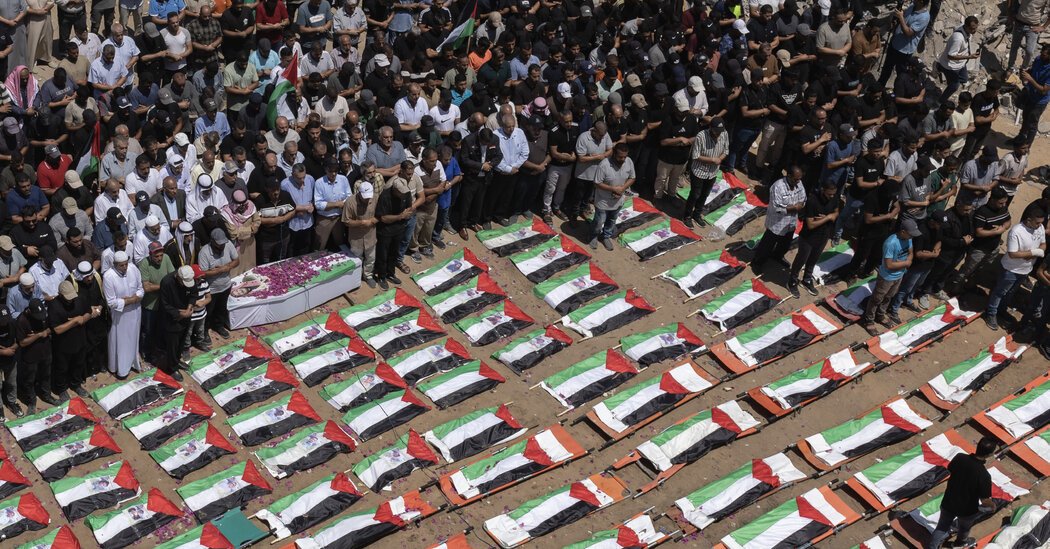
Gaza under a cease-fire remains an extremely violent place. Israel has continued striking on a near-daily basis, killing more than 1,000 Palestinians since October, according to the Gaza health ministry. Among them are senior Hamas officials, but also civilians, including children, my colleagues report.
More than 60 percent of the Gaza Strip remains occupied by Israel, which says that Hamas is seeking to rearm and that Israeli forces are targeting militants. Yesterday, Israel rejected a 15-point plan backed by the Trump administration that called for Hamas to disarm in exchange for an end to the occupation.
The war in Gaza has been hard to cover because Israel has barred foreign journalists from entering the territory. The cease-fire is hard to cover for the same reason. Which is why I want to introduce you to Saher Alghorra, a Gazan photographer who has been documenting the war for The New York Times and this year received a Pulitzer Prize for his work. Today, he writes about what it’s like living in Gaza now.
Gaza City is my home. I grew up in the Tal al-Hawa neighborhood, and I still live there today. I’ve never left Gaza. I studied journalism at the University of Palestine and began working as a freelance photojournalist in 2021.
There have been six major wars between Israel and the Hamas authorities in Gaza, but the one that began after the Hamas-led Oct. 7 attacks in 2023 was unlike any that came before.
Since October last year, there’s been a cease-fire in place. But for those of us living here, it hasn’t felt like peace.
We’ve been living in extraordinary conditions for roughly 1,000 days now. During the war there was a constant sense of danger — the feeling that death was never far. The relentless bombardments have ceased, but Palestinians are still killed almost every day. Rats and disease are spreading. Malnourishment remains widespread.
It’s not easy to be a journalist in Gaza. During the war, many of my colleagues were killed. The frequent blackouts made it difficult to send my work to my editors. I now work from a cafe with internet access. Fuel remains hard to come by and is expensive. When I can’t use a car, I walk long distances to reach the scene when news happens.
I am 29. My family and I have been displaced from our home six times since Oct. 7. During the war, and in the months since, the safety of my loved ones has been my first responsibility. But alongside that, I’ve felt a responsibility to tell the world the story of my home.
Because my mission as a journalist is to bear witness and give voice to the voiceless.
Scenes I can’t forget
Smoke and flames rising after an Israeli airstrike hit a mosque in Gaza City on July 28.
I took this image in July, when an Israeli airstrike hit a mosque in central Gaza City that Israel said Hamas was using to store weapons.
After reports that Israel was planning an attack in the area, I climbed to a rooftop to wait and see what might happen. About two hours later, I heard the sound of a fighter jet. Seconds later, through my camera’s viewfinder, I saw rising flames, followed immediately by a massive explosion. After photographing the blast, I made my way to the site. As soon as I arrived, I could smell the lingering scent of explosives. Broken glass and pieces of stone were scattered across the streets. The strike had hit a mosque.
Palestinians in Gaza City attending a mass funeral on Aug. 4.
This was one of the most painful scenes I have ever witnessed. It was the funeral of 112 people whose remains had only recently been recovered from the rubble.
What compelled me to take this photograph was the overwhelming scale of the loss. I wanted to convey not only the magnitude of the tragedy but also the long and painful journey these families had endured before they were finally able to bury their loved ones with dignity.
A school in the Zeitoun neighborhood of Gaza City on June 14.
This image is from a school that opened in east Gaza City a few months ago, to help students make progress in their education despite the enormous challenges.
As I walked through the school, several details caught my attention. The classrooms were simple and worn, yet filled with eager students. The desks had been built from the wooden pallets once used to transport humanitarian aid, transforming materials associated with survival into something that represented hope. What moved me most was the students. Despite the destruction and the uncertainty that pervade their lives, they arrived each day wearing clean, tidy clothes. In the midst of so much chaos, their determination to learn and preserve a sense of normal life was deeply inspiring.
Palestinians in Gaza City gathering to watch a World Cup match between Egypt and Argentina on July 7.
This image captures a moment of collective disappointment — it’s the moment a group of Palestinians watched Argentina score the winning goal against Egypt in a gripping World Cup match.
Minutes earlier, the people in this photo had been on the verge of celebrating what had seemed destined to become a memorable Egyptian victory.
I did not go out that day intending to work or photograph a story. I had simply gone to watch football, joining a large crowd that had gathered to support the Egyptian team. I watched the entire first half without carrying a camera or taking a single photograph.
But as the match went on, I found myself mentally composing photographs without actually taking them. Eventually, I walked back to my car, retrieved my camera and began documenting. For me, this photograph is about more than football. It captures a rare moment in which people living through extraordinary hardship came together to experience joy, hope and a sense of belonging — and then, like football fans all over the world, disappointment.
A family sitting down to break their daily Ramadan fast in the charred remains of their home, overlooking the ruins of Beit Lahia, in Gaza, on March 4, 2025.
This image was taken before the October cease-fire, but I’m sharing it here because it’s a scene I haven’t been able to forget.
It shows the family of Tamer Hassan al-Shafei. They’re sitting at a table in what remains of their home to prepare Iftar, the meal after sunset during Ramadan. The contradiction in the frame struck me: the bright yellow tablecloth, a sliver of normality and togetherness, amid the destruction.
For Gazans like Hassan the biggest fear now is that the world might stop paying attention. Much of Gaza still looks like it did when I took this image. The war might be over. But the hardship and the injustice Palestinians endure daily in Gaza are not.
MORE TOP NEWS
WHAT ELSE IS HAPPENING
TOP OF THE WORLD
The most clicked link in your newsletter on Friday was about surfing in Alaska.
A growing number of single people are finding it more fulfilling to focus on hobbies rather than on dates. Instead of spending hours swiping on apps, they are investing their time, energy and disposable income in passions like rock climbing, cake decorating and printmaking. When their social calendars are packed, they say, their friend groups are expanding and their lives feel rich, with or without a romantic partner.
You’re hearing, but are you listening?
To experience New York City, consider tuning into the sounds that mere mortals normally can’t hear.
Jacek Smolicki, an artist, scholar and designer, uses sensitive microphones to help people engage with their sonic environments: the sounds traveling through tree roots in Central Park, the clicks of aquatic snails, the quiet pops of fish mouths opening and closing. For Smolicki, soundwalks are an opportunity to “take a break” from the incessant text alerts and ringtones among other distractions. Listen to the sounds of New York.
RECOMMENDATIONS
Explore: The Edinburgh Fringe opened on Friday. Here are nine shows that are sure to make waves.
Read: In the hilarious novel “The Responsible Party,” a woman vapes her way through her wild family history.
Tone up: These single-leg exercises can help improve balance, core strength and coordination.
Hunt: Which one of these American homes would you choose for $845,000?
This hangover kimchi soup — garlicky, gingery and full of bright flavors — will heal you from within. White beans offer protein, and it becomes even heartier with the addition of white rice or noodles. You can reheat it throughout the week, adding more broth and vegetables along the way.