dailynewsnblog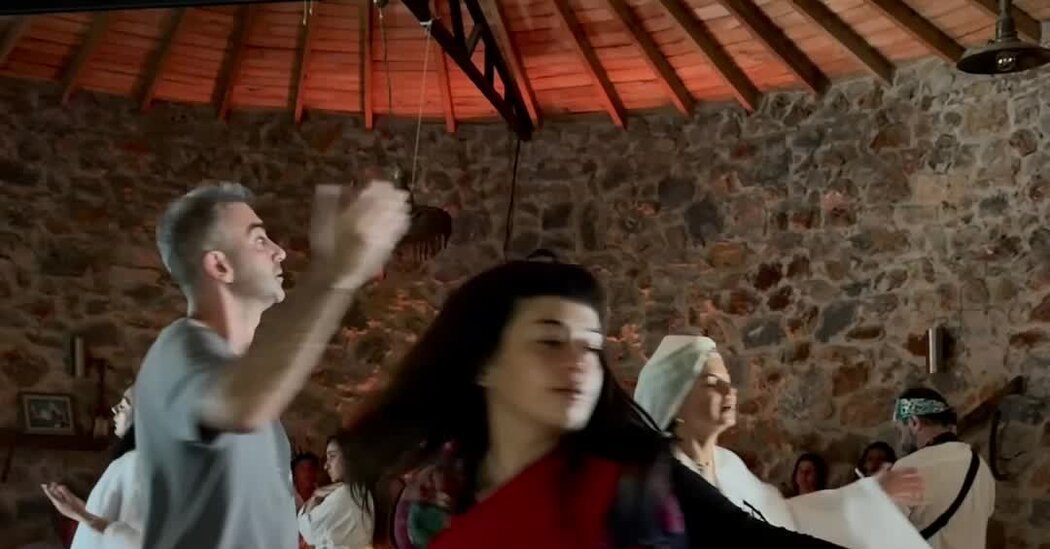
An elder gave a blessing, more than 100 people in a large hall recited Quranic verses and a musician played a melody on a reed flute, soon joined by about 15 bandmates on folk instruments and drums.
A woman in white took to the floor and began to spin, her skirt billowing as she accelerated and lifted her arms toward the sky.
Then came a man with a blond ponytail, a guy with a backward baseball cap, women in flowing dresses — all whirling.
This was the start of a recent gathering in southwestern Turkey focused on the ancient tradition of sema, the spinning form of prayer made famous by the so-called whirling dervishes.
Sema is rooted in the mystical Islamic tradition of Sufism and associated with the Islamic scholar and poet Jalaluddin Muhammad Rumi, who lived in what is now Turkey more than seven centuries ago.
In its best-known iteration, sema is performed by men, accompanied by male musicians, in choreographed ceremonies. In Turkey, it is often done for tourists who buy tickets.
This event, however, was open to everyone and led by a younger generation of whirlers who are making the ancient tradition their own.
The participants came from Turkey, France, Italy, Bulgaria, Iran, the United States and elsewhere. Many saw sema as part of a big-tent spirituality that encompassed Buddhism, yoga, astrology, shamanism and other traditions.
Instead of the classic white outfits and tall wool caps of the dervishes, they spun in embroidered shirts, baggy dresses, jeans, T-shirts and polka-dot socks.
Men whirled alongside women, with the women often outnumbering the men. The band at the heart of the gathering, Tumata, has both and is led by two sisters.
The event was organized to ensure that the whirling would continue nonstop for seven days and nights, with no fewer than two people spinning at any given time.
When I asked Cem Aydogdu, a Sufi guide in attendance, if there were any prerequisites for joining, he answered mystically.
“Whoever comes is called,” he said. “So whoever comes should be here. That’s including you.”
As for the purpose of a week of perpetual whirling, he said it created a vortex, like a whirlpool or tornado, that drew in energy to be dispersed.
“It’s not up to us where the energy goes,” said Mr. Aydogdu, 69, whose followers call him Cem Baba, or “Father Cem” in Turkish. “The one who is causing this to be generated knows where it’s supposed to go.”
The meeting took place at a retreat center with rustic accommodations surrounded by pine forests. It felt like a folk festival combined with a hippyish spiritual retreat.
There were a few rules. No drugs or alcohol, and no exposed backs, chests, bellies or legs in public areas. Rooms, bungalows and glamping facilities were available, but most people pitched their own tents. Attendance was free, but participants were expected to contribute to running costs and to volunteer, including helping with the three communal vegetarian meals per day.
Journalists from The New York Times joined for three days, which included a few hours of washing dishes and chopping onions, beets and leeks.
During the days, there were spiritual talks under a willow tree and whirling workshops for beginners. (Start slowly. Keep your vision blurry. If you feel sick, slow down!)
One afternoon, musicians played and people whirled at the opening of an outdoor market, recalling a story in which Rumi spontaneously spun to the sounds of jewelers hammering in a bazaar.
The gathering’s focus was the whirling hall: a stone-walled room where musicians took turns around the clock. Sometimes, only a few people whirled while others rested along the walls. Other times, two dozen whirlers filled the floor, spinning at different speeds, some with rhapsodic expressions, periodically calling out “Allah!” At one point, a young girl joined in, only to become dizzy and fall to the floor.
Sophie Fitzpatrick, 29, a chiropractor from Australia, said she initially felt awe and trepidation watching the experienced whirlers.
“I was scared of being the one who would fall over,” she said.
She eventually tried, felt nauseated and took a break, she said. The second time was easier and made her feel as if she was “part of something bigger.”
Sema has been practiced in Turkey for centuries and spread in the Ottoman Empire with the religious order founded by Rumi’s followers.
After the foundation of modern Turkey in 1923, its new, secular government shut down Sufi lodges and outlawed sema and other practices. Decades later, the government eased restrictions on the public performance of sema.
In 2008, the United Nations’ cultural agency recognized the sema ceremony as part of the “intangible cultural heritage of humanity.”
Melike Kilic, 25, an artist from Istanbul, said she had grown up with a strict version of Islam but was moved by the music and openness at her first sema gathering, which changed her view of religion.
“Allah turned into an entity that I can feel within, not this finger-wagging, scolding, judging figure,” she said.
Tumata, which was an organizer of the event, began in the 1970s. The band’s founder, the Sufi scholar and musicologist Rahmi Oruc Guvenc, organized sema gatherings lasting as long as 99 and 114 days. Since he died in 2017, his daughters have kept the band and the gatherings going.
One daughter, Kanikey Guvenc Akcay, 37, said the band sought to preserve the spirit of how it believed Rumi practiced sema — not focused on rules or choreography but on “ecstasy” and “the call of the heart.”
The event’s communal format hit a few snags. The organizers frequently reiterated the dress code (no shorts, beware of translucent pants), said they were short of volunteers and made it known that the donations were not keeping up with the size of the crowd. When only two whirlers remained on the floor, organizers walked through the outdoor dining area, calling for more.
But the sema never ceased, concluding late on the seventh day.
Many participants said they found the experience transformative.
Ilgaz Yuksel, from Istanbul, said he had left his job as a data scientist after living in a tent on a mountain during the coronavirus pandemic. He traveled to India, studied yoga and went to Thailand and Nepal. He took a vegan cooking course and now works as a chef in a plant-based restaurant.
While in India, he saw Rumi books and realized that he knew little about him, despite the poet’s having lived in Turkey. So he investigated Sufism and learned to whirl, finding it to be “a very powerful practice.”
“After an hour, you see your body start to whirl itself and you become the observer,” Mr. Yuksel, 33, said. “There is a kind of unity, oneness and peace.”
Elena Bogoslovova, 59, came from Bulgaria for the gathering and said she had discovered Sufism after being a drug addict and surviving a near-death experience. She found Tumata on YouTube and came to Turkey for one of its gatherings.
In the 17 years since, she has participated in many such events, she said, drawn by the teachings of love and acceptance and the feeling that “the spiritual traditions are real, not some Western retreat where you pay some money.”
She didn’t like to talk about sema, she said, because it was something you had to experience.
“You can see it and know about it, but to know it for yourself is different,” she said. “Otherwise it’s just crazy people whirling.”