dailynewsnblog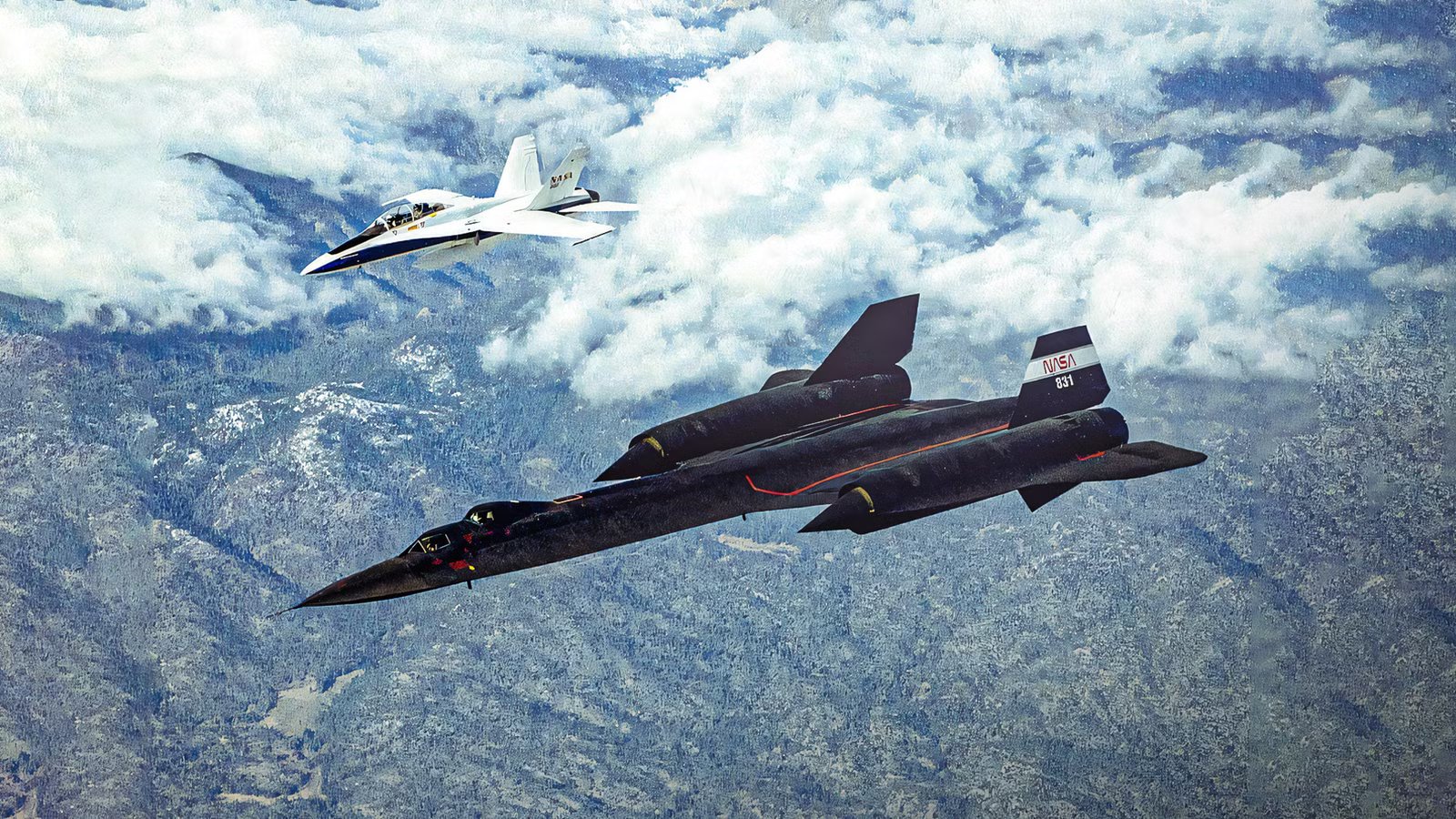
High in the sky over West Texas, one of the most dramatic aerial refueling mishaps in the history of the US Air Force took place on June 17, 1970. The notorious incident started as a routine air-to-air rendezvous between a Lockheed SR-71 Blackbird and a  Boeing KC-135Q Stratotanker. While the two planes were circling over the desert near El Paso, a catastrophic mechanical failure caused the Blackbird to suddenly pitch up into the tail of the Stratotanker.
When the SR-71 suddenly pulled up, it violently struck the tail of the KC-135Q and crippled the tanker jet. Fortunately, no one on board was injured, including the boom operator, and the Stratotanker was able to safely limp back to Beale Air Force Base. The Blackbird wasn’t nearly as lucky, with the initial impact catastrophically destroying virtually all the avionics and breaking the back of the airframe instantly.
Thankfully, the survival systems were intact, and the pilots were able to safely eject despite internal communications being severed after the collision by following emergency procedures. They were later recovered from the desert with only minor injuries, but their jet, ‘Super Skater,’ completely disintegrated in midair, leaving a trail of coveted aerospace artifacts scattered across a vast patch of soil in West Texas.
The Unfortunate Fate Of ‘Super Skater’

The Blackbird involved was SR-71 serial 61-7970, named ‘Super Skater,’ piloted by Lieutenant Colonel Buddy Brown with reconnaissance systems officer Major Mortimer Jarvis on board. The aircraft had departed Beale AFB in California earlier that day en route to the Eglin AFB test range over the Gulf of Mexico to evaluate new electronic countermeasures. The crew met up with the Stratotanker at 26,000 feet in an uneventful initial hookup to get gas.
According to the records of the USAF’s 127th Air National Guard Wing, the jet was able to take thousands of pounds of its unique JP-7 fuel and complete the air-to-air transfer before tragedy struck. A couple of minutes after the Blackbird disconnected from the Stratotanker’s boom, the pilot felt a sudden ‘bump’ followed by violent turbulence. Brown attempted to stabilize the plane, but it entered uncontrollable oscillations before suddenly pitching up.
Brown yelled over the intercom for Jarvis to eject. Because the intercom wires were already severed, Jarvis never heard the command. However, Jarvis saw a blinding flash of light as Brown’s seat fired out of the cockpit, followed by the ‘Pilot Ejected’ warning light. They were recovered roughly 20 miles east of El Paso with only minor injuries, as the Aviation Safety Network recounts.
Artifacts Of Historic Air Force Mishap Up For Grabs

The pieces of ‘Super Skater’ scattered across the desert have become highly sought-after collectors’ items in the online aerospace memorabilia market. To some, it may sound like the US Air Force would want to keep pieces of one of its most classified aircraft out of the hands of private collectors, but because of where the jet crashed, that never happened. Sellers like Arizona Skies Meteorites gather the fragments of the shattered Blackbird from the non-federally owned private lands where it can be found.
Obviously, for safety reasons, the majority of the Blackbird’s broken hull was cleaned up by the Air Force in the immediate aftermath of the mishap. In the years that have passed, however, local land laws allowed independent aviation archaeologists and scavengers to legally access the site and recover what the US military left behind during the initial 1970 cleanup.
Some of the ‘Super Skater’ fragments circulating online today trace back to an expedition in June 2013, as Taylor Wilson described online. Some sellers have subjected the metal to testing with spectrometers, verifying that the material reads as true Beta-120 titanium to confirm authenticity, such as the Jet Works online storefront.
While many of the pieces are small enough to fit in the palm of your hand, large pieces of titanium aerostructures are still found from time to time. Prices range from $50 at the entry level to $500 or more depending on the size of the fragment and whether it bears any clear factory markings from Lockheed’s famous Skunk Works division that built it.
Unraveling The Truth Of An Ill-fated Blackbird

According to the USAF investigation findings, after ‘Super Skater’ went down, the midair collision resulted from wake turbulence. Although the SR-71 is famous for its incredible Mach 3 top speeds, its performance at subsonic speeds during maneuvers like aerial refueling was just as hazardous as flying three times the speed of sound, or even more so. The jet wash from the Stratotanker triggered an unrecoverable aerodynamic crisis that spelled doom for the Blackbird.
The initial wake turbulence hit by the KC-135Q could potentially have been recoverable; however, the second violent bump caught the aircraft at a vulnerable angle of attack. At subsonic speeds, the delta-wing design of the Blackbird could quickly lose flight control authority if forced into a sharp vertical pitch, as the Chuck Yeager Organization explains. Bill Weaver also experienced a similar unresponsive nose-up emergency in 1966 during a test flight when his aircraft disintegrated while flying Mach 3.18 at 78,800 feet above the ground.
Despite the enormous difference in speed, in both accidents, the pilots encountered a rapid, terminal vertical pitch-up that completely overrode the aircraft’s control stick authority and the automated stability augmentation system. The primary differentiator lies in why the aircraft pitched up. One was a failure of high-speed engine intake physics, while the other was a failure of low-speed control surface aerodynamics.
The SR-71’s thin, sharp delta wings were designed to slice through supersonic air, meaning they generated very poor lift at subsonic speeds. Because ‘Super Skater’ was heavy with fresh fuel, it was already flying on the ragged edge of its subsonic performance envelope. When it hit the Stratotanker’s jet wash, the air separated from the delta wings. The airframe failure was ultimately caused by a metal-on-metal impact between the Blackbird and the Stratotanker.
A Necessary Hazard In The Line Of Duty

Fully loaded with fuel, the Blackbird weighed over 140,000 pounds. Taking off with a lighter fuel load significantly reduced catastrophic stress on the lightweight landing gear and lessened the chances of a high-speed tire blowout on the runway. Aerial refueling was the true lifeblood of the SR-71 Blackbird program. Without it, the spy plane’s range was limited to just 2,000 nautical miles. Through multiple midair refuelings, the aircraft completed globe-circling missions over 12,000 nautical miles.
Catch what other flight trackers miss
Emergency squawks, holds, NOTAMs — live signals, no signup.
Open tracker
Catch what other flight trackers miss
Emergency squawks, holds, NOTAMs — live signals, no signup.
Open tracker
A common aviation myth is that the SR-71 had to refuel immediately after takeoff because it “leaked too much fuel” on the ground. While the titanium tanks did seep JP-7 fuel on the tarmac due to deliberate expansion joints that only sealed when heated by Mach 3 friction, this was not the primary reason for immediate refueling. Another reason is the SR-71 had no wing slats and no mechanism to dump fuel in an emergency. If the plane took off fully loaded and suffered an immediate engine failure, it would be too heavy to land safely without crashing through its own landing gear.
Adding to all of those reasons, at Mach 3, friction heats the aircraft’s skin to over 400°F, warming the fuel inside to over 300°F. At these temperatures, space in the tanks is filled with highly explosive fumes. To prevent spontaneous combustion, the SR-71 carried liquid nitrogen flasks to pressurize the tanks with inert gas. The only way to purge all ambient oxygen out of the system was to fill the tanks 100% full while airborne, venting the regular air out and replacing the empty headspace entirely with safe nitrogen gas. Without doing this, the plane was strictly speed-limited to Mach 2.6.
The KC-135Q: Made For The Mission

Standard Air Force tankers could not service the Blackbird. The SR-71 ran exclusively on JP-7 fuel, a highly specialized, low-volatility fuel with an extraordinarily high flashpoint. It was so stable that you could drop a lit match into a bucket of JP-7 and it would simply extinguish. Because standard military jets ran on highly volatile JP-4 or JP-8 fuel, the Air Force had to build a dedicated fleet of KC-135Q variants.
The Q-model tankers featured entirely isolated plumbing and fuel tank systems. They carried conventional fuel in their wing tanks to power their own engines while keeping the main fuselage body tanks loaded with JP-7 reserved exclusively for the Blackbird. Because SR-71 missions were top-secret, KC-135Q crews were the only tanker units trained to execute completely radio-silent rendezvous procedures in pitch-black conditions or dense clouds using only electronic tracking.
Lessons Learned From A Bitter Loss

Refueling the Blackbird was widely considered by pilots to be the most demanding and exhausting portion of any mission. To maintain control and stay tucked right beneath the tanker’s belly, SR-71 pilots frequently had to light the afterburner on just one engine while keeping the other engine in military power. The KC-135Q had to fly at its maximum possible speed and altitude, while the SR-71 had to fly at its absolute minimum speed just above a stall.
Following the 1970 ‘Super Skater’ collision, which was caused by the Blackbird encountering a commercial airliner’s invisible wake turbulence right after disconnecting from the boom, the Air Force adjusted its refueling flight protocol. Pilots were instructed to establish a clean horizontal or vertical separation immediately upon boom release, ensuring the heavy, low-lift subsonic Blackbird drifted well clear of the tanker’s immediate airspace before stabilizing its flight path.
Tanker rendezvous tracks were given stricter altitude segregation from known commercial jet routes to minimize the risk of crossing paths with wake vortex turbulence. Out of the 12 Blackbirds lost in accidents during the program’s history, no other aircraft suffered a catastrophic midair collision with its tanker after ‘Super Skater.’