dailynewsnblog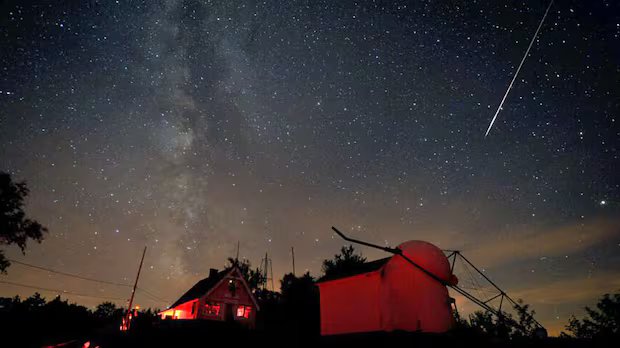
Every August we are treated to one of the best meteor showers of the year: the Perseids. This year, on the day of the shower’s peak, we will also get a partial solar eclipse.
Let’s start with the Perseids.
This shower is often considered one of the best, if not the best, of the year because of the number and brightness of its meteors, along with the usually favourable viewing weather.
The peak viewing night is Aug. 12-13, which is great news for meteor chasers: It coincides with a new moon, meaning there will be no pesky moonlight to interfere with faint meteors.
“The really cool thing this year is, I expect the Perseid grazers to be in full force,” said Peter Brown, Canada Research Chair in Meteor Astronomy and a professor at Western University in London, Ont.
These are Earth-grazers — meteors that enter Earth’s atmosphere and then head back into space. They can be bright and fast, making them quite spectacular to see.
(Note: The author saw an extremely bright Earth-grazer on the night of Aug. 3 from downtown Toronto.)
“I think people should plan on getting out early. You can start seeing Perseids around 10 [p.m.] — 9.30,” Brown said. “I would try to get out as soon as you can in that window because I bet this year people are going to get to see at least a handful of these bright grazers.”

The shower is expected to peak around midnight Eastern Daylight Time, increasing the number of meteors visible each hour. Brown said there could be upwards of 120 an hour.
But don’t expect to see that many. That estimate assumes ideal conditions at a dark-sky location.
Still, a higher overall rate increases the number people are likely to see.
“You’re not going to see 120, but you’ll probably see a dozen or 20 in the early evening, and many of those will probably be bright,” Brown said.
‘Meteor Christmas’
You don’t have to wait until the peak night to see Perseids. The shower began July 17, and the number of visible meteors increases each night as the peak of Aug. 12-13 approaches.
Check the forecast. If the peak night is expected to be cloudy, consider observing in the days beforehand.
“I focus on the night of the 12th, morning of the 13th — I mean, that is the best. But, you know, the 11th will probably be 80 per cent of the show,” Brown said. “If it looks like the weather is better on the Tuesday night, it is totally worth going out.”
He also noted that, statistically, the meteors tend to be brighter the night before the peak.
The first requirement for seeing as many meteors as possible is a clear sky. If conditions co-operate, find the darkest location you can.
Stay off your phone: Its light will interfere with your eyes’ adjustment to the dark. Once outside, it can take more than half an hour for your eyes to adapt fully and allow you to see faint objects.

The meteors’ radiant — the point from which they appear to originate — lies in the constellation Perseus, which gives the shower its name.
Perseus can be found low in the eastern sky after sunset and will rise higher throughout the night. But you don’t have to face the constellation to see the meteors; they can streak across the entire sky.
But wait. There’s more.
Two other major meteor showers are also active: the southern delta Aquariids and the alpha Capricornids.
Those showers produce far fewer meteors at their peak — about 25 and five an hour, respectively — but they still increase your chances of seeing a “shooting star.”
There is also a minor shower called the kappa Cygnids, which produces about three meteors an hour at its peak.
And then there are random, or sporadic, meteors.
“So, you know, it’s meteor Christmas,” Brown said. “It really is.”
Partial solar eclipse
Now, on to the solar eclipse.
On Aug. 12, a total solar eclipse will be visible across Greenland, Iceland and Spain, along with a very small part of Portugal.
While the total eclipse won’t be visible from Canada, the moon will appear to take a small bite out of the sun.

The farther east you are, the bigger the bite will appear. In B.C. and Alberta, however, it will be almost imperceptible.
If you hope to see it, remember to do so carefully. Use only approved solar eclipse glasses.
“If you have the appropriate solar filters available, watching the sun be ‘eaten’ by the moon is very neat!” said Paul Delaney, an astronomer and professor emeritus in York University‘s department of physics and astronomy in Toronto.
A solar eclipse is a great way to see celestial motion of the Earth, moon and sun in action, he said.
“Almost humbling in my opinion.”