dailynewsnblog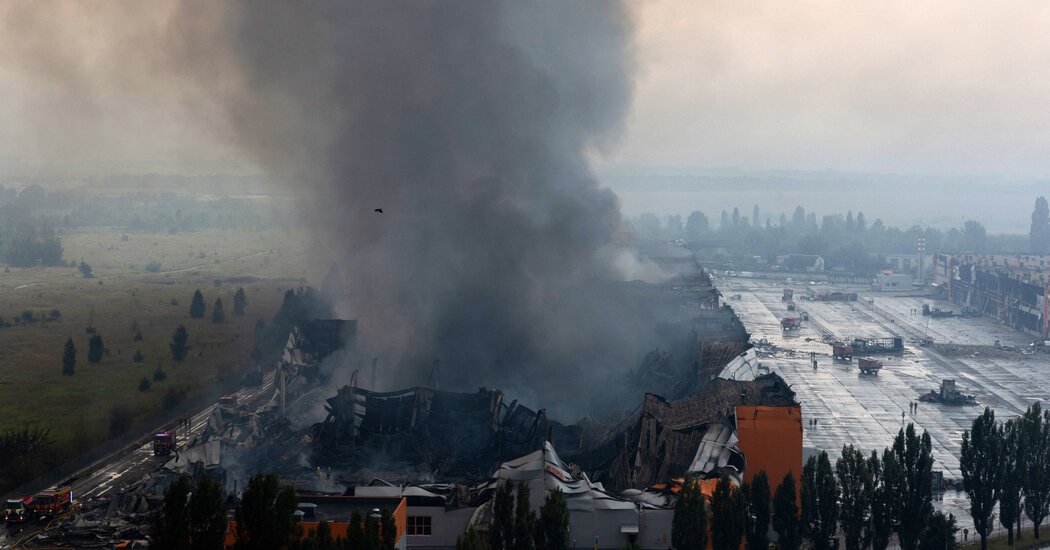
For much of the war, President Volodymyr Zelensky’s appeals to Western allies for air defenses have paid off. His lobbying helped persuade Washington to give Kyiv its first U.S.-made Patriot air defense system in 2023, followed by several more sent by Western nations over the years.
Now, as Ukraine confronts the most intense Russian missile campaign of the war, Mr. Zelensky’s renewed pleas are falling flat.
After yet another deadly assault on Kyiv early Wednesday, in which the capital was left completely undefended against Russian ballistic and hypersonic missiles, Mr. Zelensky offered an accounting. In a statement, he said the number of air defense missiles supplied by Western partners so far this year had “dropped threefold compared with 2025.”
Ukraine’s allies “do have the missiles,” he said, but “the necessary political decisions” to send them and accelerate production have yet to be made.
Most recently, Mr. Zelensky has framed his position in human terms, arguing that every additional interceptor saves lives. But his entreaties are no longer as successful because of a changed geopolitical landscape.
Western allies are more hesitant to give up missiles they may need for their own defense as war rages on multiple fronts, including in the Middle East, where fighting has whittled global stockpiles.
Even if Ukraine’s partners did heed Mr. Zelensky’s call, they could not fully meet the country’s needs. Russia produces ballistic missiles faster than the West can make the interceptors designed to stop them.
So far this year, Russia has fired 650 ballistic missiles at Ukraine, according to a New York Times analysis of figures from the Ukrainian Air Force. That is more than the number of PAC-3 interceptors — the advanced weapons most capable of intercepting ballistic missiles — that their U.S. manufacturer, Lockheed Martin, delivered worldwide all of last year.
“The situation today is more critical than at any point since the start of the war,” Yehor Cherniev, the deputy chairman of the Ukrainian Parliament’s defense and intelligence committee, wrote in a text message.
“There was a time when we lacked antiballistic missile capabilities, but Russia also did not possess such a large number of ballistic missiles,” he added. “Today, however, Kyiv is subjected to massive strikes several times a week, and we are unable to shoot down a single missile.”
The last two major Russian missile barrages offer a stark measure of Ukraine’s rapidly eroding ability to defend itself. On Saturday, Ukrainian air defenses intercepted just two of the 35 missiles launched by Russia. Then, on Wednesday, they failed to intercept any of the 28 missiles fired. More than 25 people were killed in the two assaults.
Mr. Zelensky acknowledged to security officials on Wednesday that the country faced a “shortage” of air defenses that Russia was exploiting to wreak havoc and sow terror, targeting industrial facilities and logistical centers.
The same day, Mr. Zelensky resumed his lobbying campaign for more air defenses. In a call with President Alexander Stubb of Finland, he said, he discussed global stocks of air defense missiles and whether more could be sent to Ukraine. Mr. Stubb has developed a close relationship with President Trump and could help sway Washington to supply more interceptors.
Mr. Zelensky also spoke with the NATO secretary general, Mark Rutte, writing on social media that they were coordinating efforts “regarding countries that have the necessary missiles and the capacity to help.”
Rallying NATO’s support is crucial. Nearly all of the Patriot interceptors that Ukraine receives are purchased through a NATO-backed system in which European money is used to buy U.S. weapons.
The program was set up to secure continued American weapons deliveries while aligning with Mr. Trump’s preference for selling rather than donating U.S. weapons. But it has fallen short of expectations.
When it was started last summer, Mr. Zelensky said he hoped it would finance $1 billion in weapons purchases each month. Two weeks ago, Ukraine’s defense ministry said that monthly contributions over the program’s first year reached about half of that.
Alyona Getmanchuk, Ukraine’s ambassador to NATO, outlined in an interview several ways that Kyiv was trying to bolster its air defenses.
Beyond the NATO-backed program, Ukraine is using European money to secure long-term contracts for U.S.-made weapons. It is negotiating a license from the United States to produce Patriots — a project that Mr. Trump at first publicly supported but recently cast doubt on. And it is working with European partners to develop its own antiballistic system.
But those efforts will take time to bear fruit. Ukraine urgently needs more Patriots to shield its energy infrastructure from what Kyiv expects will be another winter campaign of Russian strikes intended to make Ukrainians freeze. That is why Ukraine has continued to press European allies to donate air defenses.
While Europe has increased military aid to Ukraine, overall contributions have declined since Mr. Trump halted U.S. weapons donations. Data compiled by the Kiel Institute for the World Economy, a think tank in Germany, shows that Ukraine has received on average just over 2 billion euros, or $2.3 billion, in military aid each month so far this year, down from more than 2.5 billion euros a month in previous years.
As deliveries of air defense to Ukraine dwindled, civilian deaths rose. In the first six months this year, 1,396 civilians were killed, a 37 percent increase from the same period in 2025, and a 114 percent increase compared with the year before, according to the United Nations.
The toll of Wednesday’s attack was laid bare at a train station in a Kyiv suburb, where rescuers carried away the bodies of eight victims in white bags.
Oleksandr Pertsovskyi, the chief executive of Ukrainian Railways, said a strike near the station had ripped through the platform, where people were waiting for a train. Until Ukraine gets enough air defenses, Mr. Pertsovskyi said in a phone interview, “how many human lives are going to be lost?”
Ms. Getmanchuk, the ambassador, said she worried that Ukraine’s task in campaigning for more air defenses was becoming more difficult as Russia’s relentless air assaults began to feel like a grim new normal.
“It’s becoming harder to convey this message,” she said. “People perceive a deadly attack as just another attack.”
Siobhán O’Grady and Kim Barker contributed reporting.