dailynewsnblog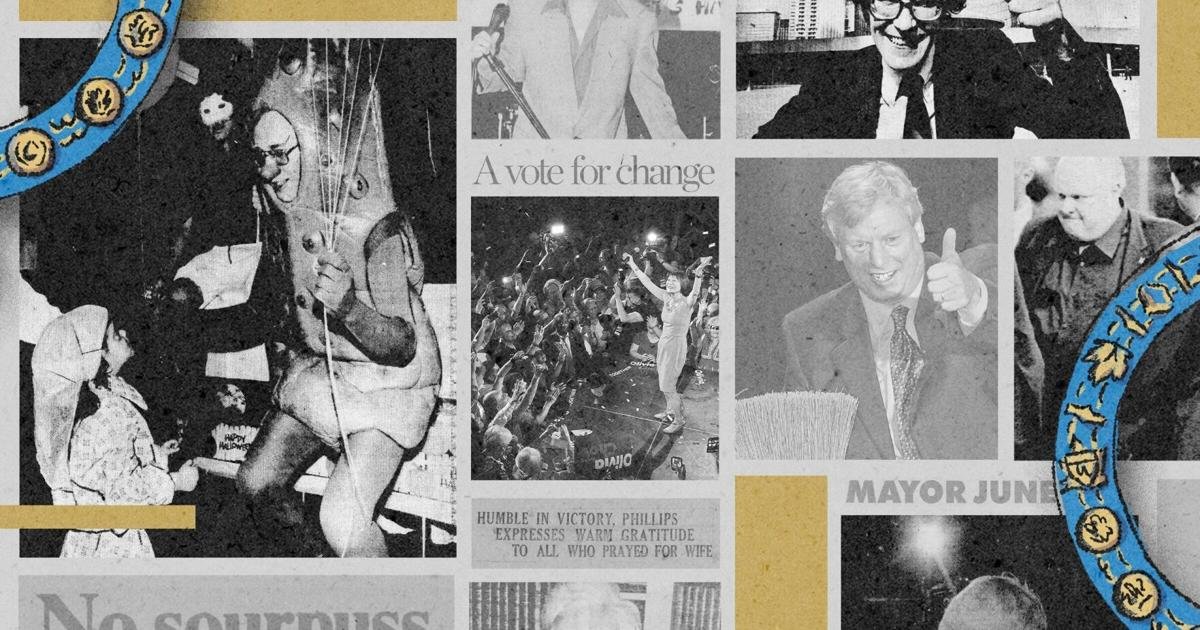
Toronto mayors have been pragmatists and radicals, “boy scouts” and troubled men.
In the nearly 200 years since this city was formed, there have been 66 people at the helm, brought to power in campaigns featuring scandal, intrigue and bloodshed.
As Torontonians prepare to vote again this October, the Star has compiled a smattering of the most memorable moments of elections past — historic firsts, shocking upsets and international embarrassments — with commentary from some former mayors and the writers who chronicled their time in office.
The assassin: John Powell (1838)
Toronto’s spring years could be as brutal and repressive as any in the industrial age. Children toiled in dangerous factories. Families lived in rotted-out hovels inside crowded slums. A powerful fraternal organization called the Orange Order ensured a century of Protestant hegemony through violence and intimidation.
The city was also the site of bloody insurrection, during which the former and future mayors warred with each other over independence from the British Empire. In 1837, Canadian rebel leader and former mayor William Lyon Mackenzie was nearly killed by his eventual successor, John Powell.
During the Battle of Montgomery Tavern, a captured Powell lied to Mackenzie about being unarmed. En route to rebel headquarters, Powell pulled two pistols from his coat and shot one of his captors dead through the back of the neck. Before fleeing, he tried to do the same to Mackenzie but misfired.
Powell received a hero’s welcome back in Toronto and was acclaimed mayor a few months later.
The coward: William Henry Boulton (1859)
Neither Powell nor Mackenzie were voted in by the people of Toronto. The city’s first 14 mayors were instead appointed by elected members of council. Public voting for the mayor didn’t start until 1859.
This election ended the shortest mayoralty in Toronto history, that of David Breakenridge Read, who was only in office 50 days. Read had taken over after four-term mayor William Henry Boulton resigned after a dispute with police, who were “incredibly incompetent” at the time, according to writer and historian Jamie Bradburn. (A famous example of this was the great clown riots of 1855, wherein police did little to quell a mob of volunteer firefighters trying to run a troupe of clowns out of town.)
“It was so bad they actually disbanded the Toronto police force and started from square one again within like a year or two,” he said.
Boulton had wanted to fire the chief of police but had been outvoted by council. As he resigned, he declared his intention to run again and let this new kind of mayoral election open to the public be a referendum on police corruption.
Boulton’s gamble didn’t pay off. He lost his bid for re-election. His opponents cast his resignation as cowardly, an accusation that seemed to resonate with voters. Boulton had also previously gotten in trouble for owning a building he knew was being used as a brothel. As historian and author Adam Bunch tells it in “The Toronto Book of Love,” Boulton, being well-connected, escaped any legal repercussions, but public opinion on him soured nonetheless. The judge who tried the case was his uncle, and it was the man who ran the brothel, not Boulton, who ended up being fined.
This first public election was only a marginally more democratic process than what preceded it. For most of the 19th century, voting was the exclusive right of property owning men. Universal suffrage in Toronto mayoral elections only became law in 1972.
Nevertheless, as the electorate widened, elections became one of the most exciting events in the city.
“Election night really became a community celebration,” said Bradburn. “People would usually gather out in front of the newspaper offices and listen to speeches. As you get into the 20th century, you’d have the results projected against walls, you’d have bands playing, there were cartoons for the kids.”
One of the most striking things he has noticed from poring over archives is how the political landscape hasn’t changed much in Toronto — because the human heart hasn’t changed much.
Crusaders for democracy and better government, like Mackenzie, have occupied the office of the mayor since the start. Occasionally, they have been displaced by people driven by baser desires, such as Ernest Albert Macdonald, mayor for a year in 1900, whom Bradburn said only ran to “promote his canal-building scheme.”
“There are always going to be gadflies,” said Bradburn. “And there will always be people of stern moral fibre.”
The radical: John Sewell (1978)

A column in the Sunday Star about the launch of John Sewell’s by-election campaign
Toronto Star archive
By modern standards, one-term, preamalgamation mayor John Sewell’s brand of progressivism is fairly unremarkable. He biked to work, defended gay rights and was sharply critical of the police. For this, he was treated with derision and distrust by pundits and political opponents.
“One of the things (mayoral candidate) David Smith said was ‘Electing Sewell would be like telling Jack the Ripper he had an Avon route,’” Sewell said in an interview with the Star this month. “That’s pretty shocking stuff. Just really, really disgusting.”
Sewell, who had been on city council for nine years at that point, said he ran to carry the torch of outgoing mayor David Crombie, who quit to run in a federal byelection, by continuing to expand public transit and affordable housing.
He was fortunate to be running against two Liberal-linked opponents who likely cannibalized each other’s supporters: Smith and Tony O’Donohue. Combined, they had over 100,000 votes. Sewell won with 71,885, or 38 per cent of the total share.

The Toronto Star on John Sewell’s unlikely mayoral win
Toronto Star archive
As ugly as this byelection had been, the 1980 general election was significantly worse.
In 1979, mayor Sewell spoke out in support of The Body Politic, a gay liberation journal, which had been raided the year before by police after it published a highly controversial article profiling men who said they sexually assault children.
Police “seized all the advertising records and all of the subscriber records,” said Sewell. “People were worried that they were going to spread everyone’s personal information. At that point, if you were gay, you’d get fired. Just like that. And so I was saying ‘This is wrong,’ and that we need a law to stop discrimination on the basis of sexual orientation.”
“The police took me on,” he said. “The police actually ran ads in the 1980 election saying, ‘Don’t vote for Sewell.’”
Sewell’s opponents learned from their vote-splitting mistakes and rallied around liberal Art Eggleton. It was tight contest, with Sewell only losing by 1,767 votes.
“I wouldn’t change a thing,” said Sewell. “I’ve always believed that you aren’t there to get re-elected, you’re there to do the right thing.”
The mega-mayor: Mel Lastman (1997)

The Toronto Star front page from Mel Lastman’s 1997 win as first mayor of amalgamated Toronto
Toronto Star archive
A new “megacity” was forming and it needed its first leader. Then-premier Mike Harris was merging Toronto with five other neighbouring cities in the name of efficiency. The front-runners were two sitting mayors from the dissolving municipalities. A giant suburban-urban electorate would be picking between bombastic conservative North York mayor Mel Lastman and lower-key progressive Toronto mayor Barbara Hall.
Hall was a popular figure but not as charismatic as Lastman. Her achievements at city hall were practical, the most enduring of which was allowing development on King Street, which led to the creation of Liberty Village out of a former abandoned industrial town.
Lastman was a furniture salesman who pulled stunts like flying to Nunavut to sell a refrigerator to an Inuit man to prove his business acumen. He’d been mayor for 25 years at this point and overseen the transformation of North York from a quiet suburb to a lively urban hub he called “downtown uptown.”
In the end, Lastman’s boisterousness and pledge to freeze property taxes — a decision that would have long-term consequences for the city’s finances — won.
The RFK Jr. endorsed: David Miller (2003)

RFK Jr. poses with David Miller at a press conference to oppose a bridge to the island airport
Toronto Star archive
The race to succeed Lastman was unpredictable and far more competitive than anyone would have figured at the outset.
“It introduced the roving all-candidates debate. I went to dozens and dozens of them,” said urban affairs writer John Lorinc. “At the start, Barbara Hall was considered a shoo-in, she was the heir apparent. Then her campaign fell apart. John Tory went from being an executive only known in Rosedale to a citywide figure. David Miller went from being not very well known to having a campaign that exploded. In the end, it became a horse race between him and Tory. If it had gone on a week or so more, Tory could have won.”
Miller, a failed provincial and federal NDP candidate and three-term city councillor, needed to break out of obscurity.
In an interview this month, he said his campaign manager, John Laschinger, told him early polling showed half of all the people who were familiar with him would vote for him. That would have sounded promising to the candidate, if only more than eight per cent of Torontonians had heard of him.
Miller said he told his manager the numbers seemed daunting. But Laschinger felt the opposite. Miller recalls him responding: “This is the easiest campaign I’m ever going to run. I’m just going to introduce you to a million people. If half of them vote for you, you will win.”
One key person in making that happen was environmentalist Robert F. Kennedy Jr.
Miller wanted to prevent the island airport from being expanded so his campaign asked Kennedy to travel up north to back him up.
Historic polling data shows this moment catapulted Miller from an unknown to a top-five contender, landing him coveted debate invitations that helped him spread his message across the city.

Polls show how opposing the expansion of Billy Bishop airport helped catapult David Miller to victory
Toronto Star archive
Miller said while “all of us raise our eyebrows” looking back at photos of him with Kennedy — who is now the U.S.‘s anti-vaccine secretary of health — at the time his environmentalist credentials were unassailable, particularly his work to clean up river pollution.
Miller wound up winning with 299,385 votes to Tory’s 263,189.
The late-night sensation: Rob Ford (2014)

The Star’s dispatch from Los Angeles on Rob Ford’s Kimmel appearance
Toronto Star archive
By the time Rob Ford signed up to run for a second term, he’d achieved something none of his predecessors had: global fame. International press agencies were at city hall hanging on his every word. Everyone wanted to see what the infamous crack-smoking mayor would do next.
“I remember I was at a literary event and somebody said, ‘It’s an interesting thing about Canada, that the most famous Canadian is an author.’ She was talking about Margaret Atwood,” said Star columnist Ed Keenan. “Stephen Marche and I looked at each other and went, ‘Rob Ford is by far the most famous Canadian in the world right now.’”
His re-election campaign included an appearance on “Jimmy Kimmel Live,” just “another detour in the fever dream” of Ford’s political career, Keenan said.
Ford didn’t know it then, but he was at crest of that career on that Hollywood stage. Two months later, he was in rehab. Three months after that he got diagnosed with a rare and aggressive cancer, after which he withdrew his re-election bid and endorsed his brother, Doug.
All of a sudden, Ford, who had for so long been a spectacle became a sympathetic figure, Keenan said. Torontonians had been itching for a referendum on him. This robbed them of that chance.
Rob Ford died in 2016, two years after the election. Doug Ford went on to become Premier in 2018.
With files from Sadeen Mohsen