dailynewsnblog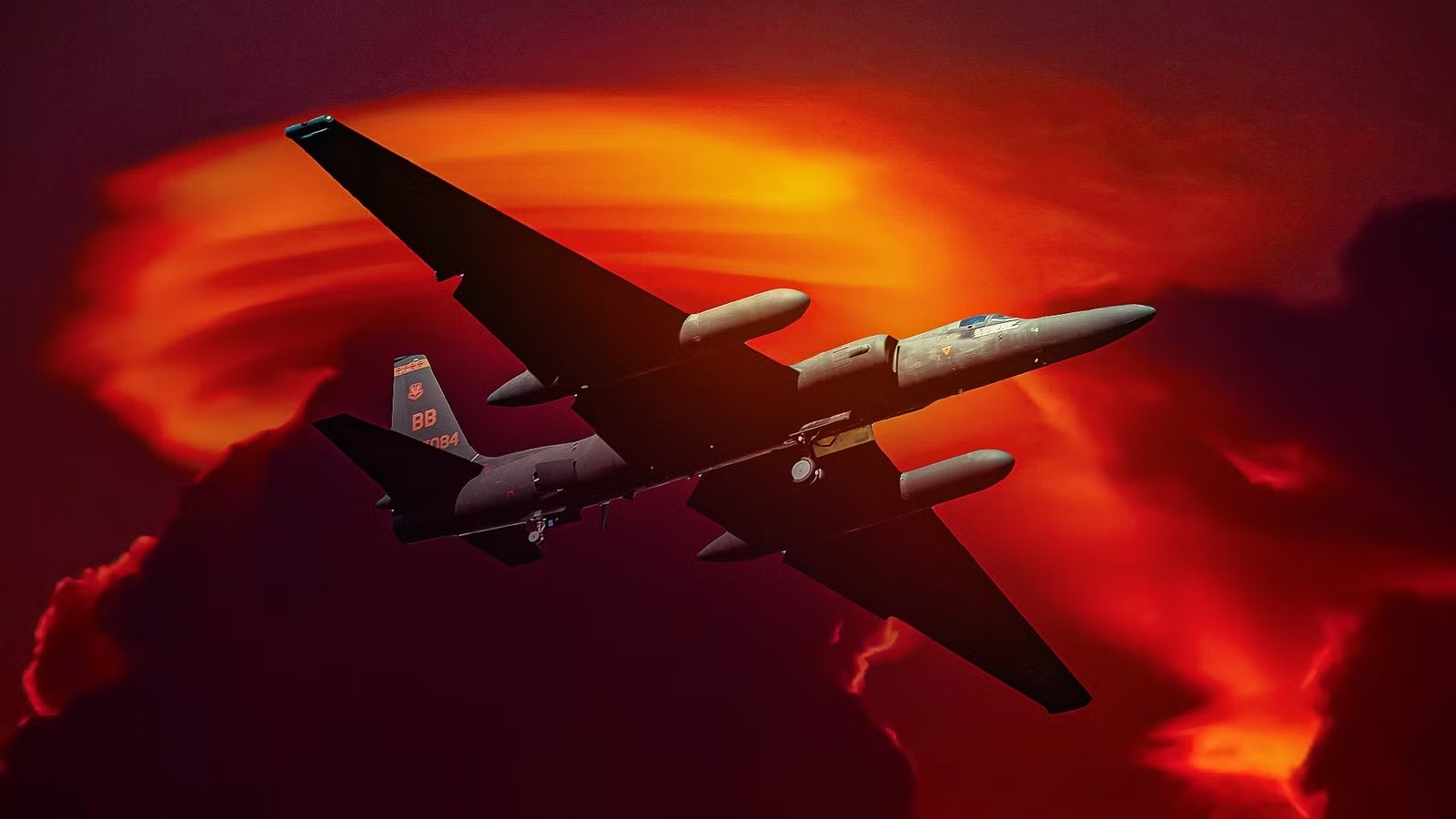
After seven decades of service, the famous Lockheed U-2 Dragon Lady spy plane is still serving the US Armed Forces as a critical strategic reconnaissance aircraft. It has even outlasted its successor, the iconic Lockheed SR-71 Blackbird. Today, despite the proliferation of intelligence satellites, the Dragon Lady is still a vital part of America’s strategic recon network. Unconstrained by a predictable orbital path, the venerable U-2 offers flexible real-time battlefield intelligence.
In addition to an unpredictable deployment tempo that keeps the enemy guessing, the Dragon Lady can loiter over areas of interest to repeatedly observe targets as needed. The U-2 has been upgraded over the years, and its modular open systems architecture can be adapted with new sensor suites to counter emerging threats. Satellites have a fixed sensor suite, but the U-2 can be equipped with everything from synthetic aperture radar to electronic countermeasures, or electro-optical and infrared cameras.
Flying near the edge of space, the Dragon Lady continues to offer a premier intelligence, surveillance, and reconnaissance package to strategic commanders of the US and coalition forces. Despite being a relic of the Cold War, the U-2 is far from irrelevant on the battlefield of the 21st century.
The Advantage Of Airborne Intelligence

Even with the proliferation of sophisticated space-based assets in larger and larger numbers, the U-2 offers an excellent capability bridge between low Earth orbit and geostationary spy satellites. Unlike a passing satellite that leaves a target unmonitored for hours until its next orbit, the U-2 provides a nonstop, live video feed of an entire event from start to finish. It does so from over 70,000 feet (21,336 meters) in the sky, at the edge of the atmosphere.
LEO satellites zoom around the Earth at an orbit that takes them up to a speed of 17,000 miles per hour, which gives them coverage over vast areas in short cycles but limits the time of opportunity over any one target area. On the other hand, a geostationary satellite is tens of thousands of miles from the Earth in its orbit, which limits the detail that can be gathered and induces communication delays.
Because the Dragon Lady flies in the stratosphere, it can detect and geolocate weak signals from devices like handheld radios that a satellite is unlikely to pick up at all, let alone intercept. The U-2 can also fly outside the borders of a nation when it observes a target area and looks sideways into the designated zone, unlike the overhead view of a satellite. This offers a unique capability that can bypass some forms of concealment and countermeasures.
The Dragon Lady’s Dwell Time Perk

One of the key distinguishing differences between the performance of a U-2 spyplane and a spy satellite is the ability of the Dragon Lady to dwell over a target and persistently collect intelligence. This is highly valuable when either the exact timing of a target of opportunity is unknown, or there is a chance to gather more information by remaining in the area for as long as possible. This simply is not something a satellite can do because it is governed by the physics of its orbital path, which sets a fixed time to perform ISR over any given spot on Earth.
In July 2025, Lt. Col. John “Jester” Mattson, 1st Reconnaissance Squadron (RS) commander, described the purpose of continuous improvement after one of his squadron’s U-2s completed a historic mission. Demonstrating the plane’s incredible endurance, the squadron flew one of its jets on a tour of all 48 contiguous US states in a single flight. Jester remarked:
“The character of war is changing, but our extreme ownership of our mission to build aircrew ready to exploit and dominate the electromagnetic spectrum and win will never change. We continue to hone our combat competencies, showcasing Beale’s capacity as a power projection platform to rapidly respond to adversary actions anywhere in the world.”
Satellites follow strict, predictable orbits. Enemy forces use software to track exactly when a spy satellite will pass overhead. The moment the satellite is inbound, the enemy stops moving convoys, covers up weapons, and goes silent. Once the 10 minutes are up, they uncover everything and resume operations. Once that satellite leaves, it might take 12 to 24 hours, or more, for its orbit to bring it back over the exact same spot.
The USAF’s Timeless Eye In The Sky

The U-2 does not fly by; it ‘stares.’ It has a total flight endurance of around 12 to 14 hours. Because it can park itself outside or directly over the target area, it doesn’t catch a snapshot but rather builds a picture of every target. The U-2 sits in the sky all day, watching who arrives, which doors open, when guards change shifts, and where supplies are moved. It builds a continuous narrative.
If an enemy launches a mobile missile truck, they don’t do it on a satellite’s schedule. A U-2 can catch the exact moment a garage door opens, track the vehicle as it drives down a highway, watch it set up, and pinpoint its location in real-time. The U-2 can stay locked onto that specific target for hours on end, tracking it through cities and highways without ever breaking the visual link. And when the plane reaches its limit, instead of returning to base every time, it can even break away briefly for aerial refueling and return on especially critical missions.
Flexibility And Adaptability: The U-2’s Modular Payload

Another major trump card that the Dragon Lady has over a space-based platform is its capability to land and swap out sensor devices in between sorties. Thanks to its modular open systems architecture, the plane can drop equipment that is not ideal for the mission and instead load up a new package tailored to the exact target or scenario. If an adversary deploys a brand-new type of radar jammer or communication frequency, a satellite may lack the hardware to intercept these signals, but the U-2 can be upgraded rapidly to counter threats as they emerge.
For example, if the U-2 takes off on a clear day with a camera package but the weather sours overnight, it can launch the next day with a radar pod instead to continue its mission. It adapts to changing battlefield technology in real-time. If a sensor breaks, it lands, gets a new part, and goes back up. When a spy satellite is launched, its hardware design is frozen in time. If a sensor degrades, a wire fries, or a component becomes obsolete six months into a fifteen-year lifespan, there is often nothing that can be done.
Lockheed’s Future-Proof ISR

The U-2 features a modular nose cone, a large main fuselage bay, and detachable wing pods. Because it uses an open architecture with standardized physical mounts, power connections, and data buses, ground crews can hot-swap entirely different sensors in under an hour. It has even been upgraded with open mission systems to make its digital backbone universally interoperable with new equipment instead of being locked into proprietary software bottlenecks.
Where the adaptable qualities of the Dragon Lady shine the most are on missions to conduct electronic warfare and signals intelligence. Space-based EW assets are geared toward long-term strategic mapping. They map an enemy’s national air defense grid over months and years, identifying permanent radar installations.
If an enemy suddenly activates a mobile surface-to-air missile radar or steps up tactical radio communication ahead of an assault, the commander can re-task the U-2 instantly. It can hunt down the specific source of that emission in real-time and relay those coordinates directly to friendly units within minutes.
No Time Like The Present

Because the U-2 spy plane takes off within the region where its mission will be located and maintains direct communication with the ground control, it offers a much more rapid communication relay than a space-based platform. Even a LEO satellite is hundreds of miles above the Earth’s surface, which requires every signal to travel an exponentially farther distance than it does to the U-2. The latency of a signal from the Dragon Lady is measured in microseconds, and delivers a near real-time live feed at all times.
The U-2 has also been retrofitted to be an airborne network router. It carries native tactical data links like Link 16 and the Common Data Link. This allows it to stream live radar contacts and target tracking data directly into the joint ‘combat cloud’, which builds a common ‘picture’ of the battle space over the data link network. It also has a greater bandwidth capacity because its communication suites are powered by electricity from jet engines.
Satellites must conserve electrical power based on their batteries and solar power supplies, which makes bandwidth limits variable and generally lower than that of an aircraft. The U-2’s General Electric F118-GE-101 engine can produce enough electrical power to run synthetic aperture radar that emits powerful pulses that penetrate adverse weather like rain and clouds. This high-powered array can precisely map ground terrain and find targets even among dense ground clutter.
The Dragon Lady provides high-fidelity, high-volume, instantaneous updates from its perch high in the sky. The massive amount of live data from multiple types of sensors provides a comprehensive evaluation to battlefield leaders. This helps them make the best decisions, even in the most dire scenarios. This capability is still unmatched by any space-based platform and makes the U-2 a valuable element of the US strategic arsenal even as it passes seven decades of service.