dailynewsnblog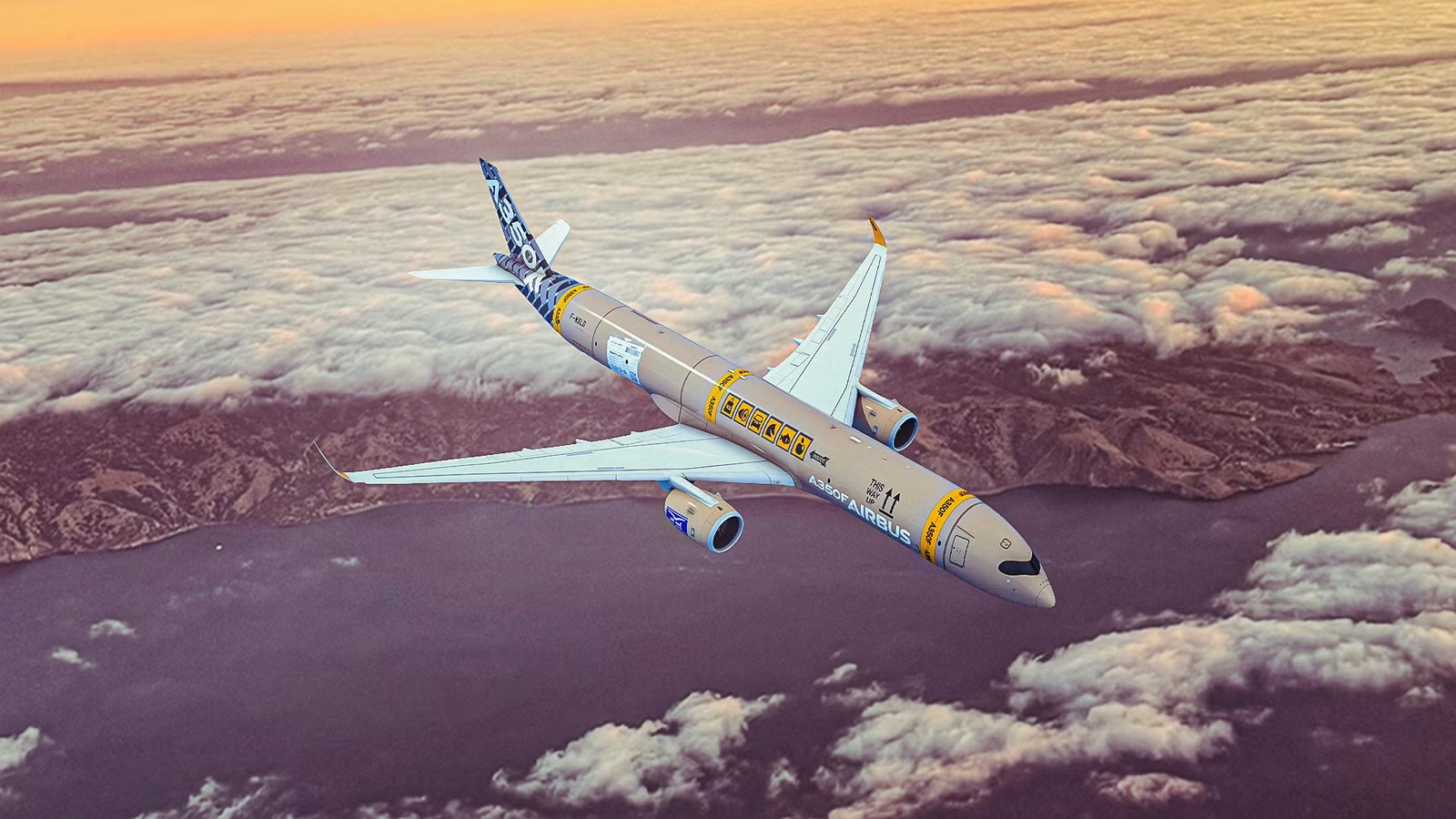
For decades, the large purpose-built freighter market was one of the safest corners of the commercial aviation industry for  Boeing. The 747 Freighter became synonymous with global air cargo, while the 777F established itself as the dominant modern widebody freighter. Airbus, by comparison, struggled to translate its strength in passenger aircraft into a meaningful share of the dedicated cargo market.
The Airbus A350F is changing that equation. With its growing order book, modern composite airframe, and arrival at a time when emissions regulations are forcing older cargo aircraft out of production, the aircraft has already done something Airbus had failed to achieve for years: break Boeing’s near-monopoly. However, with the larger Boeing 777-8F attracting major customers of its own, the real question is who will win the freighter battle in the 21st century?
The A350F Has Already Broken Boeing’s Near-Monopoly

The Airbus A350F genuinely threatens Boeing’s historic dominance of the large freighter market. However, “threatens” is a more accurate description than “overturns.” Airbus has successfully transformed what was recently an overwhelmingly Boeing-controlled segment into a genuine two-manufacturer contest.
The speed of the shift is particularly impressive. According to an Air Logistics International interview with Airbus Head of Freighter Marketing Crawford Hamilton, the European manufacturer went from having effectively no share of the new large-freighter market to securing roughly half of the new orders. At the time of that interview, Airbus had sold 55 A350Fs to 10 customers, including Cathay Pacific,  Singapore Airlines,
  Air France, Martinair,
  Etihad Airways, and Silk Way West Airlines.
That momentum has continued. As detailed in our analysis of the A350F program, the freighter has attracted customers from several major global cargo markets. More recently, orders from Cathay Group,  Air China, and Atlas Air have helped push the program beyond 100 firm commitments, demonstrating that airlines see the A350F as a credible long-term alternative to the delayed Boeing 777X program, which includes an -8F variant.
Boeing’s historical advantage remains enormous. The 747F family dominated the heaviest end of the market for decades, while the 777F became the default choice for airlines needing a highly capable long-range twin-engine freighter. Airbus’ previous attempts to compete, most notably with the A330-200F, never came close to challenging that position.
The A350F is different because Airbus is no longer competing primarily on price or availability. It is offering a clean-sheet freighter based on one of the world’s newest widebody platforms that has already demonstrated its competitive advantage with passenger service. The cargo variant arrives precisely when the industry needs to replace the aging transport planes.
A Regulatory Deadline Has Given Airbus An Advantage Over Boeing

Several factors explain why the A350F has gained ground so quickly, but timing may be the most important. Airbus is bringing the aircraft to market as new international emissions requirements threaten the continued production of Boeing’s current-generation freighters.
New ICAO CO2 emissions standards will apply to newly manufactured aircraft from the beginning of 2028. The regulatory change has major implications for current production freighters, including the Boeing 767F and 777F, because aircraft that do not comply with the new standard cannot continue production indefinitely. That creates a natural transition point toward a new generation of cargo aircraft.
Airbus has timed the A350F to profit from that transition. Although the program has experienced delays, the aircraft is now approaching a planned 2027 entry into service. Meanwhile, Boeing’s next-generation answer, the 777-8F, is tied to the broader 777X program, which has suffered years of certification and development delays.
Boeing’s difficulties with the 777X have therefore created an additional opportunity for Airbus. With the 777X passenger certification program running years behind its original schedule, Boeing has had to devote significant resources to getting the baseline aircraft into commercial service. The freighter variant remains an important part of the company’s strategy, but Airbus has gained valuable time to establish the A350F with cargo operators.
The significance of this regulatory and product-cycle transition is difficult to overstate. Boeing dominated the large-freighter market partly because airlines had few realistic alternatives. Once the 747-8F ended production and the existing 777F approached its regulatory deadline, Airbus suddenly had an opportunity to enter a market in which customers needed new aircraft regardless of manufacturer loyalty.
This combination of regulation and timing may ultimately prove just as important as the A350F’s technical specifications. Airlines replacing older freighters are being presented with two genuinely new-generation products, giving Airbus an opportunity to compete for orders that might once have gone to Boeing by default.
Major Airlines Are Voting For Competition With Their Order Books

The strongest evidence supporting the A350F is the airlines’ placing orders for the aircraft. Some of the world’s most experienced long-haul cargo operators have committed to the program, giving Airbus a level of market credibility it never achieved with its previous dedicated freighters.
Cathay Group is an especially important customer. As AirInsight reported when examining Cathay’s A350F decision, the Hong Kong-based airline became one of the major carriers backing Airbus’ next-generation freighter strategy. Cathay operates one of the world’s most important international cargo businesses, meaning its decision represents a significant endorsement of the A350F’s capabilities.
Air China has provided another major boost. According to our coverage of Air China’s expanded commitment, the carrier increased its order to 10 aircraft, making it the first mainland Chinese customer for the type. The deal is strategically important because China is expected to remain one of the world’s largest air cargo markets over the coming decades.
These orders show why the A350F represents a structural threat to Boeing. Airbus does not need every airline to choose its freighter. It only needs enough major carriers to regard the aircraft as a credible alternative, forcing Boeing to compete for orders that it might previously have won almost automatically.
The A350F also gives airlines something the market has lacked for years: genuine negotiating leverage. Operators planning multibillion-dollar fleet replacements can now compare two next-generation products, potentially extracting better pricing, support packages, and delivery terms from both manufacturers.
The diversity of Airbus’ customer base is equally important. The A350F has attracted major network airlines worldwide, dedicated cargo operators, and traditional Boeing customers, such as Atlas Air. Such variety suggests the aircraft’s appeal is not limited to one market or a small group of existing Airbus customers.
The Technical Battle Is Much Closer Than The Sales Numbers Suggest

Airbus’ challenge to Boeing is not based solely on favorable timing. The A350F has a legitimate technical case, particularly for airlines prioritizing fuel efficiency, emissions reductions, and lower operating weight. According to Airbus executives interviewed by Air Logistics International, more than 70% of the A350F’s airframe is made from advanced materials. Airbus says the resulting weight advantage contributes to a roughly 30-tonne lower maximum takeoff weight and approximately 20% reductions in fuel consumption and CO2 emissions compared with competing older-generation aircraft.
Therefore, the A350F is particularly attractive to operators concerned about fuel prices and increasingly stringent environmental requirements. Lower structural weight can reduce fuel consumption, while the A350 platform’s modern Rolls-Royce Trent XWB engines give Airbus a substantial efficiency advantage over older freighters.
Airbus A350F vs Boeing 777-8F Specs
Specification | Airbus A350F | Boeing 777-8F |
|---|---|---|
Aircraft family | Airbus A350 | Boeing 777X |
Program launch | 2021 | 2022 |
Planned entry into service | 2027 | 2028 |
Engines | 2 × Rolls-Royce Trent XWB-97 | 2 × GE Aerospace GE9X |
Maximum structural payload | 244,700 lb (111 metric tons) | 260,100 lb (118 metric tons) |
Maximum range | 4,700 NM (8,700 km) with a 240,300 lb (109 metric ton) payload | 5,000 NM (9,260 km) with a 242,500 lb (110 metric ton) payload |
Maximum takeoff weight (MTOW) | 710,000 lb (322 metric tons) | 805,000 lb (365,140 kg) |
Overall length | 232 ft 3 in (70.8 meters) | 232 ft 6 in (70.9 meters) |
Wingspan | 212 ft 5 in (64.75 meters) | 235 ft 5 in (71.8 meters) extended; 212 ft 9 in (64.8 meters) folded |
Height | 55 ft 11 in (17.05 meters) | 64 ft 1 in (19.5 meters) |
Main deck cargo volume | Approx. 24,545 ft³ (695 m³) | Approx. 27,050 ft³ (766 m³) |
Main deck pallets | Up to 30 | Up to 31 |
Airframe materials | More than 70% advanced materials | Composite wings with primarily aluminum fuselage |
Key challenge | New entrant to the large freighter market and production delays | 777X certification and development delays |
However, the Boeing 777-8F is a formidable competitor. As Aviation Source News noted in its comparison of the two aircraft, they are aimed at slightly different priorities. The Boeing is expected to offer greater payload capability, while the Airbus emphasizes lower weight and efficiency. The 777-8F is set to become the largest twin-engine freighter in service and is expected to carry more payload than the current 777F. That capability matters enormously for operators transporting dense or heavy cargo over long distances.
There is no obvious winner in this battle. As The Loadstar observed while examining Atlas Air’s future freighter options, choosing between the A350F and 777-8F involves balancing capacity, efficiency, fleet commonality, and long-term operating requirements. For the first time in years, Boeing cannot assume that the largest cargo operators will automatically choose its aircraft.
Airbus Still Faces Delays, Order Changes, And A Powerful Rival

The A350F’s growing order book does not guarantee the program’s success. Airbus faces its own development and production challenges, while Boeing retains decades of experience, extensive customer relationships, and a competitive new freighter.
One warning sign came from Air France-KLM and Martinair Cargo. As examined in the A350F orders and delays, the group reduced its A350F commitment from eight aircraft to six, converting two orders into passenger A350s. The decision came amid Airbus production delays and a broader reassessment of the group’s future cargo fleet.
The A350F’s development schedule has already slipped, demonstrating that Airbus is not immune to the problems affecting almost every major modern aircraft program. Entry into service has moved to 2027, and further delays could weaken one of Airbus’ biggest advantages: reaching customers while Boeing remains occupied with the 777X certification process.
Boeing also has a meaningful order book of its own. The 777-8F has secured 59 firm orders, including a major commitment for 34 aircraft from  Qatar Airways. That means Airbus has broken Boeing’s monopoly, but it has certainly not removed the US manufacturer from its traditional stronghold.
Fleet commonality could become another major factor. Airlines already operating large numbers of 777Fs may prefer the 777-8F because of operational familiarity, existing maintenance infrastructure, and long-standing relationships with Boeing. The same principle could benefit Airbus among carriers with substantial A350 passenger fleets.
The biggest risk for Airbus may be interpreting early success as a final victory. The next-generation freighter market will ultimately be decided over decades, not by which manufacturer accumulates the most orders before either aircraft enters commercial service. Certification progress, production stability, real-world reliability, and delivery availability could eventually shift the balance.
Airbus Has Changed The Market Even If It Has Not Conquered It

The A350F genuinely threatens Boeing’s dominance because it has already achieved something Airbus had been unable to do for decades: establish a credible, commercially successful alternative in the large purpose-built freighter industry. Its order book, customer list, technical efficiency, and favorable regulatory timing have transformed the competitive landscape.
However, the evidence does not support declaring Boeing defeated. The 777-8F offers greater payload capability, has attracted major customers, and benefits from Boeing’s history in the dedicated cargo business. If Boeing can overcome the delays affecting the broader 777X program, the aircraft should remain a powerful competitor for decades.
The fairest verdict is that Airbus has split open a market that Boeing once controlled almost outright. Going from virtually no presence in new large freighters to competing for roughly half the market represents a historic shift, regardless of which manufacturer eventually sells more aircraft.
The next phase will depend heavily on execution. Airbus must certify the A350F, ramp up production, and deliver aircraft without further major delays. Boeing must do the same with the 777-8F while finally moving the 777X program beyond the certification difficulties that have consumed years of its schedule. For cargo airlines, that rivalry is likely to be beneficial. The market now has two genuinely competitive next-generation freighters offering different combinations of payload, efficiency, and fleet commonality.
So, does the Airbus A350F truly threaten a market Boeing once owned outright? Yes. The A350F has already ended Boeing’s near-monopoly and forced the company into a genuine fight for the next generation of large freighter orders. But Airbus has not yet overturned Boeing’s position. The more accurate conclusion is that a market once dominated by a single manufacturer has finally become a two-aircraft contest — and the ultimate winner will be determined by which company can turn ambitious specifications and substantial order books into reliable, on-time aircraft deliveries.
Simple Flying Quiz
Think you really know Airbus?
Answer 10 questions and put your knowledge to the test
Think you really know Airbus?
Answer 10 questions and put your knowledge to the test
Easy (15s)Medium (10s)Hard (5s)