dailynewsnblog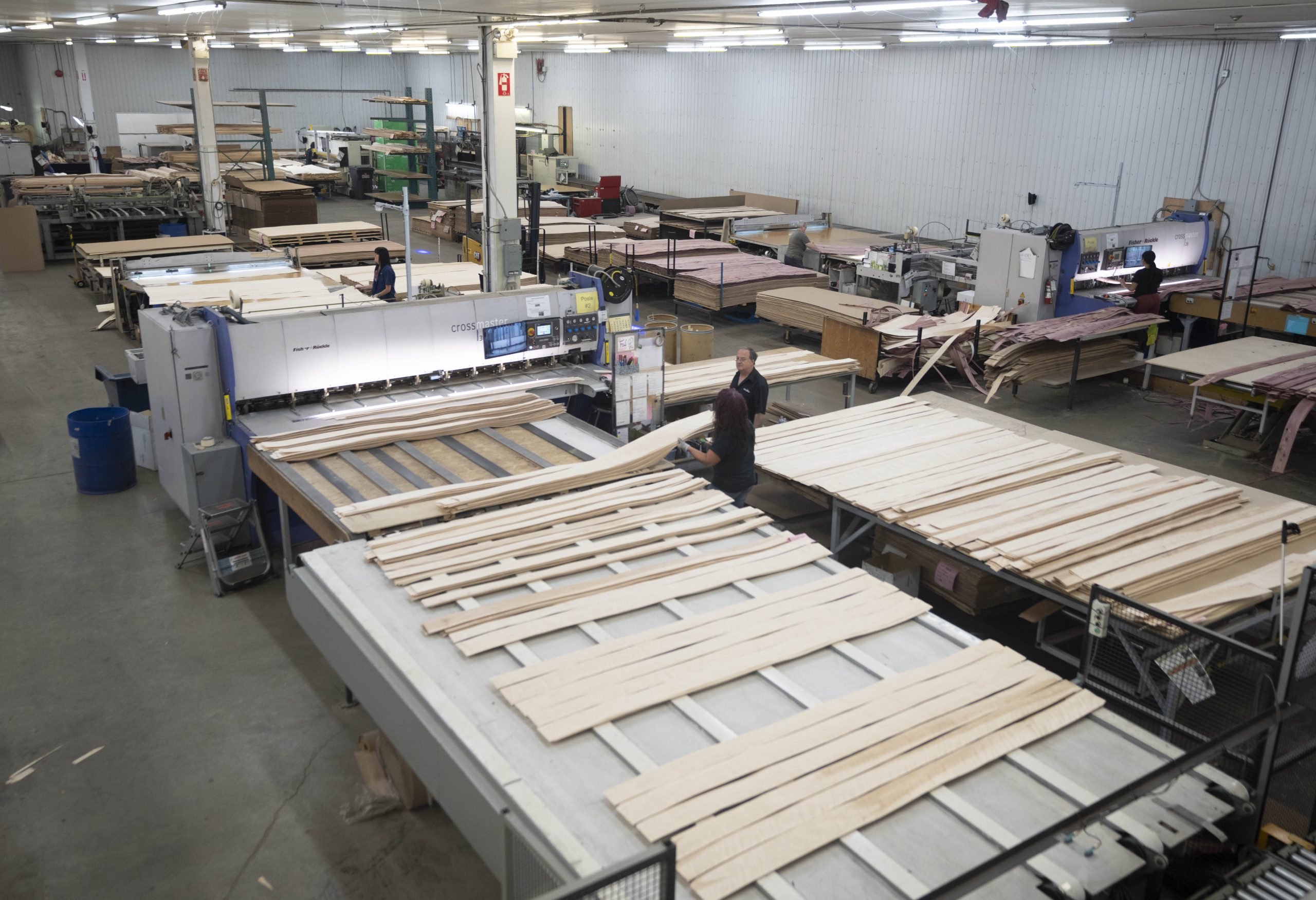
Canadian industry is on pace to fall below 50 per cent capacity utilization this year. At that threshold, manufacturers like us do not slowly decline, they close. And they leave unemployed skilled workers, weakened supplier networks, and lost production capacity in their wake.
Canada’s wood products manufacturers are on the operating table, bleeding out. And the federal government is standing in the hallway, filling out paperwork, worried about what its trading partners might think if it steps in.
The United States has slapped tariffs on foreign steel, aluminum, and automobiles — but many Canadians don’t know the Section 232 and 338 tariffs also target wood products, like furniture and kitchen cabinets. Products that Washington has decided, with a straight face, constitute a threat to American national security.
The absurdity of that designation would be funny if the consequences weren’t so devastating.
Those U.S. tariffs have created a two-headed monster. On one side, wood products manufacturers like us have lost meaningful access to our largest export market. On the other, every other country in the world is now scrambling to find alternative buyers for product they can no longer sell into the United States.
They found one: Canada.
Today, Canada’s warehouses are bursting with cheap imported wood products. Too many of the goods redirected here are priced artificially low, even lower than the cost of the raw materials they’re made from. No domestic producer could reasonably be asked to match that.
Local manufacturers are prepared to compete globally, but not on an impossibly imbalanced playing field.
Canadian industry is on pace to fall below 50 per cent capacity utilization this year. At that threshold, manufacturers like us do not slowly decline, they close. And they leave unemployed skilled workers, weakened supplier networks, and lost production capacity in their wake.
The math is already brutal. In 2025 alone, members of the Canadian Wood Products Alliance recorded more than 1,000 direct job losses and over $40 million in lost margins — and they represent a fraction of the sector. South Shore Furniture, an 85-year-old institution that once employed 1,000 people, has shuttered permanently. As have Dorel Industries and Holsag Canada, amongst others. They will not be the last.
Our own company, Cabico&Co, has recently laid off more than 120 employees at our two manufacturing sites in Ontario and Québec. Preverco has also cut hundreds of thousands of worker hours per year.
These are not your uncle’s artisan workshops. Canada’s leading wood products manufacturers are highly automated, globally competitive operations that have invested heavily in modern robotics and technologies. They’re the last step in one of Canada’s most foundational industries — forestry — and their collapse has ripple effects impacting tens of thousands of jobs in adjacent sectors.
No one can claim to support Canadian forestry and watch the downstream industry die.
Consider what Ottawa has done for steel. When Canadian steel and aluminum faced U.S. tariffs, Canada responded with retaliatory tariffs of its own, including tariffs on every country around the world. The logic was sound: Canadian steelworkers deserve protection from a distortion that is not of their making.
Why would the same logic not apply to wood?
Wood products manufacturers are facing the same trade distortion through the same U.S. legal mechanism. The import diversion is, if anything, worse. And the case for emergency relief is likely more urgent, because wood products manufacturing is more geographically dispersed and more deeply embedded in small towns and rural regions across Canada.
We’ve heard the rhetoric from Ottawa about “Building Canada Strong” and “Buying Canadian”. We’ve seen the announcements about “building more resilient supply chains” and how Canadian workers “will not be left behind”. If we cannot support domestic wood manufacturing in its time of greatest need, then those words ring hollow.
The good news is that Ottawa does not need to invent anything new.
The government has already asked the Canadian International Trade Tribunal (CITT) to launch an investigation into the impact of trade diversion on wood products. That investigation is important, but its findings will not be known until early 2027.
That timeline does not work. By the time a final remedy is in place, much of the industry it is meant to protect may already be gone.
International law and trade agreements allow us to deal with this problem. If Canadian businesses and workers need immediate relief, provisional tariffs can be imposed as a temporary emergency measure, while these types of investigations are ongoing.
Canada has a tool designed for exactly this kind of emergency. It’s incomprehensible that it has not been used.
The solution is not a subsidy, or more loan programs to stack debt on manufacturers’ already destroyed balance sheets. We need a short-term provisional tariff now, to bridge the gap between launching an investigation and finding an appropriate longer-term solution.
The patient is in critical condition. It’s time for the government to pick up the tourniquet. Do not let our wood product manufacturing sector and its workers bleed out while we waver or attempt to placate our trading partners.
Alain Ouzilleau is president of Cabico&Co., a major wood cabinet manufacturer. Jean-François Dufresne is President & General Manager at Preverco, a major wood flooring manufacturer. Both authors are members of the Canadian Wood Products Alliance.
The views, opinions and positions expressed by all iPolitics columnists and contributors are the author’s alone. They do not inherently or expressly reflect the views, opinions and/or positions of iPolitics.