dailynewsnblog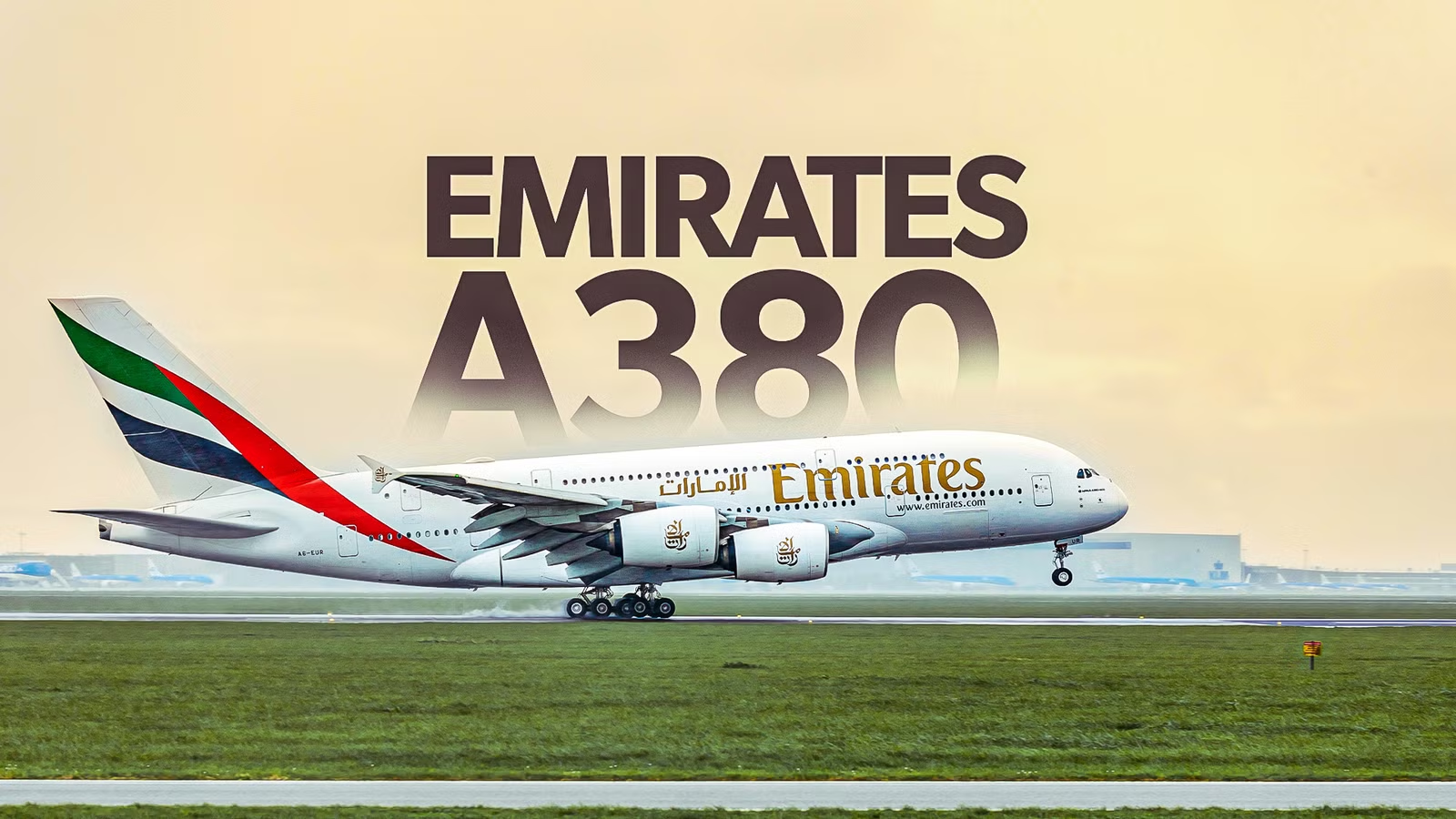
The sight of a massive four-engine double-decker superjumbo pulling up to an airport gate for a short regional hop seems completely counterintuitive to modern fleet planning. Most global legacy carriers have spent the last few years aggressively retiring their largest quad-jets in favor of nimble, twin-engine widebodies and hyper-efficient single-aisle aircraft, but a singular Middle Eastern powerhouse continues to double down on the Airbus A380. To an outside observer, assigning an aircraft designed to conquer transoceanic paths to a brief regional flight looks like a financial miscalculation, but it forms a foundational element of a deeply optimized network strategy.
Finding the real commercial value of these short sectors is something that  Emirates has been focused on for some time, and has been perfected with an aircraft far larger than any other used on such routes. Traditional carriers typically evaluate short routes as isolated, point-to-point markets that must achieve standalone profitability based entirely on local ticket sales. By contrast, a highly integrated hub-and-spoke model views these rapid turnarounds as critical collection channels that feed high-yield traffic into a sprawling intercontinental web, where a superjumbo can thrive precisely when smaller planes limit growth.
Getting Full Flights Maximizes Profitability

Regardless of what aircraft an airline uses, planners have to balance between the raw expense of operating a flight and the cost allocated to each individual seat to make sure a route remains profitable. Narrowbody aircraft like the Airbus A321 present minimal financial risk to an operator because their total trip cost remains remarkably low, making them easy to fill and cheap to run. However, a fully filled superjumbo completely flips this economic equation by offering an unmatched unit cost that smaller single-aisle competitors cannot replicate on high-density routes.
The operating math shows a staggering disparity in raw fuel burn and resource consumption between these distinct generations of commercial airframes. A standard modern narrowbody jet consumes roughly 2.4 tons (2.18 metric tonnes) of aviation fuel per hour, whereas a massive four-engine Airbus A380 burns closer to 15.4 tons (14 metric tonnes) during the same period. Such a massive increase in trip cost means that operating an under-filled widebody will rapidly drain cash reserves, presenting a high financial vulnerability that very few global operators are willing or able to absorb.
Despite this clear fuel penalty, aviation economic data demonstrates that unit cost efficiency peaks dramatically when an airline consistently achieves exceptionally high passenger loads. The key is to spread fixed landing fees, heavy maintenance cycles, and cockpit crew salaries across more than 500 available seats, so that the cost per seat mile plummets below that of a smaller jet. When regional consumer demand is virtually guaranteed, the superjumbo achieves an unbeatable economy of scale.
The Hub Multiplier & Sixth Freedom Traffic Rights

The ultimate profitability of a short widebody segment relies heavily on how an airline structures and routes its passenger traffic across its network. Regional low-cost carriers depend almost exclusively on local point-to-point travelers moving back and forth between two adjacent cities, which leads them to compete fiercely on base ticket prices. A global megacarrier like Emirates has its central geographic home base at its disposal to collect passengers across multiple oceans. What this does is turn a brief regional hop that would not seem overly of any real importance into a vital feeding mechanism for long-haul routes.
Global network carriers excel in exploiting sixth freedom traffic rights to aggregate passengers from dozens of international origins onto highly coordinated departure banks. To help visualize this, a traveler flying all the way from New York to a nearby regional destination does not view the final short leg as an isolated journey, and neither does the airline’s automated revenue management system. The high-yield premium airfare paid for the entire intercontinental journey heavily subsidizes the baseline operational costs of running the larger aircraft on the final short leg.
Ticket Category | Target Passenger | Primary Revenue Source | Average Margin per Seat |
Point-to-Point Narrowbody | Local regional commuter | Base airfare only | Low to moderate margins |
Hub Transit Economy | International connecting leisure | Bundled multi-leg airfare | Moderate, volume-driven margins |
Hub Transit Business / First | Premium corporate traveler | High-yield multi-leg airfare | Ultra-high profit margins |
Emirates’ tight network integration creates a structural buffer that protects the carrier from the natural volatility of local regional demand, which is incredibly high with equally large carriers like  Qatar Airways and
  Etihad Airways running on similar business models. Competing regional operators must slash ticket prices to fill their narrowbody cabins during off-peak seasons, whereas Emirates populates its double-decker cabins with high-paying international transit passengers. Consequently, the commercial value of the flight is gained through global network connectivity rather than relying on local ticket sales alone.
Pushing Through Slot Restrictions

Severe airport infrastructure limits are another critical variable that forces network airlines to completely rethink their aircraft deployment strategies. When a central megahub operates at absolute runway capacity during peak morning and evening departure waves, adding more flights becomes an operational impossibility. Under these rigid operational constraints, getting the most out of the passenger throughput of every single takeoff and landing slot becomes the only viable path to sustained revenue growth.
 Dubai International Airport(DXB) is a perfect example of this structural bottleneck, which in 2025, handled 95.2 million passengers across just two active runways. If Emirates operated standard narrowbody jets for its busy regional operations, it would rapidly exhaust its precious slot allocations within a single departure wave, severely limiting its capacity. Up-gauging the airframe to a superjumbo allows the operator to transport three times as many passengers per runway movement compared to a standard single-aisle jet.
The immense concentration of cabin capacity allows the airline to break down the walls that frequently throttle the growth of legacy carriers globally. Airline management studies note that this scale insulation protects the carrier from traditional profit traps, allowing it to maintain a dominant market position without adding runway congestion. The superjumbo, therefore, is the perfect answer to these growth limits, because if the slot numbers cannot grow, why not just grow the individual capacity of each flight?
A Bit Of Cash Always Helps

Managing a massive widebody fleet on short-haul sectors needs an entirely different approach to capital cost insulation than traditional aircraft leasing structures permit. Many global legacy operators retired their superjumbos early because monthly lease payments became unsustainable on variable regional routes, but Emirates leveraged its massive cash reserves to completely shift its asset dynamics.
Catch what other flight trackers miss
Emergency squawks, holds, NOTAMs — live signals, no signup.
Open tracker
Catch what other flight trackers miss
Emergency squawks, holds, NOTAMs — live signals, no signup.
Open tracker
During its record-breaking 2025–2026 financial year, the Dubai-based carrier reported a pre-tax profit of $6.2 billion, enabling it to outright purchase 29 of its leased Airbus A380 airframes. The airline acquired these aircraft at depressed market valuations, often hovering around $45 million per asset, which helped eliminate its heavy fixed lease overhead. This drastic reduction in daily ownership costs alters the financial break-even calculation for short regional hops, allowing the airline to fly these massive planes on brief sectors without the burden of ongoing monthly capital payments to lessors.
Additionally, owning these assets completely gives the airline total operational flexibility over the life cycle of the airframe, which is projected to extend into the 2040s. Instead of facing strict lessor return conditions or expensive end-of-lease maintenance penalties, the airline can easily adjust its short-haul frequencies based on shifting seasonal demand. When specific airframes eventually reach the absolute end of their commercial utility, the carrier can simply cannibalize them for spare parts. Having a massive internal inventory of components provides a vital protection layer against the growing global scarcity of superjumbo parts, driving down maintenance expenses for the active fleet across both short and long sectors.
Why Do Other Airlines Not Follow Emirates’ Lead?

What is clear is that not all airlines share the same idea as Emirates, as other major hub airlines almost universally reject heavy widebodies on regional routes in favor of single-aisle narrowbody fleets. For standard hub operators outside of the Middle East, a network built entirely around single-aisle aircraft like the Airbus A320neo or Boeing 737 MAX provides a critical level of operational flexibility that protects them from regional economic problems. These airlines operate in markets characterized by fragmented demand spread across dozens of smaller secondary cities rather than a few massive population centers.
A narrowbody aircraft allows a carrier to offer high-frequency schedules throughout the day, which is the primary factor that attracts lucrative last-minute business commuters who value timing choices over cabin space. If demand suddenly drops on a specific route, a single-aisle jet carrying only 150 passengers represents a minimal financial risk compared to a half-empty widebody.
Introducing a massive narrowbody fleet into Emirates’ specific business model would actually disrupt the delicate operational balance that makes its hub so wildly successful. The carrier does not operate a domestic network in the traditional sense and instead focuses heavily on connecting massive international cities. As a result, it relies on a completely standardized widebody fleet to streamline its pilot training, ground equipment, and maintenance infrastructure. Bringing in a single-aisle aircraft into this highly specialized system would destroy these critical efficiencies of scale, creating separate pilot pools and requiring separate ground handling resources. The superjumbo works for this specific airline precisely because it eliminates the need to manage a complex, multi-tiered fleet structure on short-haul sectors.
It Just Makes Sense

The biggest reason for operating the largest commercial airliner on a brief regional hop extends far beyond passenger seat dynamics into the highly lucrative realm of belly freight capacity. Short-haul flights connecting a primary global transit hub to neighboring regional capitals often serve as critical links for time-sensitive cargo that cannot wait for surface transport methods.
A standard single-aisle narrowbody provides very little space for commercial freight after passenger luggage is loaded, but a superjumbo offers massive cargo holds that can accommodate up to 20 tons (18.1 metric tonnes) of high-yield belly cargo. This allows the airline’s freight division, Emirates SkyCargo, to seamlessly transfer heavy palletized goods arriving from intercontinental routes directly onto short regional sectors without requiring dedicated freighter aircraft. The substantial revenue generated from this under-floor cargo space creates an excellent financial floor that significantly offsets the high hourly fuel burn of the four-engine aircraft.
These brief regional routes provide an invaluable operational tool for managing flight crew training schedules and regulatory currency requirements. Flying a massive widebody exclusively on ultra-long-haul routes across oceans means that pilots accumulate plenty of flight hours but very few takeoffs and landings, which are essential for maintaining legal pilot currency.
Cockpit crews can complete multiple takeoff and landing cycles within a single duty day without leaving the immediate region, all while getting increased flight time on the A380. It is this smart scheduling that ensures that the airline maintains a highly qualified and fully compliant pilot workforce while extracting maximum utility from its most capital-intensive flying assets.