dailynewsnblog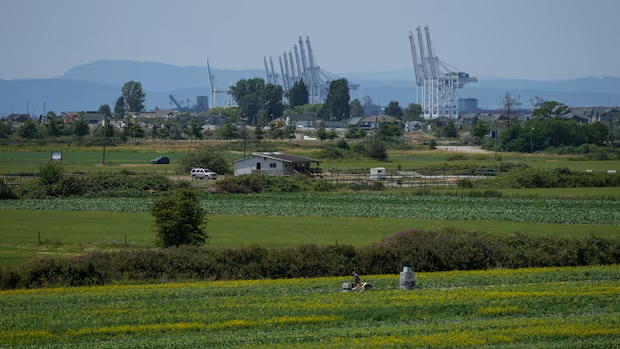
Shahin Dashtgard, a sedimentologist from Simon Fraser University, holds an open palmful of muddied sand from the Fraser Valley in Delta, B.C.
This material, known as sub-surface, is weak, loose and water saturated, and it’s one of the main challenges of building Alberta’s proposed new pipeline terminal on the shores of southern British Columbia at Roberts Bank, near the Fraser River estuary.
As Dashtgard shakes his hand, the wet sand dissolves and runs through his fingers “almost like a soup.” He’s demonstrating the process of liquefaction, which could occur if there’s an earthquake.
“That becomes the concern of building on top of water saturated or loose sediment or sand like this,” he said.

A deviation in the route
Prime Minister Mark Carney and Alberta Premier Danielle Smith have both been bullish on a new Alberta pipeline route, now under consideration by the Major Projects Office (MPO), which would mostly replicate the path of the existing Trans Mountain pipeline corridor.
The two met in Calgary for a joint media conference on July 2, where Smith presented the pitch as “the fastest, most cost-effective path” for the pipeline just hours after B.C.’s North Coast tanker ban was upheld.
“The best route for a new pipeline is one that goes through one that already exists, south through the Trans Mountain corridor,” Carney told the journalists in Calgary.
But there’s a major section of the proposed route that doesn’t exist yet. The deviation would begin at Hope, B.C., where the route would continue through the Fraser Valley and terminate at Roberts Bank rather than Burrard Inlet near Metro Vancouver as two previous oil pipelines have.
There are longstanding concerns with this preferred terminus.
Seismic and environmental issues, space contraints and the influential say of local First Nations will shape the speed and direction of the project, even if it’s chosen as a project of national interest by the October deadline.
Alberta has acknowledged some of those longstanding concerns in their submission, which notes that Roberts Bank and the land around it is “the highest sensitivity area along the corridor” and “the region will have strong concerns about oil and marine spills, tanker traffic and cumulative effects.”

Port expansion project
But Roberts Bank is already being scrutinized for suitability concerning another major project — Roberts Bank Terminal 2 — an expansion of the Port of Vancouver more than 10 years in the making that would increase its container handling capacity by more than 30 per cent.
The pipeline and port terminals are roughly the same size, according to submission documents.
The port project has most of its approvals in hand, except for a federal permit under the Species at Risk Act, but proponents at the Vancouver Fraser Port Authority called for it to be fast-tracked.
At an event announcing the referral of the port expansion to the MPO in mid-July, CBC News asked port CEO Peter Xotta how the container expansion and proposed pipeline terminal could co-exist.
Xotta replied that of the two projects, the port expansion “is much further along,” but he said they’d work with the MPO on details.
Later, a port spokesperson emphasized in a statement to CBC News that “it’s important to keep in mind that these are two separate projects.”
But environmentalists say technicalities like that won’t matter to how species like Pacific Salmon, Western Sandpipers and Southern Resident Killer whales experience another terminal on these shores.

“It’s terrifying,” said Lucero González, a campaigner with environmental group the Wilderness Committee, which challenged the container terminal expansion in federal court.
“If a pipeline were to be built alongside the port expansion, it would be something that no person in British Columbia has seen in terms of project development and tanker traffic in the province,” said González.
Alberta’s submission to the MPO details how it plans to mitigate the impacts of its pipeline infrastructure, including on federally protected aquatic animals.
If the pipeline project is listed under the Building Canada Act, federal approvals are automatically granted. But an MPO spokesperson told CBC News the pipeline could still need some permits and authorizations.
The MPO spokesperson noted that having the project listed under the Building Canada Act means the MPO would no longer look at “whether” the project should proceed, but rather “how” it should proceed.

Seismic issues
Then there’s what lies beneath: the Fraser Valley floor, which could turn soft and squishy in an earthquake.
Trans Mountain, the Crown corporation that holds 90 per cent equity in the project, told Canada’s National Energy Board (NEB) in 2015 that geological factors around building a marine terminal at Roberts Bank would result in a significantly greater footprint and higher capital cost than a terminal in the Burrard Inlet.

In public documents submitted to the NEB, Trans Mountain said “the potential for seismically-induced soil liquefaction is an important issue.” It also noted that ground improvement measures under the footprint of the pipeline and terminal may be necessary before construction.
CBC News reached out to Trans Mountain to ask what had changed since then to result in Roberts Bank becoming the preferred location for its pipeline terminal.
The company referred CBC to the government of Alberta, which noted that Roberts Bank was identified because it offered an established marine shipping corridor and existing marine safety infrastructure.
It said any engineering concerns specific to that site would be assessed as the project advances.
Alberta’s plan proposes two options for pipeline routes from Hope, B.C., to Roberts Bank. The final route, it says, will depend on community consultations.
There will be different engineering approaches depending which way they go, says Ribu Dhakal, as assistant professor of Civil Engineering at the University of British Columbia.
The well known high risk of liquefaction will be the biggest challenge, he said. “They’re going to have a difficult time, but it’s possible.”
Compacting the ground underneath the project, different trenching approaches and other engineering fixes can mitigate the risks, but Dhakal says they will likely make the project more complex and expensive.

First Nations concerns
Underpinning all of this are the rights and titles of several First Nations, whose traditional territories encompass the pipeline terminal land. Many haven’t yet taken a position on Alberta’s proposal and are awaiting more details.
One of them, Tsawwassen First Nation, holds territory near the proposed pipeline project’s marine terminal.
It consented to the proposed port expansion, but specified in a media release that “consent does not constitute support for the project.”
Tsawwassen Chief Laura Cassidy declined to be interviewed, but offered a hint about her government’s appetite for more development in the Fraser River delta at the July 16 news conference announcing the port expansion project’s bid for an MPO listing.
“The benefits may be national, but the environment, cultural and harvesting impacts fall most directly on Tsawwassen people,” she said.
“To say we are concerned about what happens here is an understatement.”