dailynewsnblog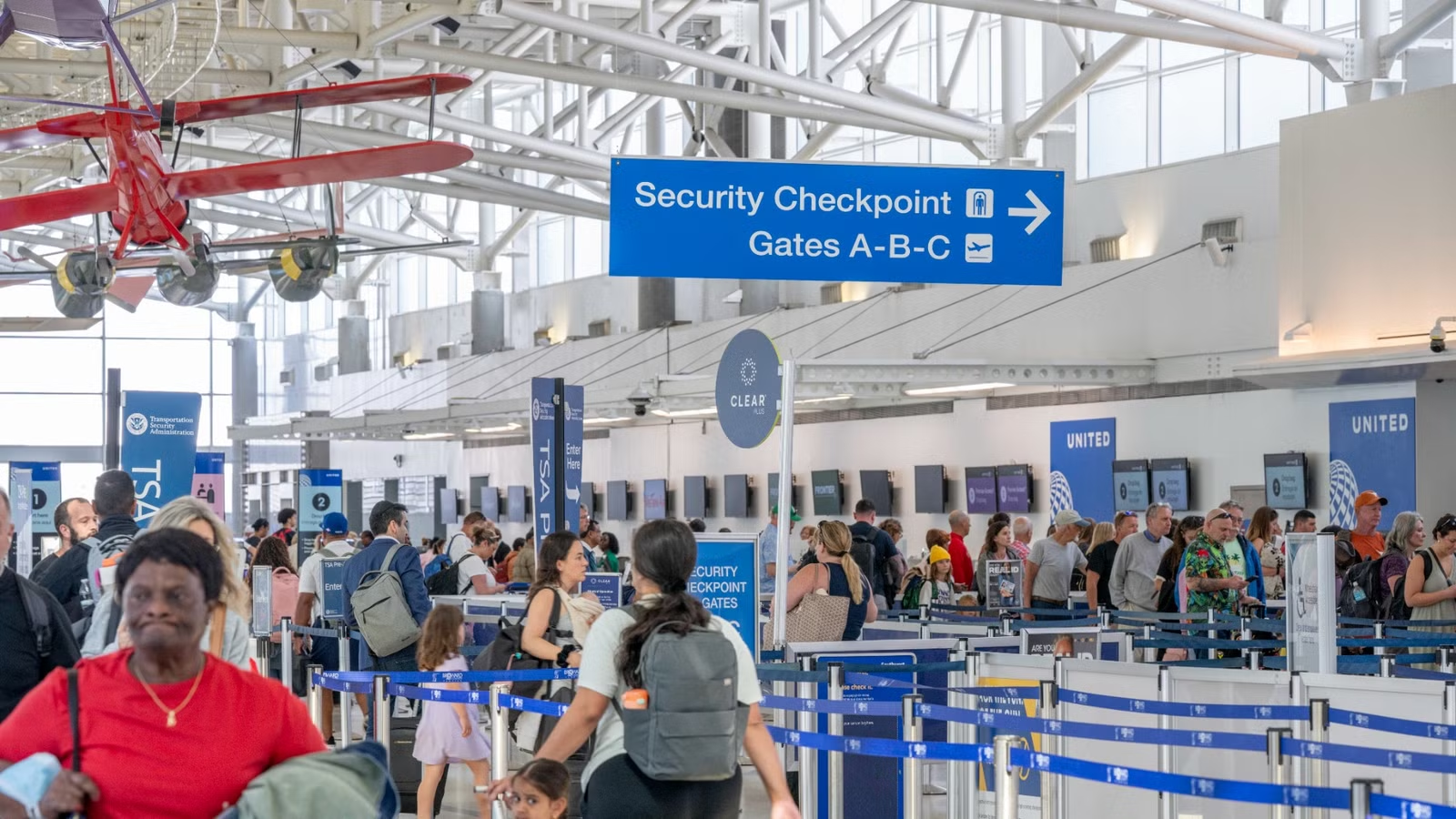
Tampa International Airport (TPA), Des Moines International Airport (DSM), and Charleston International Airport (CHS) will be the first trio of airports in the United States to adopt the new private screening model of the Transportation Security Administration. According to the New York Times, the decision has prompted opposition from the union of TSA agents who will be replaced by security contractors.
The agency announced the new program in May, dubbed “Gold Plus,” as a means to alleviate congestion at airports around the US. It is intended to be an expansion of the screening partnership program, which 20 airports that are already members of used to alleviate traffic jams during the 43-day government shutdown at the end of 2025 and two shorter shutdowns earlier this year.
A New Private Screening Model: Privatizing The Checkpoint

The deployment of TSA Gold Plus directly stems from the fallout of a partial Department of Homeland Security service interruption during the longest government shutdown in US history and following partial shutdowns. During the weeks-long impasse, federal TSA screeners were forced to work without pay. Up to 36% of the unpaid federal workforce called out from duty when their paychecks failed to arrive week after week. The result was checkpoint lines that extended out into parking lots, hours-long delays, and canceled flights.
The new TSA budget proposed by Administrator David Cummins aggressively pushes to expand privatization across roughly 250 smaller airports, generating notable pushback. While proponents argue it cuts wait times and saves taxpayer money, major industry voices like Airlines for America and executives at large hubs have expressed resistance, emphasizing that keeping privatization strictly voluntary is paramount to maintaining safety standards.
A TSA spokesperson gave only this brief comment on the private screening rollout to NPR: “TSA Gold+ marks a significant evolution in the agency’s approach to aviation security.” Meanwhile, Everett Kelly, national president of the American Federation of Government Employees, offered clear condemnation to the New York Times in no uncertain terms:
“Changes of this magnitude should not be made behind closed doors … We don’t have to theorize about what that may look like because we have been through this before.”
From Public Service To Corporate Operation: The Post-9/11 Reversal

Representing 47,000 TSA agents, the AFGE strongly opposes the move to Gold Plus. They specifically highlight how projected cost savings come from cutting collective bargaining protections and replacing federal roles with lower-paid contractors. Beyond saving the jobs of union members, critics offer a clear operational downside as well. Passing aviation checkpoints over to for-profit contractors introduces systemic risks by shifting the primary motivation of airport security from public safety to corporate profitability.
The TSA will function as a purely administrative authority over the operations of private contractors when Gold Plus is implemented at the three airports that have opted in. That not only includes replacing traveler-facing agents but also taking over control of the screening technology used at checkpoints. AFGE and lawmakers that oppose the expansion of Gold Plus warn that the program reverses the core lesson of the September 11 terror attacks. Before 9/11, airport security was fully privatized and run by for-profit contractors.
While the primary motivations for these airports to switch to Gold+ are operational stability, the string of shutdowns was unprecedented as an exceedingly rare political anomaly. Every previous Congressional budget deadlock in the past two decades has been resolved within hours or days and had no measurable impact on TSA operations. The Trump administration’s Fiscal Year 2027 budget proposal explicitly outlines a plan to start privatizing the TSA, projecting $52 million in net federal savings by eliminating Transportation Security Officers, according to Homeland Security Today.
The First Trio: Transition Timelines And Next Steps

Despite concerns from the union and lawmakers, seeing SPP airports like San Francisco International succeed during a crisis reframed privatization as a valuable buffer from disruption caused on Capitol Hill. Des Moines expects to make the change to Gold Plus early next year, while Tampa has scheduled a transition date for its security in May 2027, but Charleston has yet to set a timeline.
While the TSA sits under the DHS, Transportation Secretary Sean Duffy oversees the broader departmental restructuring of US aviation infrastructure alongside the FAA. Duffy’s mandate is to push infrastructure development at “Trump Speed,” which includes aligning the Department of Transportation’s broader airport modernization efforts. Notably, TSA Administrator Cummins served as a senior vice president at Serco before taking over the TSA, the massive multinational government defense and logistics contractor which is already a major player in the existing SPP network.
Given TSA Gold Plus is explicitly an expansion of the SPP model, Serco has the pre-existing infrastructure, workforce pipelines, and clearances required to take over airports, as pointed out by the Federal News Network. Cummins has made efforts to ensure that the program is intended to be “pro-worker” and that existing TSA officers are being granted the “right of first refusal” to transfer to the private agencies with equivalent pay and benefits.