dailynewsnblog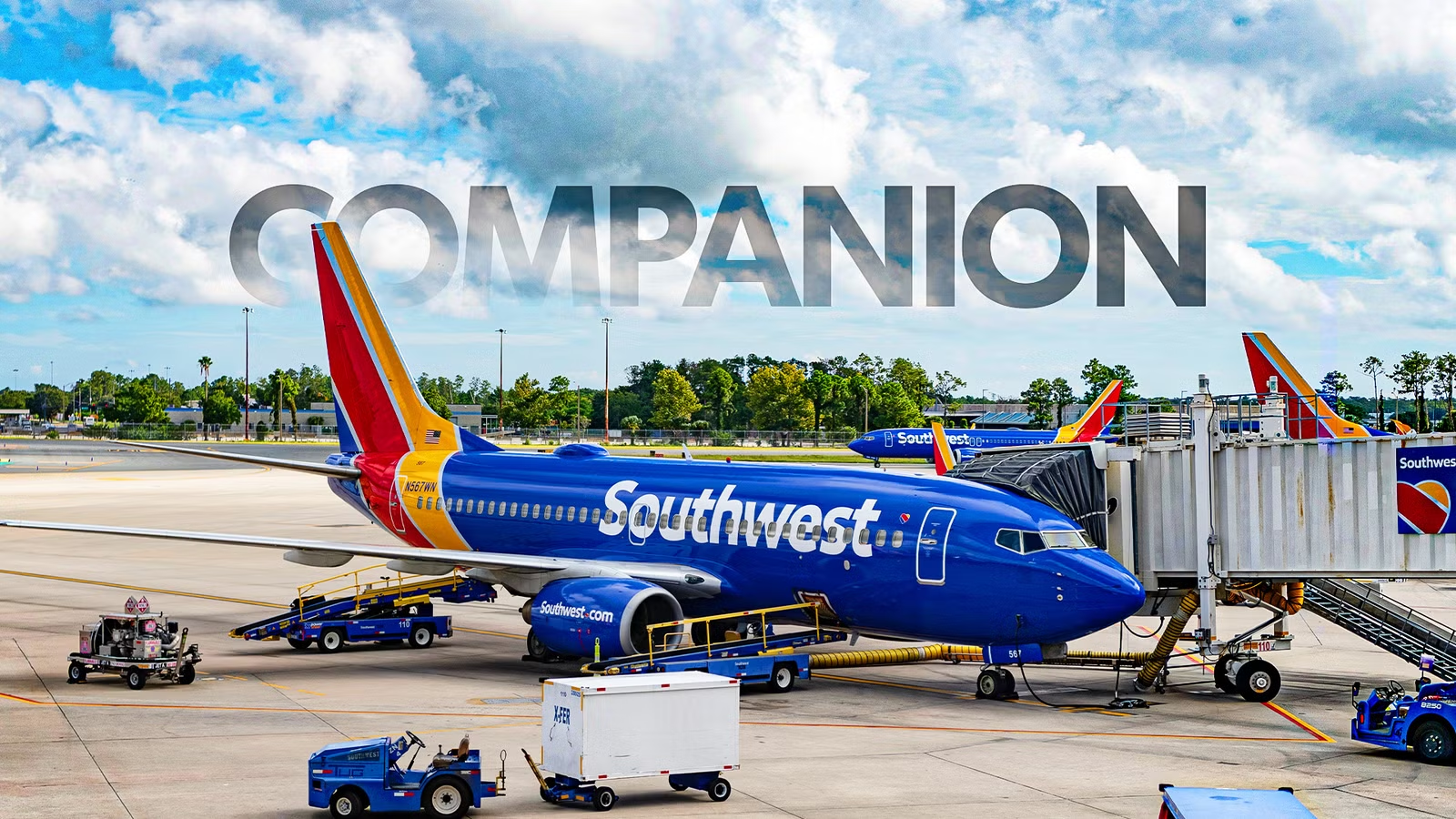
Southwest Airlines’ Companion Pass has long been regarded as one of the most valuable perks in domestic aviation, allowing members to designate one companion who can fly alongside them for little more than the cost of taxes and fees. While the headline qualification requirements have remained unchanged, the economics behind earning the benefit have shifted dramatically as  Southwest Airlines has overhauled both its fare structure and broader customer experience.
The result is a loyalty program that looks familiar on the surface but functions very differently in practice. Travelers relying exclusively on flying, especially those purchasing the airline’s cheapest Basic fares, now face a far steeper climb than they would have only a few years ago. At the same time, Southwest Airlines increasingly rewards customers who combine flying with its co-branded credit cards, creating a loyalty strategy that differs substantially from the airline’s traditional approach.
The Qualification Rules Have Stayed Exactly The Same

Shutterstock | Simple Flying
At first glance, very little has changed about Southwest Airlines’ Companion Pass. Members still qualify by earning 135,000 Companion Pass qualifying Rapid Rewards points during a single calendar year or by completing 100 qualifying one-way flights. Once earned, the pass allows travelers to bring a designated companion on both paid and award flights, paying only applicable taxes and government fees.
That consistency is precisely why many travelers have overlooked what has happened beneath the surface. The qualifying threshold has not increased, yet the number of dollars required to generate those points through airfare has changed significantly because Southwest Airlines has altered how many Rapid Rewards points different fare types earn.
Simple Flying Quiz
Think you really know Southwest Airlines?
Answer 10 questions and put your knowledge to the test
Think you really know Southwest Airlines?
Answer 10 questions and put your knowledge to the test
Easy (15s)Medium (10s)Hard (5s)
Instead of focusing on raising the qualification requirement itself, the airline has effectively changed how difficult it is to reach the same destination. The Companion Pass headline remains identical, but the journey toward it has become substantially more expensive for customers purchasing the airline’s lowest fares. This subtle redesign has attracted growing attention among loyalty analysts because the rules appear unchanged, while the practical reality has shifted considerably.
Basic Fares Now Make The Companion Pass Harder To Earn Through Flying

The largest change involves Southwest Airlines’ revised earning rates. Basic fares now earn only two Rapid Rewards points for every dollar spent, while more expensive fare categories generate substantially higher returns. Choice fares earn six points per dollar, Choice Preferred earns ten points per dollar, and Choice Extra earns 14 points per dollar, creating a much wider gap between budget-conscious travelers and those purchasing premium fare options.
That mathematical adjustment produces a striking result. A traveler attempting to qualify solely through Basic fare purchases would need to earn 135,000 qualifying points, which at two points per dollar requires approximately $67,500 in airfare spending during a single calendar year. While relatively few travelers would realistically spend that amount on the airline’s cheapest tickets, the calculation illustrates how dramatically the earning landscape has changed.
Previously, travelers could make meaningful progress toward the Companion Pass simply by flying frequently on lower-priced fares, but today’s structure rewards higher spending far more aggressively than raw travel frequency. For business travelers purchasing more flexible tickets, the qualification path remains achievable. For leisure travelers chasing bargains, however, the same objective now sits much farther away despite the official qualification requirements remaining completely unchanged.
Southwest Airlines’ Broader Transformation Has Reshaped Customer Loyalty

The Companion Pass changes are only one element of a much wider transformation taking place across Southwest Airlines. For decades, the carrier differentiated itself through policies that remained remarkably stable while competitors increasingly adopted extra fees and more segmented products. That philosophy has changed considerably throughout 2025 and into 2026.
The most visible shift came with the end of Southwest Airlines’ famous universal Bags Fly Free policy. Beginning in May 2025, many travelers became subject to checked baggage charges of $35 for a first bag and $45 for a second, unless they qualified through elite status or held eligible Southwest credit cards. Even more symbolic was the transition away from the airline’s signature open seating system. On January 27, 2026, Southwest officially introduced assigned seating, ending another defining feature that had distinguished the airline from nearly every major domestic competitor.
Each of these changes individually represents a significant departure from Southwest’s historic business model. Together, they indicate an airline increasingly willing to adopt practices that more closely resemble those used by legacy carriers while simultaneously redesigning its loyalty program to emphasize premium customers, elite members, and co-branded credit card holders.
Credit Card Holders Increasingly Receive The Greatest Advantages

Perhaps the most significant development is the growing importance of Southwest Airlines’ partnership with Chase. Cardholders now receive an automatic annual boost of 10,000 Companion Pass qualifying points simply for holding an eligible Southwest Rapid Rewards credit card. That effectively reduces the qualification hurdle from 135,000 qualifying points to 125,000 for those customers before any flying even begins.
The benefits extend beyond qualification points alone, as eligible cardholders also avoid many of the baggage fees introduced during Southwest Airlines’ policy overhaul, preserving one of the airline’s most recognizable customer benefits for themselves and, in many cases, additional passengers traveling on the same reservation. A-List elite members similarly continue receiving valuable perks that ordinary travelers no longer enjoy.
This growing distinction illustrates how Southwest has shifted from offering broadly equal treatment across its customer base toward creating a clearer separation between casual travelers and members who engage more deeply with its loyalty ecosystem. Instead of earning rewards almost exclusively through flying, members increasingly receive meaningful advantages simply by maintaining the right financial relationship with the airline through its co-branded credit cards.
Catch what other flight trackers miss
Emergency squawks, holds, NOTAMs — live signals, no signup.
Open tracker
Catch what other flight trackers miss
Emergency squawks, holds, NOTAMs — live signals, no signup.
Open tracker
Flying Alone Is No Longer The Fastest Route To The Companion Pass

Because of these structural changes, loyalty experts increasingly recommend strategies that rely far less on actual flying than many travelers might expect. Rather than attempting to generate 135,000 qualifying points exclusively through airfare purchases, experienced points enthusiasts often focus on combining welcome bonuses from Southwest Airlines credit cards with ordinary spending and a smaller amount of flying.
One commonly discussed strategy involves opening both a Southwest Airlines personal credit card and an eligible Southwest Airlines business credit card during the same qualification period, allowing welcome bonuses to contribute a substantial portion of the required Companion Pass qualifying points. While approval requirements, spending thresholds, and promotional offers vary throughout the year, stacking sign-up bonuses has become widely regarded as the fastest and most practical route toward earning the Companion Pass.
The irony is difficult to ignore – one of aviation’s best-known rewards for frequent flying is increasingly earned through financial products rather than by spending dozens of hours aboard aircraft. Travelers who insist on qualifying through flying alone, particularly on the airline’s lowest-priced fares, now face a far steeper challenge than those willing to combine flights with Southwest Airlines’ broader loyalty offerings.
According to the latest data from ch-avation, Southwest Airlines operates the largest fleet of Boeing 737 aircraft in the world, made up of 800 aircraft, with a further 455 Boeing 737 MAX aircraft on order. The low-cost carrier’s current fleet is shown in the table below:
Aircraft | Number In Fleet | Number On Order |
|---|---|---|
Boeing 737-700 | 294 | – |
Boeing 737-800 | 196 | – |
Boeing 737 MAX 7 | – | 269 |
Boeing 737 MAX 8 | 310 | 186 |
Total | 800 | 455 |
Southwest Airlines’ headquarters is located at Dallas Love Field (DAL), with more than a dozen other operating bases located across the US. These include  Hartsfield-Jackson Atlanta International Airport (ATL), Las Vegas Harry Reid International Airport (LAS), Orlando International Airport (MCO), and
  Los Angeles International Airport (LAX).
The Headline Number Hides The Real Story

The question of whether earning Southwest Airlines’ Companion Pass by flying alone now requires more than $67,000 in Basic fares has a straightforward mathematical answer. Based on the current earning rate of two qualifying points per dollar for Basic fares, generating the required 135,000 qualifying points solely through those tickets would indeed require roughly $67,500 in eligible airfare spending during one calendar year. That figure accurately reflects today’s earning structure, although travelers purchasing higher fare classes would qualify after spending considerably less because those tickets earn more points per dollar.
Yet the more significant story lies beyond the arithmetic itself. Southwest Airlines has preserved the familiar qualification requirements while quietly redesigning nearly every surrounding incentive. The airline has altered fare-earning rates, introduced baggage fees for many travelers, abandoned open seating in favor of assigned seats, expanded the value of its co-branded credit cards, and strengthened the advantages enjoyed by elite members.
Taken together, those decisions reveal an airline that increasingly rewards customers who participate in multiple parts of its commercial ecosystem rather than those who simply fly frequently. The Companion Pass remains one of the industry’s most valuable travel benefits, but the path toward earning it now reflects a fundamentally different loyalty philosophy than the one that originally made Southwest Airlines famous.