dailynewsnblog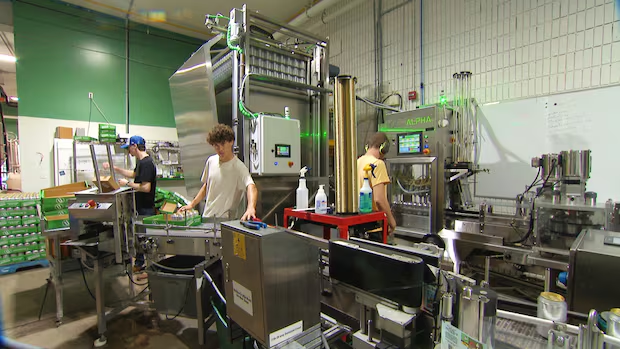

Listen to this article
Estimated 4 minutes
The audio version of this article is generated by AI-based technology. Mispronunciations can occur. We are working with our partners to continually review and improve the results.
Brewers in Prince Edward Island are applauding a move by nine Canadian premiers to drop barriers to the sale of alcohol among their provinces. But they say it’s ultimately unlikely to put more money in their pockets.
Meeting in P.E.I. this week and with trade on the agenda, the premiers agreed Tuesday to update rules to allow more Canadian brewers, wineries and distillers to sell alcohol directly to consumers in other provinces.
The premiers have said such moves matter at a time when U.S. President Donald Trump has repeatedly threatened to impose hefty tariffs on many of the goods Canada exports south of the border.
Monday, Trump announced his latest threat, which would slap 50 per cent tariff on a wide range of goods from this country, including alcohol.
“I do give a tip of the hat to the provinces that did sign on to this,” said Jeff Grandy, co-owner of Holy Whale Brewing Co., which recently expanded from New Brunswick to Charlottetown.
“We see it as maybe a future thing if we grew a little bit bigger.”
Grandy said the removal of the interprovincial sales barrier will be good for medium- to larger-sized breweries that have the capacity to ship to customers in whichever province they order from.
But, he said, high shipping costs are a “big drawback” for smaller operations like Holy Whale.
“I think this a first step that’s absolutely necessary to kind of unite the Canada front and making alcohol a little bit more accessible,” Grandy said.
‘Open access doesn’t really mean equal access’
Over at Red Island Cider in Charlottetown, owner-operator Robert vanWaarden agreed opening up interprovincial trade barriers is a good thing. And he also agreed that it’s unlikely to have much impact on their small operation.
“Honestly, from a small producer perspective, open access doesn’t really mean equal access for us,“ he said.
“It is a question of shipping, a question of packaging and a question of marketing. So if we’re getting someone in Alberta to buy our product they’ve never tried before on an online shelf they’ve never used before, that’s a big ask for a small producer and it’s not really something we’re going to see a big change in.”

VanWaarden said there are a few things the provincial government could do to help small brewing and distilling operations, like allowing them to sell directly to bars and restaurants and cut out the middleman — the P.E.I. Liquor Commission.
“That particular policy, if it were changed, would allow the local manufacturers here to see improved profit, improved margin on what we already do,” vanWaarden said.
“We have to sell, in our own taproom, our retail product for the same price it’s sold at the liquor stores. If there was an opportunity to bring that down for us, we could attract more people to the small businesses and build the community and business we’re trying to build by getting them in the door here.”
VanWaarden said his small cidery and other brewers are permitted to sell directly to restaurants and bars in Nova Scotia — but not to those at home on P.E.I.
Patrick Brannon, a senior researcher with the Halifax-based Atlantic Economic Council, also lauded the agreement as a positive and important step.
“Anytime you’re removing irritants to your trade, that’s a good thing,” he said.
Brannon also agrees the benefit to P.E.I.’s small producers “might be modest at first.”
“If they are to scale up and start to trade more with other provinces, it certainly could benefit,” he said.
“But in terms of offsetting the pains from what Trump is proposing, it’d be very small at this point.”