dailynewsnblog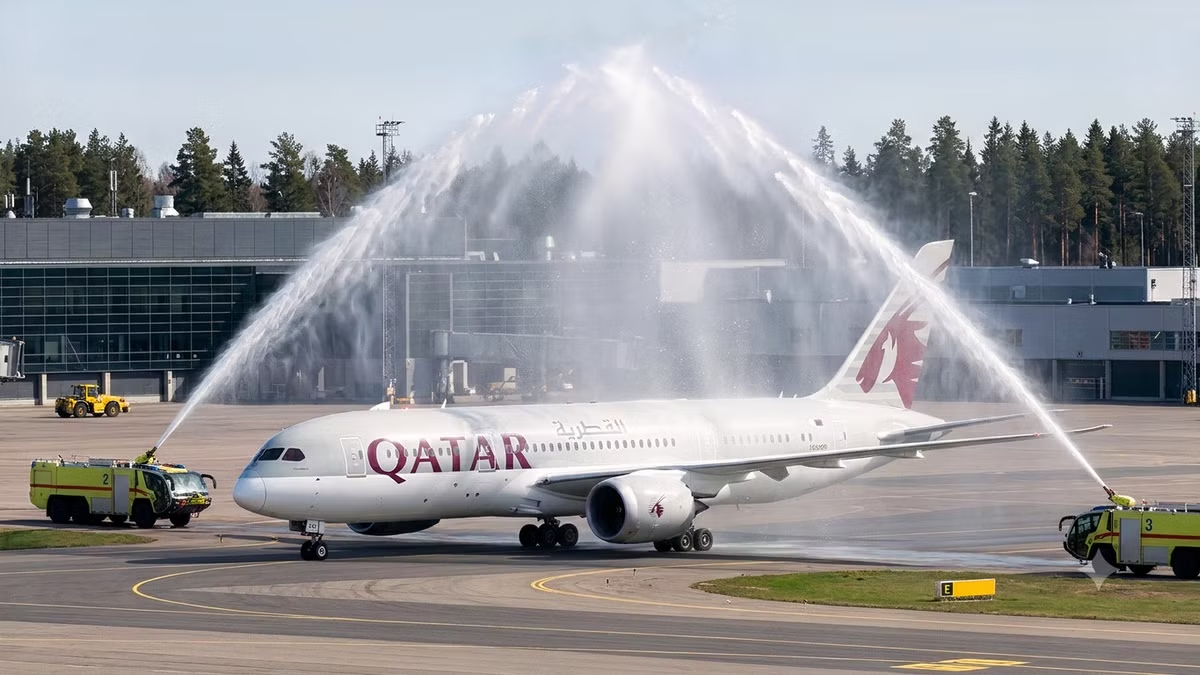
Welcome to my 216th weekly routes article! Only 40+ links started in the examined period, and only a small selection is included in this article. Six mini-stories were chosen; all the services launched between July 14 and 21. You can see the last jam-packed edition here.
Qatar Airways Resumes Two Long-Haul Routes In One Day
Due to the ongoing war in Iran, Cirium Diio data shows that  Qatar Airways has 9% fewer flights in July 2026 than in the same peak summer month last year. Despite this, the oneworld member continues to launch or relaunch new routes.

On July 15, Qatar Airways resumed flights from Doha to Helsinki and Tokyo Haneda. The destinations last saw the carrier in 2022 and 2024, respectively. Both airport pairs have a daily operation and coexist with partners Finnair and Japan Airlines, which also serve them on Qatar Airways’ behalf.
In the upcoming winter, Doha will now have two daily flights to Helsinki and four daily services to Tokyo (Haneda and Narita combined). Qatar Airways had two daily services to the Finnish capital until early 2020 (one was usually on the A320ceo), while the offering to Tokyo will be at a record level.

American Airlines Returns To This City In South America
Due to thawing relations,  American Airlines is finally back in Maracaibo, which is the oil and petrochemical capital of Venezuela. The return took place on July 14, with a daily operation from Miami (where else?) using Envoy Air’s Embraer E175s. That’s right: regional jets on the transcontinental link to South America. Of course, that’s rather hyperbolic.

The carrier previously served Maracaibo until 2019, when all flights were suspended given safety and security concerns tied to Venezuela’s political crisis and the lack of US diplomatic presence. The 737-800 was deployed, although the 757-200 and A319 were used in the past.

The relaunch came nearly two months after American resumed flights to Caracas, with the frequency now being twice daily on the E175. However, from August 17, the 737-800 will replace one of the daily E175 flights.
Dublin Welcomes First Shanghai Service
Ireland has more nonstop seats for sale to/from China in 2026 than in any prior year. This is influenced by the start of the first-ever operation between Shanghai Pudong and Dublin, which began on July 20. China Eastern runs thrice-weekly year-round using the A350-900. It is Dublin’s new longest route.

Shanghai was Dublin’s largest unserved Chinese city, although only around 23,000 passengers flew indirectly last year. They mainly did so with British Airways via London Heathrow, Lufthansa via Frankfurt and Munich, and KLM via Amsterdam.
Days | Shanghai To Dublin; Local Times | Dublin To Shanghai; Local Times |
|---|---|---|
Mondays, Wednesdays, Fridays | 1:40 AM-8:00 AM | 10:55 AM-5:55 AM+1*/6:00 AM+1 |
* Wednesday departure |
It is Dublin’s second route from China, joining Hainan Airlines from Beijing Capital (up to daily A330-300). In 2018 and 2019, some flights operated via Edinburgh. In 2019, Hainan also operated from Shenzhen to the Irish capital (twice-weekly 787-9).

Riyadh Air Arrives In Spain With Two New Routes
It is hard to imagine that the startup carrier,  Riyadh Air, has now received its sixth factory-fresh Boeing 787-9. All frames were delivered in June and July. It goes to the heart of the operator’s vision, which is closely tied to Saudi Arabia’s extraordinarily ambitious Vision 2030. The Saudi Air Connectivity Program helps with funding.

On July 14, Riyadh Air introduced its next new route, which is from the Saudi capital (where else?) to Malaga. Three days later, the second new link – from Riyadh to Madrid – began (the airline sponsors Atlético Madrid). They are served three and four times weekly, respectively, with one aircraft required to serve both cities.
For now, at least, Riyadh Air competes directly with Saudia to Malaga, while the Spanish capital has been unserved since 2022. Riyadh-Malaga has 25,000 round-trip local passengers and Madrid 44,000, with connections via the Saudi city being important, although that’s currently very limited. However, both routes are surprisingly high-yielding from strong premium demand.

Avianca Doubles Down On Fort Lauderdale
The cessation of one airline usually gives rise to many opportunities for other carriers. It is less vulture-like and more about seeing what is best for them, given their equipment availability, traffic rights, and so on.
Avianca is no exception. On July 15, Colombia’s flag carrier took off from Barranquilla to Fort Lauderdale. The next day, service from Cali began. Both routes are brand-new to Avianca’s network, with the A320 deployed daily. Avianca also operates daily between both Colombian cities and Miami. The carrier now has a record four routes to Fort Lauderdale, joining Bogotá and Medellín.

Avianca would not have started the two links but for the end of Spirit, which had flown from Barranquilla between 2010 and early 2026, and from Cali from 2018 to early 2026. The now-defunct ultra-low-cost carrier nearly always flew daily, too.
Colombia’s largest airline will not have the markets from Fort Lauderdale to itself for long. JetBlue will launch daily service to both Barranquilla and Cali in October. Two airlines will serve Cali simultaneously for the first time, while Barranquilla previously had two airlines in 2011.

Wizz Air Begins Three Brand-New Routes
Given it’s peak summer, European and North American budget airlines barely launched any routes in the examined period (their summer network is already operational). The exception is the ultra-low-cost carrier Wizz Air.

Wizz Air began three routes: Radom (a barely discussed Polish airport) to Burgas and Skopje to both Alghero and Palermo. The increasingly popular Bulgarian tourist destination of Burgas, along with Sardinia’s Alghero, are both served twice-weekly, while Sicily’s Palermo sees the airline thrice-weekly. The 239-seat A321neo operates all the flights.

Like so many of Wizz Air’s routes, these three airport pairs are brand-new. No airline has ever served them. Market creation is usually vital to ultra-low-cost carriers, particularly those in Europe, with low costs enabling the low fares to grow demand. Stimulating demand is critical.