dailynewsnblog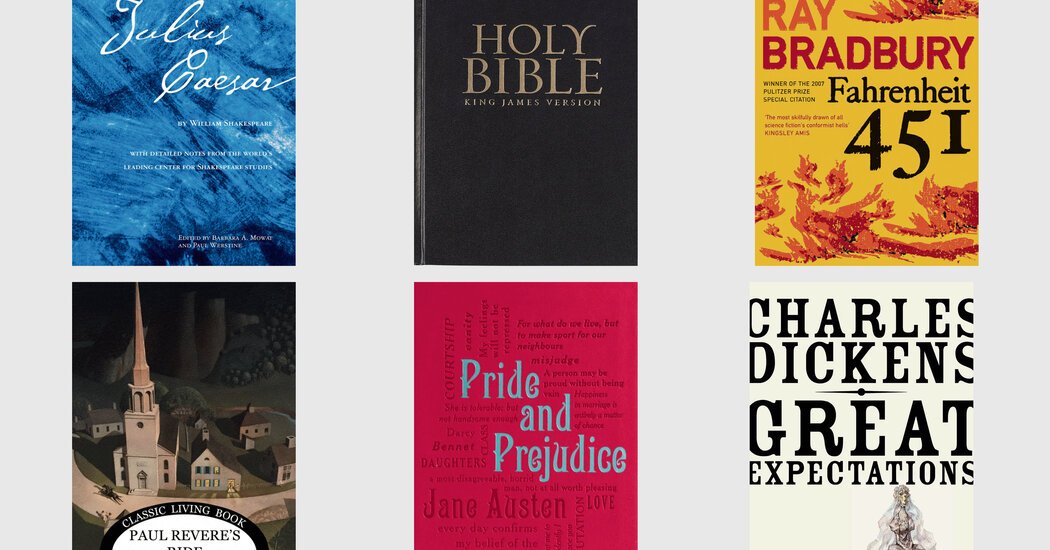
“Hamlet” by William Shakespeare.
“Animal Farm” by George Orwell.
The story of Adam and Eve, from the Book of Genesis.
These and other texts will soon be required reading for 5.4 million public school students across the state of Texas.
While individual teachers and schools routinely make reading lists for English class, Texas is doing something unusual, attempting to create a common canon of books that all students statewide will be required to read.
The list was approved last month by the Republican-led Texas State Board of Education and is in the process of being finalized. It will take effect starting in 2030.
The list was applauded in some corners for prioritizing reading, at a time when many students are reading fewer whole books in school and at home.
It was also highly contested, in part because it includes excerpts from the Bible. It puts a focus on classic texts, often written by white and male authors, stirring debate about what qualifies as essential literature in a highly diverse state. (Teachers can still assign additional books on top of the ones required.)
Here is a look at the required books for each grade.
Kindergarten
Young students will read popular classics, like “Goldilocks and the Three Bears,” and books promoting good character, like “The Berenstain Bears and the Golden Rule.”
The Texas list draws inspiration from a classical approach to education, which emphasizes reading books that have stood the test of time and focuses on building intellectual and moral character. The approach — found in some private Christian and public charter schools — has grown popular in conservative circles.
The inclusion of Bible passages — starting with Jonah and the whale in first grade — has sparked much debate.
Supporters say understanding biblical references in literature and culture is part of a well-rounded education; critics oppose it an unconstitutional attempt to infuse Christianity into public schools.
The Bible passages come from both the New Testament and the Old Testament, a text shared by Jews, but primarily cite versions of the Bible preferred by Protestant Christians, such as the King James Version, the English Standard Version and the New International Reader’s Version, an adaptation written at a third-grade reading level.
Young students will read several excerpts from “The Children’s Book of Virtues,” an anthology edited by William J. Bennett, the former education secretary under President Ronald Reagan. The book promotes virtues like courage and perseverance, in the poem “Try, Try Again,” and kindness to others, in “The Legend of the Dipper.”
They will also read about David and Goliath in another book by Mr. Bennett, “The Children’s Book of Heroes.”
Grade 3
The list spotlights U.S. founding fathers, in line with a Republican vision for a more patriotic education.
But the books are also doing double duty as social studies instruction, which often gets little dedicated time in elementary school. In other grades, students also read about Susan B. Anthony, Frederick Douglass and Pocahontas.
Beginning in fourth grade, students will read at least one excerpt from the Bible each year.
Other biblical passages include the parting of the Red Sea (fifth grade), the “Parable of the Prodigal Son” (ninth grade) and “The Definition of Love” from First Corinthians (12th grade).
Grade 5
The fifth grade reading list focuses on the American Revolution.
That aligns with Texas’s new social studies standards, also approved last month, which has students studying the American Revolution in fifth grade.
Grade 6
Starting in middle and high school, students will read two main books each year. In sixth grade, the books are “Across Five Aprils” and “All Creatures Great and Small.”
Other texts listed under the main book are to be taught in the same thematic unit. For example, “All Creatures Great and Small” is paired with two poems, a short story, and a biblical excerpt.
Grade 7
Around the country, there is wide variation in which books are taught, and in what grades. The decisions often reflect local politics, academic rigor and a teacher’s own discretion.
As one point of comparison, at Success Academy, a charter school network in New York City, students read the following books in seventh grade: “Something Wicked This Way Comes” by Ray Bradbury; “Lord of the Flies” by William Golding; “To Kill a Mockingbird” by Harper Lee; “A Midsummer Night’s Dream” by William Shakespeare; “Purple Hibiscus” by Chimamanda Ngozi Adichie; and other short stories and texts, like the poem “Caged Bird” by Maya Angelou.
In eighth grade, students will read “The Giver” and “Night.”
Alongside “Night,” students will also read Lamentations, Chapter 3, the only instance in which a shared Judeo-Christian text is pulled explicitly from the Tanakh, the Hebrew Bible.
There are no readings on the list from other religious texts, like the Quran or the Bhagavad Gita.
Grade 9
In ninth grade, the main books are “Animal Farm” and “Great Expectations.”
One goal of the list was to ensure students are reading whole books from start to finish — preferably in paper form — something that has become increasingly rare in an era of tech and social media distractions.
Grade 10
The list leans heavily on classics, often written by white and male authors in earlier eras, like “The Tragedy of Julius Caesar” by William Shakespeare, dated around 1599, and “The Inferno,” by Dante, from the 14th century.
Though the famous “I’ve Been to the Mountain Top” speech by the Rev. Dr. Martin Luther King Jr., is included, the overall list has faced criticism for including few texts by prominent Black and Hispanic authors, such as Toni Morrison, Zora Neale Hurston or Sandra Cisneros.
Grade 11
The Texas list initially had around 300 texts in total, from kindergarten through 12th grade. That version had 11th graders reading “The Great Gatsby,” “Of Mice and Men,” “The Alchemist” and “The Crucible.”
But those books were cut as the list was pared down to just under 200 texts, out of concerns about time.
Just as notable: What is not on the list.
Students will read two Shakespeares — “Hamlet” and “Julius Caesar” — but not “Romeo and Juliet,” the No. 1. most assigned book in U.S. high school classrooms, according to the National Council of Teachers of English.
In high school, there are no contemporary books, written in the last 50 years.
The list also avoids some of the most frequently contested books targeted by book bans in recent years. “The Hate U Give” and “To Kill a Mockingbird,” for example, are absent from the Texas list.