dailynewsnblog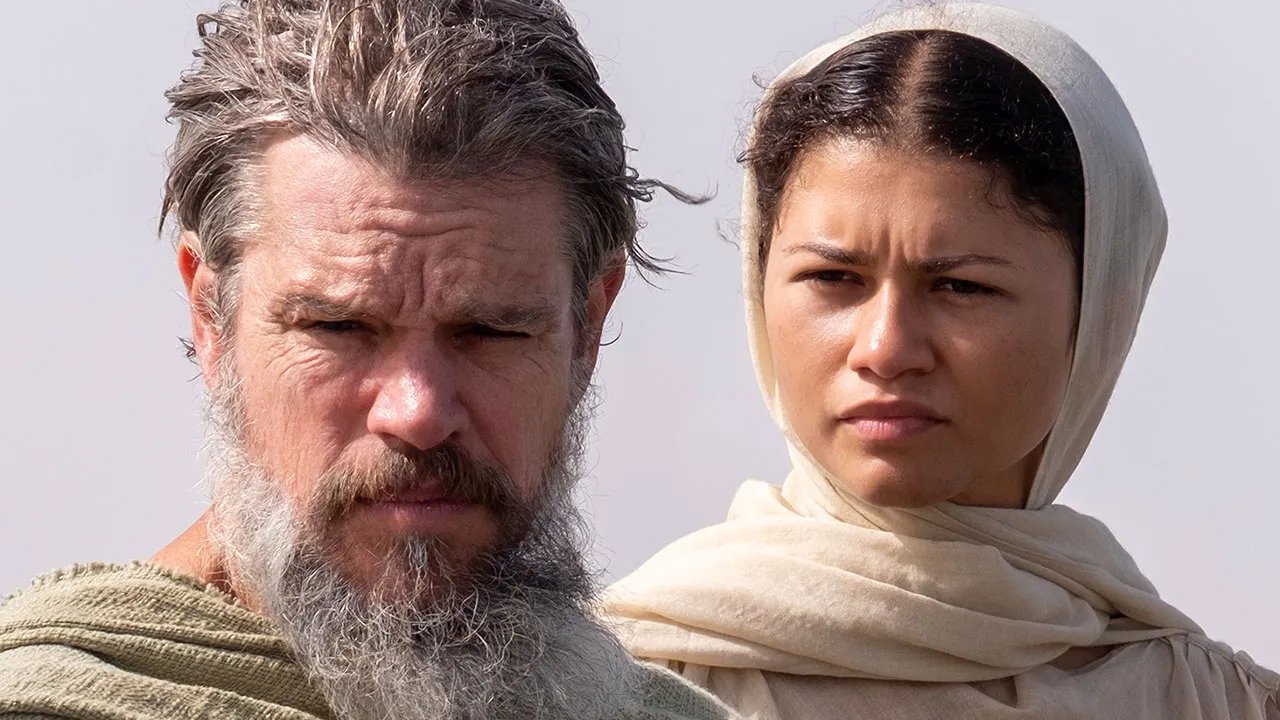
Spoilers for The Odyssey follow.
Zeus’ Law is broken. But who is to punish the guilty for it, who do they owe restitution to, if there is no Zeus?
Before its release, Christopher Nolan revealed to TIME magazine that he’d be taking a more “grounded” approach to the gods and mythical elements of The Odyssey, prompting some debate among purists who argued that this modern lens stripped Homer’s epic of elements essential to the narrative. In fact, Nolan did not cast Zeus, Poseidon, or many major Olympian gods as classic “humanized” deities intervening from Olympus.
“The wonderful thing about cinema…,” Nolan said in the TIME interview, “is that you can take an audience to a place of immersion, feeling close to events like storms, turbulent seas, high winds. You want the audience to be on the boat with them fearing the ocean, fearing the wrath of Poseidon, the way the characters do. That to me is so much more powerful than any individual image you can have [of a god].”

Nolan seems to be saying he was striving to convey an ancient people’s attempt to understand natural phenomena via their construction of the gods. In fact, Zendaya’s Athena overtly says something to the effect of, “What are the gods if not the waves crashing in?” And while the film does place the viewer directly in the perspective of the men and women living in this world (look no further than the interior POV sequence of The Trojan Horse), Nolan’s choice to depict the gods with ambiguity isn’t just cinematically engaging or reflective of a time past; it is essential to his movie working at all.
Put simply: There is no Christopher Nolan’s The Odyssey without that final Athena reveal.
Inarguably, there are stunning, fantastical elements in the film: giants, monsters, and transformational magic. However, in Nolan’s interpretation, the gods are not gods in the literal sense. Samantha Morton’s Circe rides a delicate line. Certainly, she has the abilities of a sorceress, grotesquely turning men into pigs. But it’s not clear that she is a goddess. And it’s her motivations — the rage she feels towards the soldiers she is sure have, and would, rape and pillage, in addition to her intent to punish and “reveal them for what they are” — that are thematically central to this story. Matt Damon’s Odysseus is doing the same thing to himself throughout the epic — punishing, hiding, and, ultimately, exposing his true nature.
Charlize Theron’s Calypso appears less like a true goddess and more like an extraordinarily gorgeous, lonely beach dweller who “helps” Odysseus forget his past sins. Whether this is an act of selfishness or compassion is debatable. It’s likely both. With so much isolation, anyone would be tempted to keep a companion (such as Matt Damon) who’d washed up on their shores. That said, Odysseus is and has been running from what he can’t yet face, and in that sense, Calypso is also a bit of a dealer or, at the very least, an addict’s enabler. He just can’t get enough of those lotus flowers.
Circe says the soldiers deserve a harsh sentence, and Calypso offers a reprieve from guilt in the form of denial. Both of these impulses play out in Odysseus’ own psyche through the creation of his “Athena,” which is why the “Not Athena” reveal is a stroke of true genius on the filmmaker’s part.
In one of the film’s best sequences, as the film nears its climax, Odysseus confesses his crimes to his faithful wife, Penelope (Anne Hathaway). While doing so, “Athena” holds his hand. Only we, the audience, discover in a flashback that she was, in fact, not Athena, but a young Trojan woman beheaded alongside Athena’s statue. Unable to face the horror of what he himself had unleashed, Odysseus had mapped the image of the murdered woman onto the vision of the goddess Athena. But it is the human his conscience wants him to acknowledge.
This is because “Zeus’ Law” isn’t really about affording safe passage and hospitality to strangers because a visitor to your home may be a god in disguise (though that’s what the fearful tell themselves). It’s about integrity, compassion, and recognizing the absolute dignity and honor of a fellow human being, any human being. If offending a potential god is the only motivation for kindness, then kindness has no value. Nolan knows this. And as much as Odysseus believes in the gods, on some level, he knows this as well. And when he broke that law with the deception of the Trojan Horse, he shattered the very core of what made his civilization one worth living, fighting, and dying for. So his fractured and shamed psyche merged a human girl slaughtered as a result of his actions with the image of Athena’s defaced statue.
This was an act of psychological self-protection; he was more comfortable with having defiled the sanctity of a goddess — or at the very least her statue — than he was with having broken such a covenant with his fellow man. And he understood that it wasn’t Zeus he was betraying, but himself. When he sets off on that fateful course at the end of the war, going against the advice and the trajectory of the other sailors, knowing it’ll at the very least lengthen the journey, he is running from facing his actions in a physical sense. But it was also his first subconscious act of self-punishment. A judgment he also rendered to the men who followed him.
They’d gone along with Odysseus when he elected to act without thought for consequence — for self and others — driven by the desire to win at all costs and satisfy the greed and revenge of unworthy leaders. This was their collective penance. When Calypso advises Odysseus to “take his punishment” from Poseidon, it’s really a request for him to abandon his forgetting, as Athena also urged, and face himself and what he’d done. To acknowledge that he was the mysterious, barbaric threat from the sea. (Throughout the film, various characters reference the threat of these warriors, who have no honor and threaten to unravel the social compacts that are foundational to Ithaca’s way of life.)
When Odysseus is able to see his imagined “Athena” for what she really was, not a goddess steering him, but a girl butchered as a result of his actions (one of far too many), he is, in turn, willing to own who he is, and what he’d done — befouled, perhaps forever, the very values he built his kingdom upon. He was the human who, in desperation to do anything to get home, reduced his home to ruins. Only when he’d full-throatedly confessed and made amends was he able to finally, truly return home. Only then did he emerge as a mature man willing to take his exile, understanding that even decades of punishment could not undo what he did: destroy the world he loved in one brilliant but unthinking choice.
The tragedy is that in becoming a leader worthy of Ithaca, Odysseus also had to leave it. (This self-exile is notably distinct from Homer’s original.)
If the young Trojan woman Zendaya plays had actually been the goddess Athena, directing his path, that would have robbed Odysseus of his full autonomy, humanity, and the depth of his understanding and willingness to be accountable. It would have denied a powerful moment of grace, in which Odysseus can imagine the soul of a human so compassionate that she holds his hand as he tells the story of his part in her murder. And as such, it would undercut everything that makes this movie, Christopher Nolan’s version of The Odyssey, resonant, urgent, dramatically satisfying, and the culmination of his life’s work.